Ancient chewing gum reveals new clues about our ancestors
Posted on Wednesday 18 December 2019
It’s the first time that an entire ancient human genome has been extracted from anything other than human bones. Scientists say the breakthrough provides a new untapped source of ancient DNA.
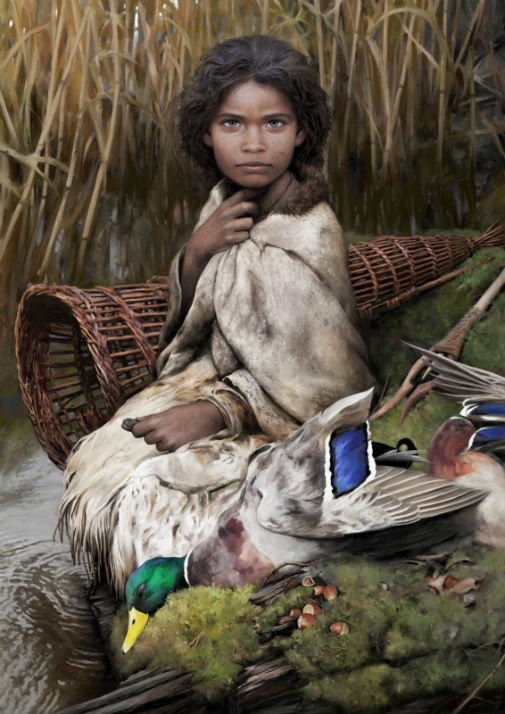
Researchers from the universities of York and Copenhagen extracted the DNA from a piece of 5,700-year-old birch pitch found in Denmark. It revealed the sticky brown substance was chewed by a girl genetically more closely related to hunter-gatherers from the mainland Europe than to those who lived in Scandinavia at the time. They also found that she probably had dark skin, dark hair and blue eyes.
Unique
First author, Theis Jensen who worked on the study for his PhD at the University of York and the University of Copenhagen, also participated in the excavations at Syltholm.
He said: “The archaeological site at Syltholm is completely unique. Almost everything is sealed in mud, which means that the preservation of organic remains is absolutely phenomenal.
“It is the biggest Stone Age site in Denmark and the archaeological finds suggest that the people who occupied the site were heavily exploiting wild resources well into the Neolithic, which is the period when farming and domesticated animals were first introduced into southern Scandinavia.”
Birch pitch was produced by heating birch bark and was commonly used as a glue to help attach stone tool heads to handles. Other suggested uses include to relieve toothache and as kind of prehistoric tooth brush, to suppress hunger, or just for fun as a chewing gum.
Human genome
Associate Professor Hannes Schroeder from the Globe Institute, University of Copenhagen, who led the research said: “It is amazing to have gotten a complete ancient human genome from anything other than bone
“We also retrieved DNA from oral microbes and several important human pathogens, which makes this a very valuable source of ancient DNA, especially for time periods where we have no human remains.”
Researchers also identified traces of plant and animal DNA in the pitch – specifically hazelnuts and duck - which may have been part of the individual’s diet.
In addition, the researchers succeeded in extracting DNA from several oral microbiota from the pitch, including many commensal species and opportunistic pathogens.
Associate Professor Schroeder said: The preservation is incredibly good, and we managed to extract many different bacterial species that are characteristic of an oral microbiome. Our ancestors lived in a different environment and had a different lifestyle and diet, and it is therefore interesting to find out how this is reflected in their microbiome,’ says Hannes Schroeder.
Chewing gums
The researchers also found DNA that could be assigned to Epstein-Barr Virus, which is known to cause infectious mononucleosis or glandular fever. According to Hannes Schroeder, ancient “chewing gums” bear great potential in researching the composition of our ancestral microbiome and the evolution of important human pathogens.
Co-first author Jonas Niemann, a PhD student at the University of York and the University of Copenhagen, said: "The very clear signal of the oral microbiome and the large number of dietary DNA sequences is highly unusual for samples that are this old, and makes birch pitch a very promising substrate for future metagenomic studies"
The study was supported by the Villum Foundation and the EU's research programme Horizon 2020 through the Marie Curie Actions.