Carefully managed fire can promote rare savannah species
Posted on Wednesday 14 February 2018
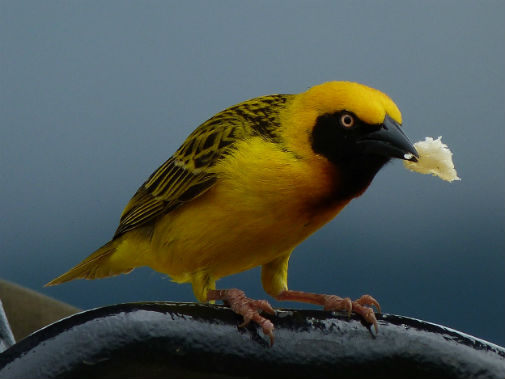
Researchers found that using highly diverse fire types increases the diversity of mammals and birds in wet savannas, including the Speke's Weaver (pictured), a range-restricted species. Credit: Dr Colin Beale, University of York.
In the first continent-wide study of the effects of fire on bird and mammal diversity in the African savannah environment, researchers have found that increasing “pyrodiversity” boosts the variety of species of mammals by around 20% and of birds by 30% in savannahs with high rainfall.
The researchers observed that varied burning regimes enabled geographically rare birds such as the Rufous-tailed Weaver and the Black-bellied Sunbird to live alongside more common species.
They now hope to be able to provide conservationists and local populations with guidance and advice on how to use fire as an effective tool.
A wider number of species can thrive
Lead author of the study, Dr Colin Beale from the Department of Biology at the University of York, said: “Fire is often viewed as homogeneous, but in reality there is a range of different fires characterised by variation in size, intensity, season and frequency of burning. We found that in wet savannah increasing the range of different types of fire in an area allows a wider number of species to thrive.
“Fire is widely thought to have a negative impact on the environment, but in African savannahs hominids have been setting a variety of fires for around a million years so fire is something the ecosystem has co-evolved with and adapted to.”
Man-made fires are set in Africa’s protected areas for a variety of reasons from improving grazing for cattle or wildlife, to increasing visibility of wildlife, or even to smoke out wild bee hives and control tick populations.
The researchers carried out the study using data collected on fires from satellites with distribution maps of all the bird and mammal species in protected areas across Africa’s savannahs.
A "niche" in which to survive
Over a 15 year period, the study found that in savannas with over 650 mm of rain, areas with the most varied types and timing of fires were associated with much richer bird and mammal communities. The researchers suggest that varied fire types in wet savannahs create a wider range of conditions within the savanna habitat - altering the availability of nutrients, terrain, shelter and predators – allowing a greater number of species to find a “niche” in which to survive and reproduce.
“We would like to use this study to help increase awareness that fire is not a blunt tool,” added Beale. “Using fire to maximise biodiversity requires detailed understanding of when, where, and how often to burn.
“Pyrodiversity is particularly important for biodiversity in wet savannah landscapes, but this isn’t the only reason people light fires: different goals require different burning patterns. We want to develop tools to help the managers of conservation areas articulate what they want to achieve and help them to use fire to do it.”
Pyrodiversity interacts with rainfall to increase bird and mammal richness in African savannas is published today in Ecology Letters. The study was funded by the Leverhulme Trust.