
Obituary: Anthony Warner
Posted on Thursday 11 June 2026
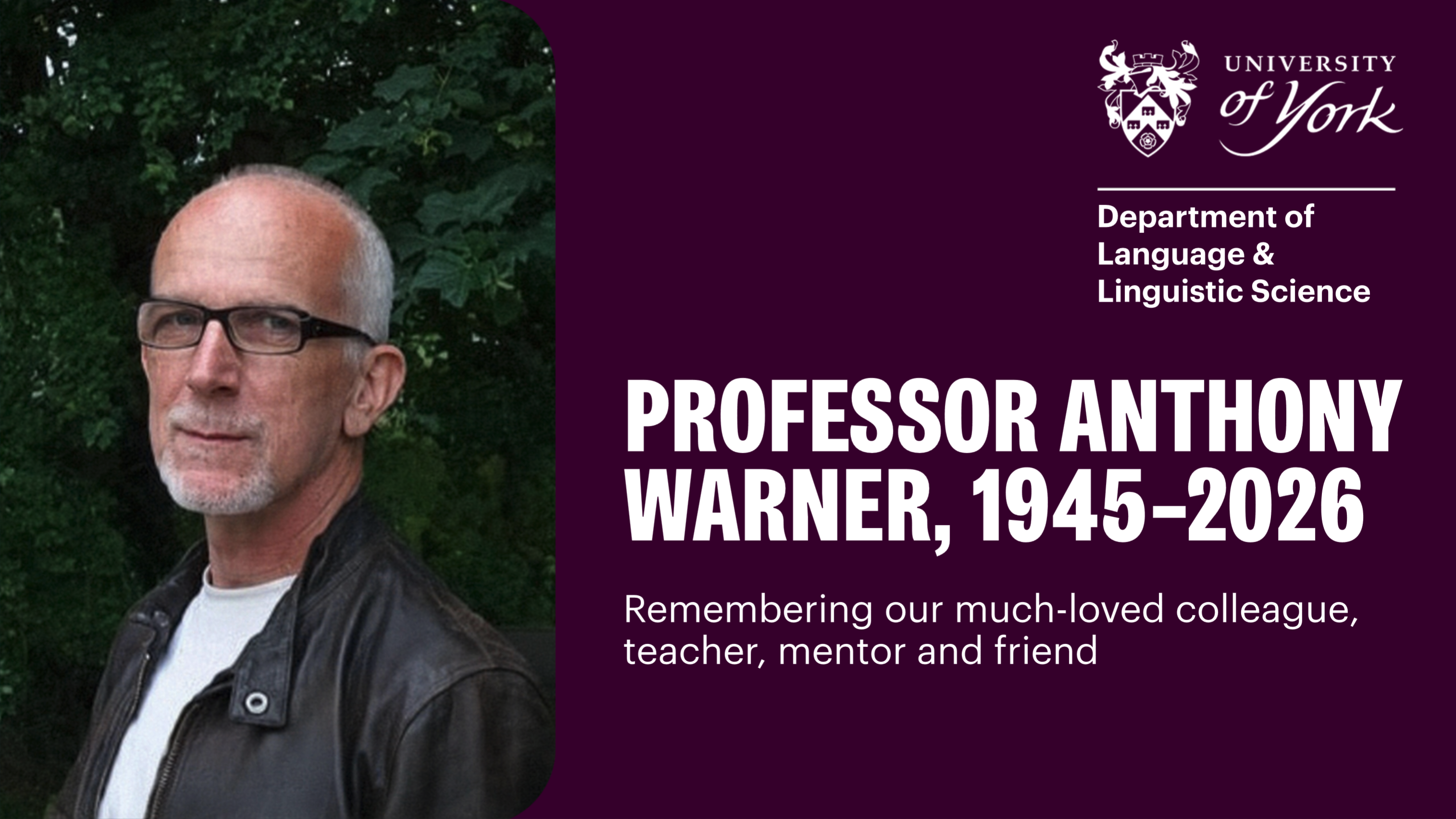
Anthony was a central figure in historical syntax and the history of English, in the UK and far beyond, and one of the people who did most to shape this Department over nearly four decades.
Anthony was born on 27 January 1945 in Bishops Stortford, Hertfordshire, and was educated at Wimbledon College. He read English Language and Literature at Oxford graduating in 1967 with a first class degree before moving to Edinburgh for doctoral study. He joined the Department of Language and Linguistic Science at York in 1975 from the University of Liverpool where he was a lecturer between 1971 and 1975, completing his University of Edinburgh PhD three years later with a thesis entitled Complementation in Middle English and the Methodology of Historical Syntax: A Study of Wyclifite Sermons, published in 1982 by Croom Helm.
That thesis already displayed the qualities that would define his scholarship. Reviewing the book in Language, Edwin Battistella observed that it set out to merge two streams of work on the history of English: the literary and philological tradition, concerned with textual analysis but largely not with linguistic structure, and the linguistic tradition, attentive to structure but often failing, in Anthony's words, to appreciate the limitations of textual evidence and "the kind of careful interpretation that it needs before grammatical conclusions can be drawn". This dual commitment — to the detail of the textual record and to the clarity of linguistic theory — was the hallmark of Anthony's work throughout his career. It made him an early adopter of quantitative approaches to diachronic syntax, and it underpinned his involvement in the development of major research resources, including the Parsed Corpus of Early English Correspondence (in collaboration with the Research Unit for Variation and Change in English Language at the University of Helsinki) and the York–Toronto–Helsinki Parsed Corpus of Old English Prose. On the theoretical side, he explored formal models with the same care, working first within GPSG and later drawing on GB and Minimalist ideas, contributions that led to significant developments in generative models of diachronic syntax.
A key formative moment in his academic development occurred in 1968, when he attended the LSA Institute at the University of Illinois at Urbana-Champaign and took classes with representatives of both camps of the famous "Linguistics Wars" between Generative and Interpretive Semantics.
His lifelong fascination with the structure and history of the English auxiliary system began in the 1980s with The Structuring of English Auxiliaries: A Phrase Structure Grammar (Indiana University Linguistics Club) and culminated in his landmark book English Auxiliaries: Structure and History (Cambridge University Press, 1993), followed by a series of important papers in subsequent years. From around 2000 the variationist perspective in historical linguistics became a major strand of his research, in studies exploring particular constructions in specific periods, their distribution across dialects, and questions of language contact and sociolinguistic typology.
Anthony's service to the discipline was equally substantial. He was Honorary Secretary of the Linguistics Association of Great Britain from 1979 to 1982. Together with Adrian Battye and Ian Roberts he founded the Diachronic Generative Syntax (DiGS) conference series, whose inaugural meeting took place in York in 1990; the conference returned to York in 1998 and again in 2018, a measure of both the series' longevity and Anthony's enduring association with it.
At York, where he remained until his formal retirement in 2012 and subsequently as an emeritus professor, Anthony was a leading figure, shaping the Department's character and redefining its approach to linguistics and its curriculum throughout his career and especially as Head of Department in the late nineties. He taught the history of English to many generations of students, and he was a beloved supervisor to a long line of PhD students, a wonderful colleague, and a mentor to many of us. He was also, quite simply, a joy to be around: fun and witty, with a sense of humour rivalled only by his warmth, kindness and a wicked capacity for repartee.
Beyond linguistics, Anthony loved his garden, especially the fruit trees, he was a voracious reader and a skilled potter, a craft he learnt at evening classes in York and pursued with characteristic dedication.
He is survived by his wife Patricia and their children Kate, David and Philip.
We will all miss him very much.
Service
The family invites you to a service to remember Anthony and to see him laid to rest at York Cemetery on Wednesday 17 June 2026 arrival time 11:50 am.
The service will take place in the Pritchett Chapel, followed by the burial a walk away through the wooded grounds of the cemetery.
We hope you can stay for refreshments in the Harriet Centre at the entrance.
York Cemetery is on Cemetery Road, near York city centre. It is about a 30-minute walk from York railway station, and several buses from the station stop a 5-minute walk to the cemetery. Limited parking is available on the drive. The nearest car park is the pay and display in Kent Street (YO10 4AH).
The only toilets are at the cemetery entrance, in the Harriet Centre.
If you wish
- Flowers to Rowley & Sons Family Funeral Services, Dilston House, 65 Lawrence Street, York YO10 3BU
- Donations to Remind UK – Research Institute for Brain Health
The service and burial will be live-streamed and will go live about 15 minutes before the service begins.
You can view the stream on any smart device. Click the link above or copy it into your browser search bar. Tap the play icon in the centre to start viewing. You can replay the completed stream on the same page for 12 months.
It would help plan arrangements if you let me know you will attend in person. Thank you. patriciaannethornton@gmail.com