
Unlocking the Secrets of MRI Signal Boosting
Posted on Thursday 9 July 2026
How do we make MRI scans sensitive enough to watch cancer metabolism in real-time? The answer lies in the York invention SABRE (Signal Amplification by Reversible Exchange)—a technique that uses parahydrogen to boost nuclear magnetic resonance signals by thousands of times.
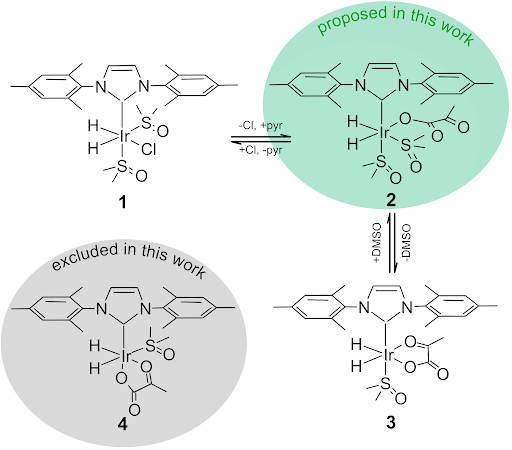
SABRE holds immense promise for developing radiation-free MRI contrast agents, such as pyruvate, which is rapidly metabolised by cancer cells and hence can enable imaging based on its chemical transformation in vivo. However, the catalytic cycle by which iridium complexes amplify the MRI signal of pyruvate prior to its use for imaging has remained a mystery. In a report recently published in Nature Communications, Simon Duckett and co-workers utilised spin-selective NMR, simulations, and computational modelling to map these hidden mechanics.
Their findings overturn current assumptions about the way the SABRE process activates pyruvate. They discovered that internal hydrogen exchange occurs much faster than previously thought, and identified a brand-new stable iridium complex configuration that revealed how passive counterions (like Na+) actively steer the binding process. These insights provide an important breakthrough in the quest to optimise new catalyst systems for next-generation medical imaging.
This work has been published in Nature Communications.
Notes to editors:
This work has been published in the journal Nature Communications.