
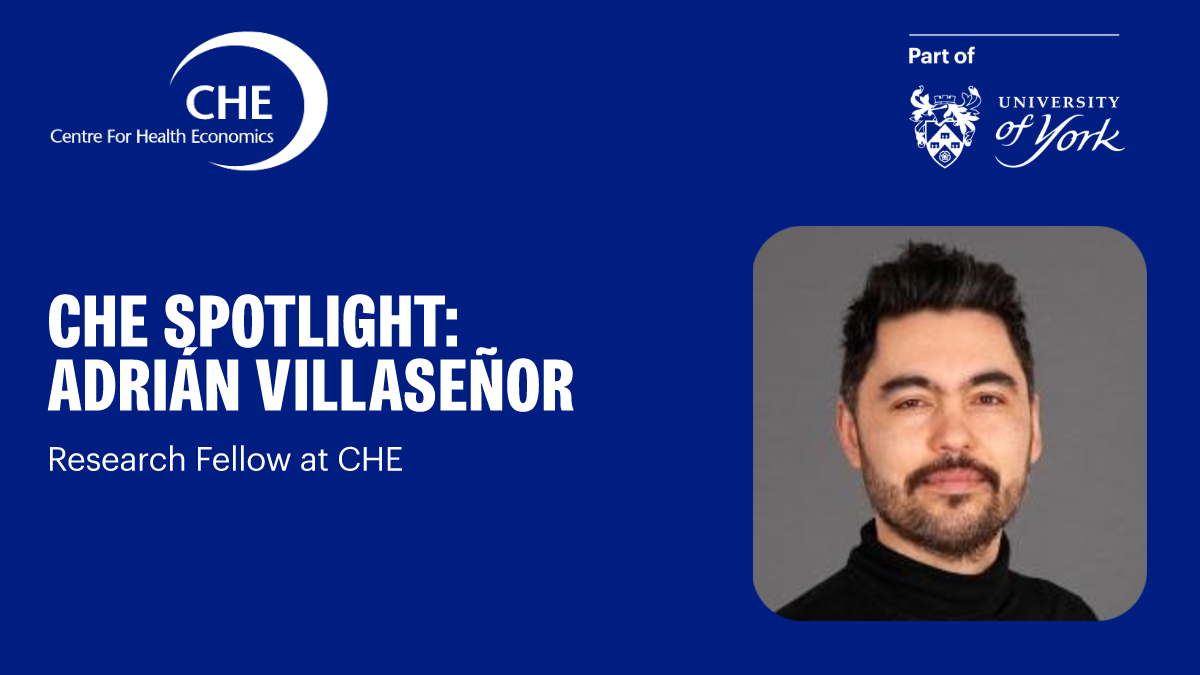
CHE Spotlight: Adrián Villaseñor
Posted on Monday 1 June 2026
What was your career route to CHE?
My route to CHE was somewhat non-linear. It was shaped by an interest in answering applied questions and evaluating the impact across different policy domains. I completed my PhD in international development at the University of East Anglia in Norwich, where I examined the relationship between relative deprivation and human development outcomes, particularly education and mental health. This was followed by an 18-month postdoctoral position in Chile, at the Pontificia Universidad Católica de Chile, evaluating the impact of environmental policies and applying methodologies for academic - policy engagement. Throughout this time, I combined research with teaching, mainly in quantitative methods and impact evaluation for both university students, and practitioners and policy makers. After that experience, I first joined CHE for around eight months before moving to the School of Environment and Geography at the University of York, where I worked on a mixed-methods impact evaluation of private nature reserves in Colombia. I returned to CHE shortly afterwards, drawn back by my interest in health research and the opportunity to apply general quantitative and causal inference methods to questions in health economics.
What have you been working on since you came to CHE and what are you currently doing?
Since joining CHE, I have worked across a wide range of projects, which I value because, as a non-health economist, it gave me the opportunity to learn from different aspects and methods from health economics, while gradually finding my focus in the area where I believe health economics still has the most to contribute: mental health. My recent work has examined the impact of COVID-19 on mental health services, evaluated a mental health intervention delivered in Pakistan and Bangladesh, and explored the costs of delivering high-quality care in mental health settings. I have also contributed to research on inequalities in access to mental health services for children and young people. Currently, I am working on a project examining whether the integration of employment support within a mental health intervention generates measurable changes in labour market outcomes.
What are your future plans in CHE?
Looking ahead, my plans at CHE centre on developing further as an independent researcher, with the ambition of leading my own research programme as principal investigator. I intend to pursue this through authoring and contributing to collaborative funding bids in the area of mental health and related topics. I would like to continue evaluating the impact of mental health interventions, examining both clinical effectiveness and broader social and economic outcomes. I also plan to return to one of the questions that originally motivated my doctoral work: the causal impact of relative deprivation on mental health. I am particularly interested in how relative deprivation at birth shapes later-life outcomes — the idea that where one is born functions as a kind of lottery ticket, with lasting consequences for mental health and wellbeing.