
In memory of Nick Bosanquet
Posted on Thursday 30 April 2026

Nick had a long and distinguished career in health and health economics in government and academia, with interests spanning a wide range of topics including the organisation, management and financing of health care. He was one of the senior founding members of CHE, later moving to academic posts in London where he was emeritus professor of health policy at Imperial College. His long-standing enthusiasm for the NHS and health economics was reflected in his involvement as a public governor in the local NHS Trust and his very recent participation in many CHE public lectures and events, where his contributions were always well-informed and incisive.
Professor Nick Bosanquet obituary in Times
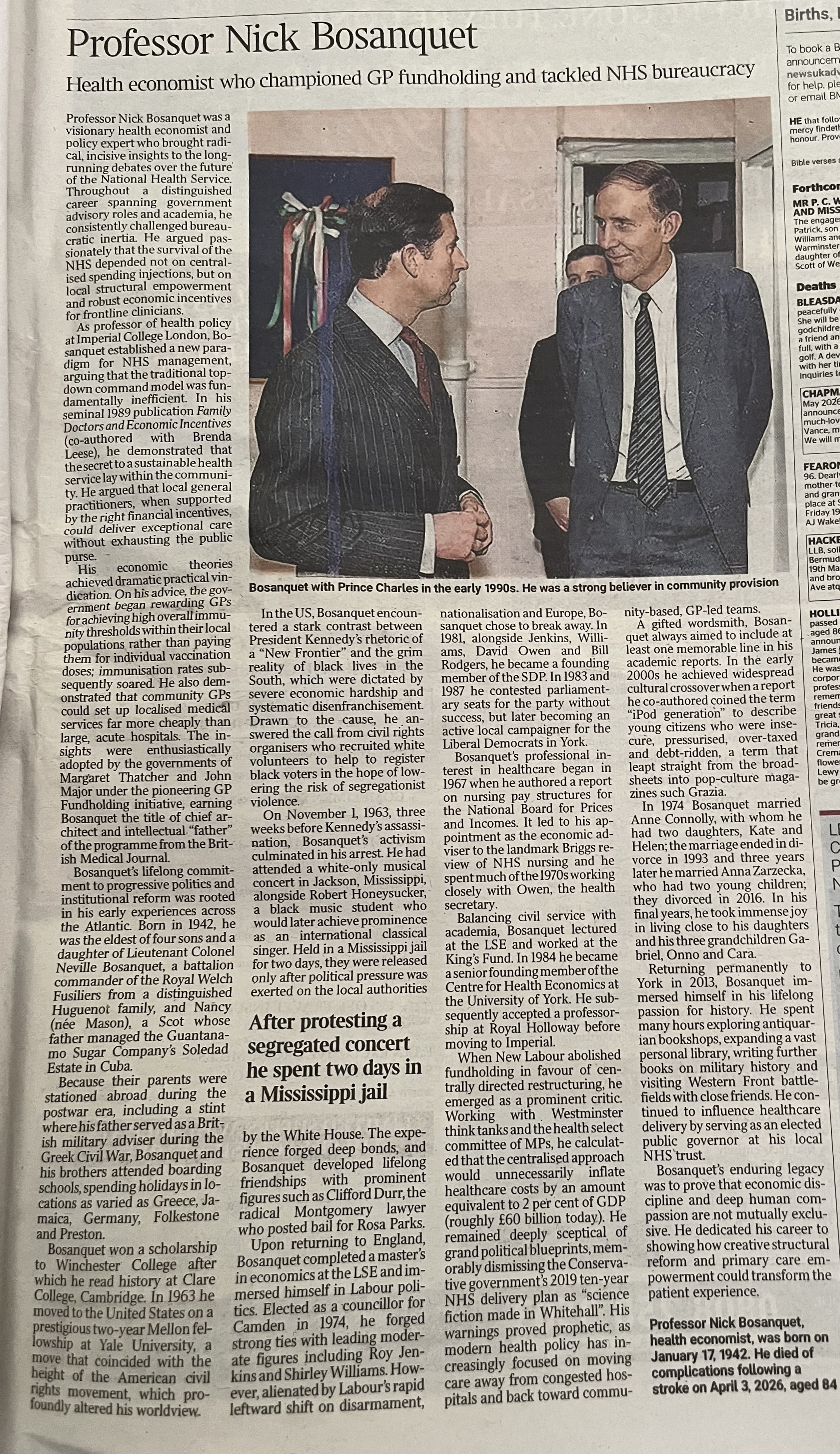
Text version:
Professor Nick Bosanquet
Health economist who championed GP fundholding and tackled NHS bureaucracy
Professor Nick Bosanquet was a visionary health economist and policy expert who brought radical, incisive insights to the long-running debates over the future of the National Health Service. Throughout a distinguished career spanning government advisory roles and academia, he consistently challenged bureaucratic inertia. He argued passionately that the survival of the NHS depended not on centralised spending injections, but on local structural empowerment and robust economic incentives for frontline clinicians.
As professor of health policy at Imperial College London, Bosanquet established a new paradigm for NHS management, arguing that the traditional top-down command model was fundamentally inefficient. In his seminal 1989 publication Family Doctors and Economic Incentives (co-authored with Brenda Leese), he demonstrated that the secret to a sustainable health service lay within the community. He argued that local general practitioners, when supported by the right financial incentives, could deliver exceptional care without exhausting the public purse.
His economic theories achieved dramatic practical vindication. On his advice, the government began rewarding GPs for achieving high overall immunity thresholds within their local populations rather than paying them for individual vaccination doses; immunisation rates subsequently soared. He also demonstrated that community GPs could set up localised medical services far more cheaply than large, acute hospitals. The insights were enthusiastically adopted by the governments of Margaret Thatcher and John Major under the pioneering GP Fundholding initiative, earning Bosanquet the title of chief architect and intellectual “father” of the programme from the British Medical Journal.
Bosanquet’s lifelong commitment to progressive politics and institutional reform was rooted in his early experiences across the Atlantic. Born in 1942, he was the eldest of four sons and a daughter of Lieutenant Colonel Neville Bosanquet, a battalion commander of the Royal Welch Fusiliers from a distinguished Huguenot family, and Nancy (née Mason), a Scot whose father managed the Guantanamo Sugar Company’s Soledad Estate in Cuba.
Because their parents were stationed abroad during the postwar era, including a stint where his father served as a British military adviser during the Greek Civil War, Bosanquet and his brothers attended boarding schools, spending holidays in locations as varied as Greece, Jamaica, Germany, Folkestone and Preston.
Bosanquet won a scholarship to Winchester College after which he read history at Clare College, Cambridge. In 1963 he moved to the United States on a prestigious two-year Mellon fellowship at Yale University, a move that coincided with the height of the American civil rights movement, which profoundly altered his worldview.
In the US, Bosanquet encountered a stark contrast between President Kennedy’s rhetoric of a “New Frontier” and the grim reality of black lives in the South, which were dictated by severe economic hardship and systematic disenfranchisement. Drawn to the cause, he answered the call from civil rights organisers who recruited white volunteers to help register black voters in the hope of lowering the risk of segregationist violence.
On November 1, 1963, three weeks before Kennedy’s assassination, Bosanquet’s activism culminated in his arrest. He had attended a white-only musical concert in Jackson, Mississippi, alongside Robert Honeysucker, a black music student who would later achieve prominence as an international classical singer. Held in a Mississippi jail for two days, they were released only after political pressure was exerted on the local authorities by the White House. The experience forged deep bonds, and Bosanquet developed lifelong friendships with prominent figures such as Clifford Durr, the radical Montgomery lawyer who posted bail for Rosa Parks.
After protesting a segregated concert he spent two days in a Mississippi jail
Upon returning to England, Bosanquet completed a master’s degree in economics at the LSE and immersed himself in Labour politics. Elected as a councillor for Camden in 1974, he forged strong ties with leading moderate figures including Roy Jenkins and Shirley Williams. However, alienated by Labour’s rapid leftward shift on disarmament, nationalisation and Europe, Bosanquet chose to break away. In 1981, alongside Jenkins, Williams, David Owen and Bill Rodgers, he became a founding member of the SDP. In 1983 and 1987 he contested parliamentary seats for the party without success, but later became an active local campaigner for the Liberal Democrats in York.
Bosanquet’s professional interest in healthcare began in 1967 when he authored a report on nursing pay structures for the National Board for Prices and Incomes. It led to his appointment as the economic adviser to the landmark Briggs review of NHS nursing and he spent much of the 1970s working closely with Owen, the health secretary.
Balancing civil service with academia, Bosanquet lectured at the LSE and worked at the King’s Fund. In 1984 he became a senior founding member of the Centre for Health Economics at the University of York. He subsequently accepted a professorship at Royal Holloway before moving to Imperial.
When New Labour abolished fundholding in favour of centrally directed restructuring, he emerged as a prominent critic. Working with Westminster think tanks and the health select committee of MPs, he calculated that the centralised approach would unnecessarily inflate healthcare costs by an amount equivalent to 2 per cent of GDP (roughly £60 billion today). He remained deeply sceptical of grand political blueprints, memorably dismissing the Conservative government’s 2019 ten-year NHS delivery plan as “science fiction made in Whitehall”. His warnings proved prophetic, as modern health policy has increasingly focused on moving care away from congested hospitals and back toward community-based, GP-led teams.
A gifted wordsmith, Bosanquet always aimed to include at least one memorable line in his academic reports. In the early 2000s he achieved widespread cultural crossover when a report he co-authored coined the term “iPod generation” to describe young citizens who were insecure, pressurised, over-taxed and debt-ridden, a term that leapt straight from the broadsheets into pop-culture magazines such as Grazia.
In 1974 Bosanquet married Anne Connolly, with whom he had two daughters, Kate and Helen; the marriage ended in divorce in 1993 and three years later he married Anna Zarzecka, who had two young children; they divorced in 2016. In his final years, he took immense joy in living close to his daughters and his three grandchildren Gabriel, Onno and Cara.
Returning permanently to York in 2013, Bosanquet immersed himself in his lifelong passion for history. He spent many hours exploring antiquarian bookshops, expanding a vast personal library, writing further books on military history and visiting Western Front battlefields with close friends. He continued to influence healthcare delivery by serving as an elected public governor at his local NHS trust.
Bosanquet’s enduring legacy was to prove that economic discipline and deep human compassion are not mutually exclusive. He dedicated his career to showing how creative structural reform and primary care empowerment could transform the patient experience.
Professor Nick Bosanquet, health economist, was born on January 17, 1942. He died of complications following a stroke on April 3, 2026, aged 84.