
Exploring health research through a CHE internship
Posted on Monday 19 October 2026
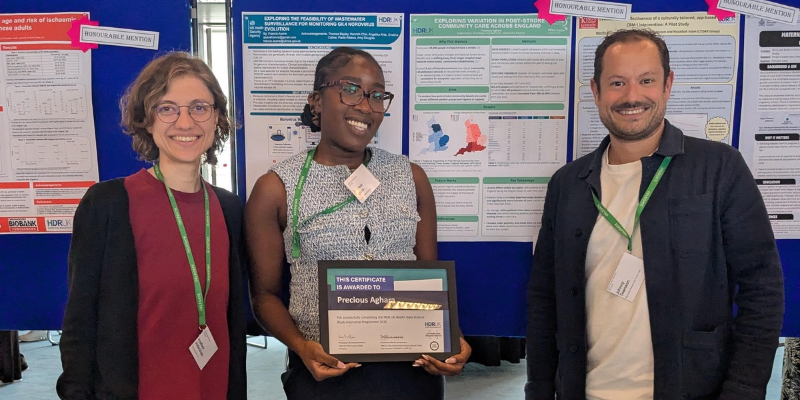
For Precious Aghara, an internship at CHE offered an opportunity to develop practical research skills, while exploring how health data and health economics can contribute to better healthcare.
Having already obtained a BSc in Clinical Pharmacology and an MSc in Bioinformatics, Precious joined CHE with an interest in using data to reveal meaningful insights and improve people’s health. The internship gave her the opportunity to explore how that interest could translate into health economics research.
“I was especially drawn to health data, as I have always wanted to find different ways of improving patients’ lives, and contributing to work that can have a meaningful impact on healthcare,” Precious said.
Precious joined CHE through the Health Data Research UK institute, after having been introduced to the opportunity through the 10,000 Interns Foundation programme. The placement offered her a chance to bring together her interests in healthcare and data science, while also gaining first-hand experience of health economics and health services research.
Exploring variation in stroke care
During the internship, Precious worked on the REAL Supply Unit Pathfinders Project, supervised by CHE researchers Anastasia Arabadzhyan and Alexandra Nazerai, exploring variation in post-acute stroke community care across England.
Using large, routinely collected Hospital Episode Statistics (HES) and community care datasets, the project investigated whether the care people receive following a stroke varies according to characteristics including age, sex, deprivation, frailty, ethnicity and geography.
Much of the day-to-day work involved using the program Stata to prepare and quality-check data, carry out descriptive analyses, and explore patterns in the datasets. Regular meetings with her supervisors provided opportunities to discuss findings and consider new questions; the structure of the placement also allowed Precious considerable independence as a researcher.
“There was a high level of independence in the way I worked through the data, which I really enjoyed, as it gave me the opportunity to understand the datasets in much greater depth,” she said. “I was also able to take ownership of parts of the research and explore specific questions and ideas that I found particularly interesting in more detail.”
Learning from the CHE research community
The experience extended beyond the individual research project, with opportunities to take part in training, seminars and wider CHE activities.
A particular highlight was the REAL Supply annual retreat, where Precious learned more about research taking place across the team, contributed to discussions about potential future research questions, and built relationships with colleagues.
“Hearing about the personal motivations behind each team member’s work, and seeing how a desire to create meaningful impact on public health and policy was at the heart of so many projects, was particularly inspiring to me,” she said.
Precious also took part in CHE’s Analysing Patient Data course, which introduced approaches to working with HES data and supported her development in an area that was new to her.
Seminars from researchers at CHE and other institutions offered another perspective on the breadth of health economics and health policy research, and on the multidisciplinary expertise involved in addressing complex healthcare questions.
Towards the end of the placement, she had the opportunity to present her own work to CHE researchers. Reflecting on this experience, she said: “This was a particularly proud moment for me because it allowed me to reflect on how much progress I had made from the beginning of the internship to my final week. It was a real honour to present the work I had contributed to, and receiving feedback from the audience was especially valuable, as I am always looking for opportunities to improve and develop further.”
Developing skills for future research
The internship provided practical experience of working with large healthcare datasets and helped strengthen skills in Stata. It also offered a deeper understanding of the decisions involved in working with real-world health data, from understanding where data comes from and what individual variables represent, to recognising missing information and the limits of the conclusions that can be drawn.
Another important part of the experience was learning from researchers with different areas of expertise.
“Discussing ideas, methods and results with people from different backgrounds often gave me new perspectives and changed the way I approached a problem,” explained Precious. “Simply being part of the CHE environment—where I could ask questions, attend seminars, and observe how researchers approach real-world problems—was an important part of my learning.”
Looking ahead
The placement has strengthened her interest in a career bringing together healthcare, data science, and research, while opening up possibilities she had not previously considered.
In particular, being introduced to health economics has encouraged her to explore how the discipline could form part of her future career.
“I would like to continue developing my skills in health data science and applying them to research questions that can ultimately contribute to improving healthcare and patient outcomes,” Precious shared. “The internship has also given me a much clearer understanding of the range of research and career opportunities available within this field.”
Learn more about CHE and find out about opportunities to work and study with CHE.