From student to researcher
It has been good making this step from a PhD student to a researcher. I think collaborating with different people has been key. When you have a multidisciplinary project everyone has different knowledge and different backgrounds - you need to be able to communicate with all of them.
I gained skills that enable me to communicate with people from different backgrounds with different expertise. This is not necessarily easy because sometimes they don’t understand your technical terms and you need to find the right terms to explain a concept. I'm more able to talk with the community about my work than I ever was before.
Interdisciplinary collaboration
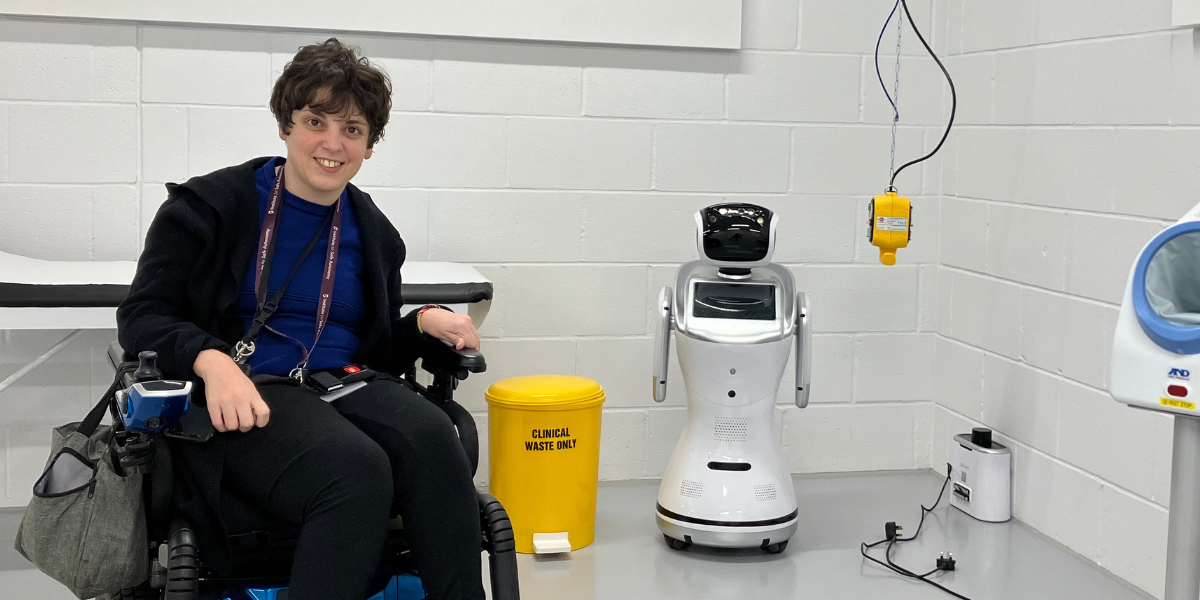
Since being at York, I've had the chance to collaborate with internal and external stakeholders on many projects. Nowadays, I'm collaborating externally with an NHS emergency consultant on the DAISY project. The aim of the DAISY robot is to help with the initial triage of patients arriving at a hospital's A&E department. DAISY will produce a report based on some questions (identifying patient family history and symptoms) and vital signs measurements like blood pressure and body temperature. The report contains suggestions for treatment and further examinations and will be sent to a senior doctor.
Working with the NHS consultant is crucial because he gives us the domain knowledge that we don’t have. We're also working with the University's Law School and with the University of Southampton. These collaborations are important to make sure that the system designed will be accepted by the different stakeholders, including the consideration of appropriate laws and standards during the design process.
Different perspectives
In a current TAS Hub-funded project, Reimagining Trustworthy Autonomous Systems with Disabled Young People, with disabled young people we realise how important and valuable their opinion is in designing the technology of the future. They had a different perspective, pointing out factors which we had not considered before.
I personally identify as disabled so I can understand the importance of different points of view. I think the more differences in the project team involved, the better for the design. If it was down to me, I would include the wider community more during the design of systems employed in society, but this is not necessarily easy.
AAIP's approach
I think the AAIP is great. I've been here from the beginning. The AAIP gives you so many opportunities to work with different people. From the wider community and with the Fellowship scheme, other academics and industrial colleagues can come and work with us on a project for a defined period, giving us the opportunity to know what they're doing and have joint publications. Demonstrator projects funded by the AAIP also give me the opportunity to work with industries on exciting projects like a wildfire detection system implemented in a satellite - we can collaborate with a really wide community.
Our AMLAS guidance is another great example of how AAIP brings together the right people. AMLAS (Assurance of Machine Learning for use in Autonomous Systems) is the the first standardised procedure to help assure the safety of machine learning components used in autonomous systems. I was one of the AAIP authors of the methodology. We worked with a team of external colleagues to review and refine the guidance before we published it. It's now free to use for practitioners and academics who want to argue the safety of systems that employ machine learning.