Skip to content Accessibility statement

Principles-Based Ethics Assurance (PRAISE)

PRAISE is a bold and ambitious assurance framework which provides a set of ethical principles to structure a principles-based ethics assurance argument.

The principles are justice, beneficence, non-maleficence, and respect for human autonomy, with the principle of transparency playing a supporting role. 
 
PRAISE is based on a set of reusable argument templates (or patterns) for individual ethics assurance cases, by which engineers, developers, operators, or regulators could justify, communicate, or challenge a claim about the overall ethical acceptability of the use of a specific AI and autonomous system in a given socio-technical context. 

PRAISE considers overall ethical acceptability, and has a high threshold of ethical acceptability which is grounded in the notion of a social contract that gives equal respect and status to all affected stakeholders. For this reason, the PRAISE acronym is perhaps apt in that it points to what could be a ‘gold standard’ for ethics assurance. The underlying belief is that such an approach will help to ensure that the benefits from the development and deployment of  AI and autonomous systems are reaped by all.

Read our open access paper in AI and Ethics
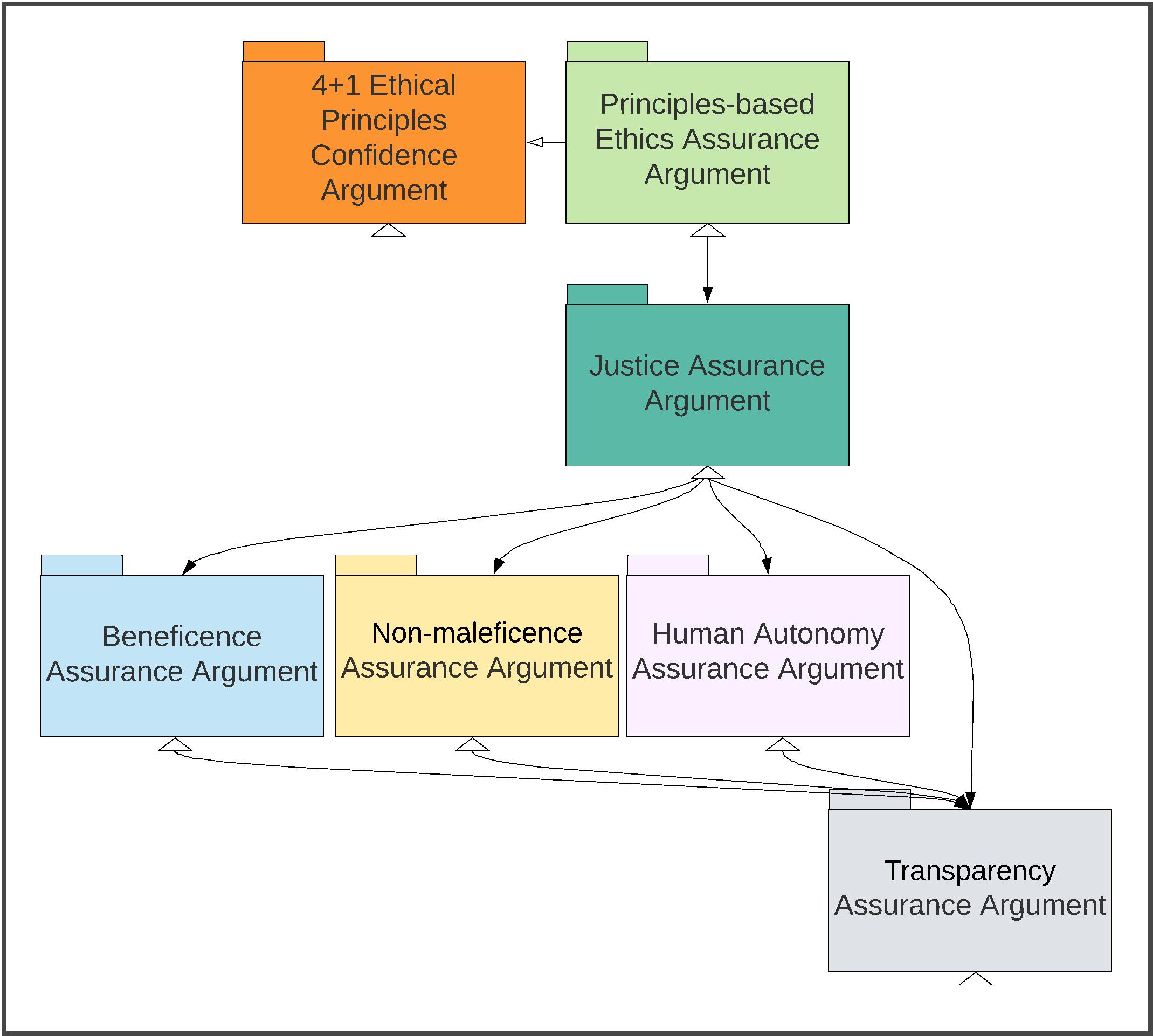
A multi-level diagram outlining the PRAISE Framework.

Our paper on PRAISE, is freely available to read in the AI and Ethics journal:

A principles-based ethics assurance argument pattern for AI and autonomous systems

New to PRAISE? Download our factsheet: PRAISE guidance downloadable brochure (PDF , 749kb)

PRAISE in action

We evaluated PRAISE with our partner, Ufonia Limited,  based on their clinical conversational AI tool, Dora. Titled Ethics in conversation: Building an ethics assurance case for autonomous AI-enabled voice agents in healthcare it showcase how the PRAISE framework could be applied in real world scenarios. 

Our other methodologies

PRAISE forms part of a suite of peer-reviewed and industry applied assurance frameworks and methodologies created by the CfAA. Learn more about AMLAS and SACE below.