
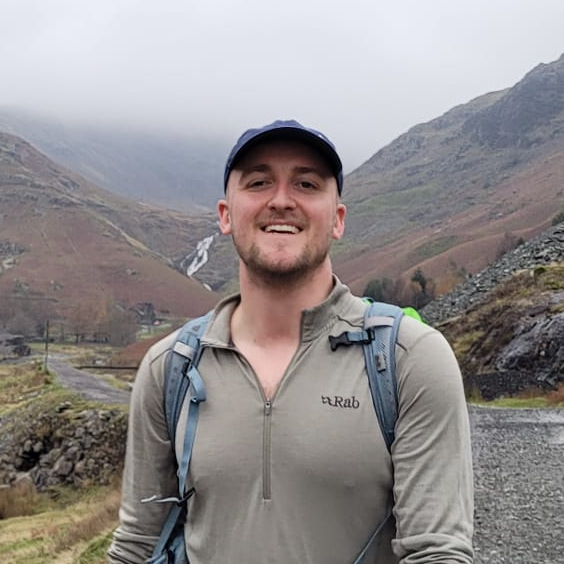
Thomas Ball
Postdoctoral Research Associate, Leverhulme Centre for Anthropocene Biodiversity
Consequences of food systems on biodiversity
Biography
My research is centred around the interactions of wild species with anthropogenic pressures, with a particular focus on food, agriculture, and habitat. I completed PhD in Environmental Science with a focus on land-use modelling at the University of East Anglia in 2022. Following that, I joined the Conservation Science Group at the University of Cambridge. There, I contributed to the development of a novel biodiversity metric centred around species extinctions (‘LIFE’) and developed a pipeline linking it to data on trade and geospatial data on food production to estimate the biodiversity impacts of food consumption in a given place. I also lead a theoretical population modelling study to examine the relationship between species extinction risks and carrying capacity.
Research
The Earth has limited space – extinctions of wild species are occurring at over 100 times the expected natural rate, driven primarily by habitat loss to agriculture. My research at LCAB aims to characterise historic and future trends in global patterns of agriculture and understand their effects on biodiversity. I will use publicly available data to examine recent trends in agricultural land-use and identify driving factors behind them – for example changes in production efficiency, food demand, and trade profiles. Then, using data on wild species populations, habitat preferences, and life histories I will develop models to understand how their populations respond to changes in agriculture. Finally, I will link these models to historic and future agricultural trends to quantify impacts on species. I am also interested in the concept of ‘leakage’: how might an action in conservation or agricultural policy have effects outside its intended area of influence?
Publication Highlights
Ball, T. S., Dales, M., Eyres, A., Green, J. M., Madhavapeddy, A., Williams, D. R., & Balmford, A. (2025). Food impacts on species extinction risks can vary by three orders of magnitude. Nature Food 6, 848–856.
Ball, T. S., Balmford, B., Rinaldo, D., Balmford, A., Visconti, P., Brook, B. & Green, R. E., A general relationship between population size and extinction risk. In revision, submitted July 2026 (Nature Communications). Preprint available
Balmford, A., Ball, T. S., Balmford, B., Bateman, I. J., Buchanan, G., Cerullo, G., d’Albertas, F., Eyres, A., Filewod, B., Fisher, B., Green, J. M. H., Hemes, K. S., Holland, J., Lam, M. S., Naidoo, R., Pfaff, A., Ricketts, T. H., Sanderson, F., Searchinger, T. D., Strassburg, B. B. N., Swinfield, T. & Williams, D. R. (2025). Time to fix the biodiversity leak. Science, 387(6735), 720-722.
Eyres, A., Ball, T. S., Dales, M., Swinfield, T., Arnell, A., Baisero, D., Durán, P. A., Green, J. M. H., Green, R. E., Madhavapeddy, A. & Balmford, A. (2025) LIFE: A metric for quantitively mapping the impact of land-cover change on global extinctions. Philosophical Transactions B, 380(1917), 20230327.
Balmford, A., Bateman, I. J., Eyres, A., Swinfield, T., & Ball, T. S. (2025). Sustainable high-yield farming is essential for bending the curve of biodiversity loss. Philosophical Transactions B, 380(1917), 20230216,