
The webbed world of women in British Mycology 1896-1926
Posted on Thursday 5 November 2026
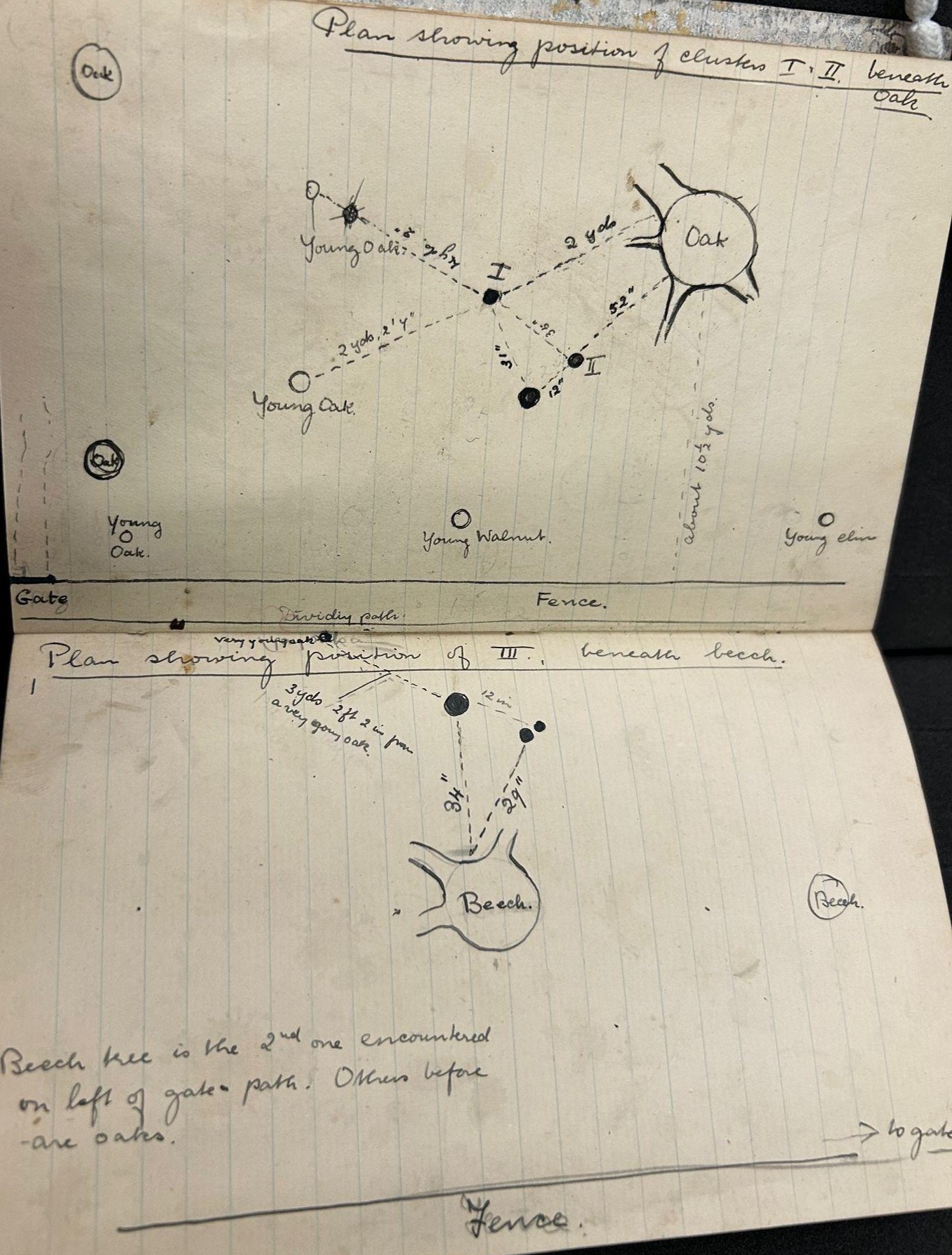
There is a longstanding (false) assumption that science had a sort of ‘purity’ about it until the 1950s: the idea that research was pursued autonomously and out of sheer curiosity by researchers – the kind that labours long hours with a microscope and a notebook. More recently though, historians are realising the necessity to do a bit of ‘myth-busting.’ Applying relational and interdisciplinary thinking to histories of science in this period, it is clear that science has always needed community to function; the idea that science has ever had a ‘purity’ is mostly an exercise in rhetoric.1
Community is an especially important idea when considering the contributions of women to science. As consistently undervalued, underfunded and under-resourced distributors of knowledge, several studies have shown women to cluster together in labs and institutions, generating their own supportive and pedagogical ‘subcultures’ away from the hostilities of professional research.2 This is something that is becoming a dominant theme in my own research into British Mycology in the first decades of the twentieth century. In a brief foray into the social sciences, data visualisation methods like Social Network Analysis have helped me to analyse the shape and genre of connection between the women of the British Mycological Society. The picture emerging is that British women mycologists were indeed a dynamic social group, grounded by a stable core that traversed hierarchies of status, disciplinary expertise and age, and most importantly, comprised of groups of friends.
Of course, Mycology is a science with an important social function, perhaps more so than other sciences in Britain. The British Mycological Society (BMS) sits at the core of the discipline and sets the mycologist’s calendar to orbit around its annual foray. Forays are gatherings of mycologists and mycophiles in the field, whose task is to collect, identify and record species in an inherently social format. The BMS forays were hosted in various locations across the country, with a conscious effort made to fairly represent members across all parts of the UK. Society members would travel (usually by train) to a designated hotel or museum (destined as the base for the foray) and spend successive afternoons scouring the local area for specimens, which they laid out in drawing rooms and halls the following morning to identify and record. Evenings were filled with a meal, lectures, an address from the Society’s president, as well as a general meeting in which new members were elected and a committee for the following season was voted on. Thus, it’s important to visualise forays – indeed the BMS as a whole – as not a setting of science, but more accurately as the locus of a community with scientific interests. It remains true even to this day that the BMS does not comprise strictly of scientists.
My surveys of the BMS’s journal, the Transactions, reveal a range of interdisciplinary contributors – from mycological illustrators, to mycological educators, government mycologists, taxonomists, field scientists, those interested in nutrition and medicine, even philosophers and clergy who argued for mycology’s role in teleological arguments – and these all range across amateur and professional members. Amidst this variation, women represented around 24% of members between 1896-1926, a number that rose over the following decades.
The BMS were not unique in their choice to admit women as Society members, but that is not to say it was usual to see women in learned clubs or institutions either. The Woolhope Club, a naturalist-club precedent to the BMS who made significant contributions to the foray tradition didn’t officially admit women until 1954. Many other local naturalist clubs similarly barred women, or made an effort to make them feel excluded. In the loftier settings of science, women did not become fellows of the Linnean Society until 1904, and the Royal Society until 1945; in both cases, after long and arduous campaigns of women like Marion Farquharson, whose pleas had for decades fallen on deaf ears.
The oscillating attitudes towards women in science is mirrored in their status in universities during the period. Though many of the new red-brick Universities awarded women degrees from the late 1870s, at Oxbridge women couldn’t officially graduate with the degrees that they had studied and passed examinations for until 1920 at Oxford and 1948 at Cambridge. Cambridge, in many ways an epicentre for study of Natural Sciences in Britain, is noted to have expressed particularly hostile attitudes towards its women students.
Thus, historians emerge with a mixed impression of women’s place within both amateur and professional science at the turn of the century. What’s interesting is that when you delve beneath the wider picture, many have noticed that where women scientists were permitted, they often established a base for themselves. They adopt more women and young protégés to join their labs, societies and clubs, making their own gender-exclusive spaces. The most famous example is the Balfour Biological Laboratory in Cambridge (1884-1914), studied by Marsha Richmond in the 1990s, which revealed a ‘feminised scientific subculture’ that attempted to provide shelter from institutional misogyny by becoming a self-sustaining lab run by women, for women.3 Balfour offered students and researchers the fundamental lab skills that were often omitted by girls secondary education and were essential in participating in scientific research. Many of these women germinated successful careers in botany, genetics, and mycology.
Women of the Linnean Society also established their own ‘subculture’ in the Women’s Linnean Club.4 The club was established as a counterpart to the ‘Linnean Club:’ one of the oldest scientific dining clubs in Britain (and void of women until 1953).5 Though short-lived, the Women’s Linnean Club offered a chance for women scientists (and wives of scientists) to discuss papers delivered at the Linnean in a space where their opinion was valued and heard and considered equal to their peers. It was also figured as a space to expand the network of female scientists, with each member being allowed a guest without Linnean fellowship to participate in discussion (as long as the guest was also a woman). Surprisingly, the majority of the women in the Women’s Linnean Club crossed over with membership of the BMS.
Thus, we get a picture of women mycologists as a particularly expansive and interconnected social group; indeed quite an important part of not only British Mycology but communities of female scientists in Britain as a whole. This is something further emphasised by their choice to refer to themselves occasionally as ‘comrades’ – a word or sentiment that appears semi-frequently in both the archives and in secondary literature that I’ve been reading. Often, women will be described as a ‘comrade’ in the study of fungi, relating to their kind willing to teach and distribute mycological knowledge and skills to the next generation.
This ought to highlight the multiple facets to science – that research was composed of community, camaraderie, and friendships as much as it was of knowledge, resource and skill. Recognising the importance of social contexts to science perhaps gives us the chance to reassess the metrics we use to measure the value of science. Is it the legacy of scientific lone-geniuses that we want to preserve? Or does relational or network-based thinking unlock a hidden richness that forwards our understanding of the world around us?
References
1. See Frank Turner’s article on the definitions of ‘fundamental science’: Turner, Frank. ‘Public Science in Britain, 1880-1919.’ Isis 71 (4); 1980. p. 589–608.
2. See Marsha Richmond’s article on the Balfour Biological Laboratory: Richmond, Marsha.“‘A Lab of One’s Own’: The Balfour Biological Laboratory for Women at Cambridge University, 1884-1914.” Isis 88 (3); 1997. p. 422–55.
3. Richmond, 1997.
4. See McCulloch, Christina. ‘Botanists and Blackouts.’ Linnean News 15/03/26.
5. See McGow, Liz. ‘Pub Anyone?’ Linnean News 12/11/2025