
The Gardens Trust Research Symposium
Posted on Tuesday 17 November 2026
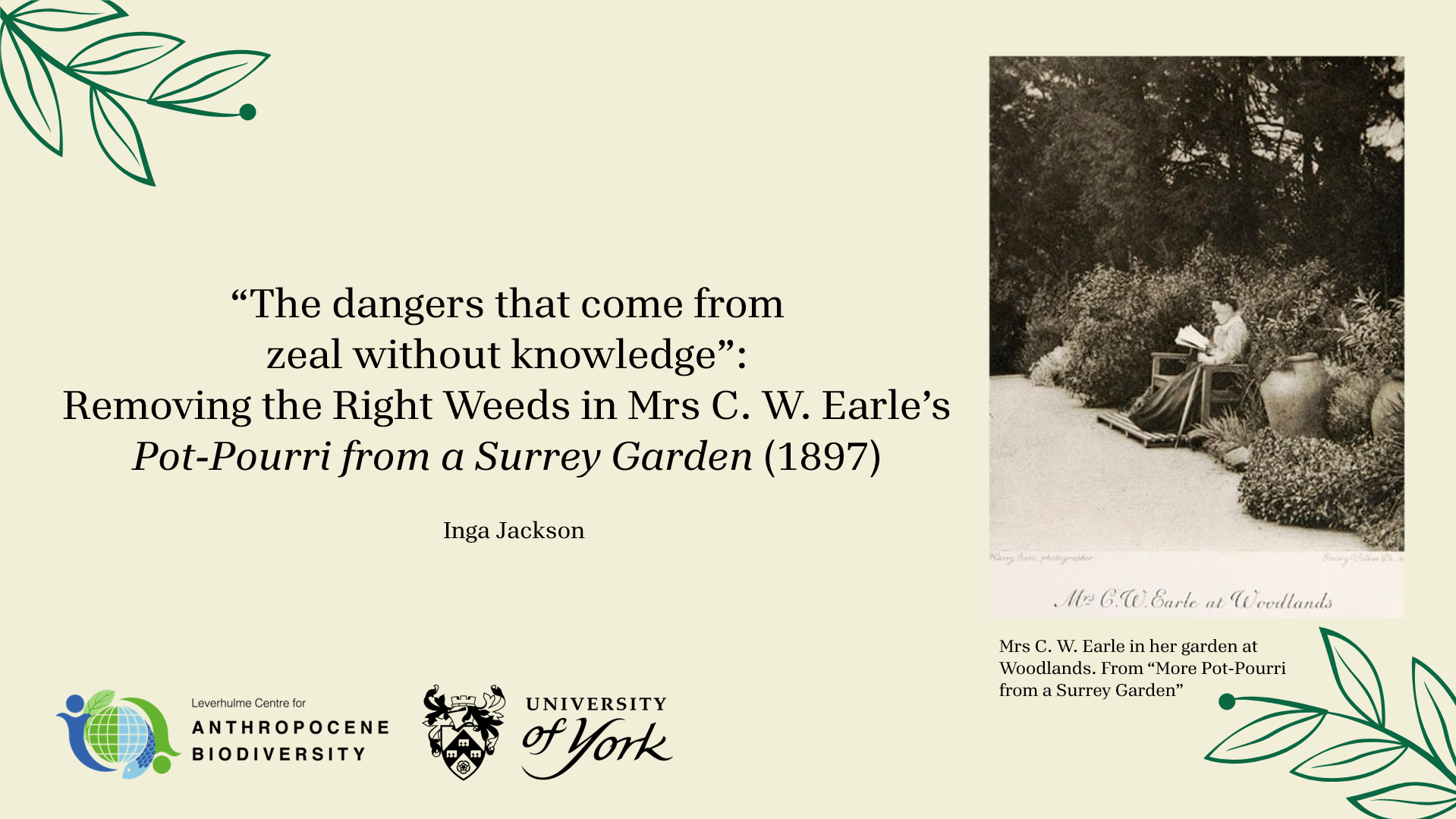
The Gardens Trust Research Symposium is an annual event that brings together researchers working on the history of gardening to share new and upcoming research. The interdisciplinary event featured speakers on topics ranging, from 19th-century seed catalogues to archaeological reconstructions of Pompeii’s gardens and the development of Stowe’s Garden. With an academic and public audience, it was a welcoming and valuable space to present evolving research and its contribution to the field of gardening history. Inga's paper discussed the latest developments in her work.
Weeding often has a reputation of being a common-sense, mundane or simple activity, as historically it was a task performed by ‘unskilled’ young children and women. This perception of weeding understates the assumptions, knowledge and experience that are not only required to recognise a plant but to then decide how to manage it. Mrs C. W. Earle warns
of the “dangers that come from zeal without knowledge”. She describes moving to her country house in Surrey, and a family member coming to stay who, rather than removing what they thought were weeds, proceeded to tear up annuals that had been sown. With an air of frustration, Earle was cautioning that the difference between weeds and sown plants is less
obvious than an amateur might assume, so proceed with caution.1
Mrs C.W. Earle’s book Pot-Pourri from a Surrey Garden was a hugely successful book on gardening alongside several other household topics, which was published at the end of the nineteenth century. Her writing gained a significant reception, and she was esteemed for her friendly writing style, comprehensive knowledge and love of her garden. Weeds, both within
Earle’s writing and garden, were not marginalised or unwanted, but she described their aesthetic value. For instance, finding enjoyment in Creeping bell-flower from “the way it throws up its flower-stems” and praised common Marigolds for being “precious with their grand glowing orange faces”.2 Through attention and careful routines of cutting back the plants, they could have a welcome place within the garden.
Weeding was not a mindless activity but one which required an understanding of plant identification, behaviour and decisions about whether to keep those plants within the garden. However, these were not requirements exclusively for the practice of weeding. Earle warned her readers that gardeners can often allow their more ‘precious’ plants to grow and become ‘no better than weeds’.3 Therefore, the dangers of ‘weedy’ growth were not just about misidentifying so called weeds, but the mistreatment and lack of care of all plants. The distinction between a plant and a weed was anything but straightforward in Earle’s experience.
Mrs C. W. Earle was an avid reader and strongly advised her own readers to engage with other gardening books. She was particularly fond of The English Flower Garden, by William Robinson, frequently referencing Robinson’s advice and directing her readers to look at his plant illustrations to know what the plants she discussed looked like. Without this, she declared, “you will derive very little benefit from these notes”.4 Earle referred to Robinson’s
book in an entry where she recommended the use of low-growing foliage, like giant saxifrages, to keep out weeds and give a picturesque appearance.5 As one audience member noted, this is a gardening practice that has come back into fashion.
In today’s context, Earle’s gardening advice might not seem surprising: that not all weeds are undesirable, you should manage plants that are weed-like in their growth and that plant identification, knowledge and caution are important. Books like the RHS What’s that weed are built around the premise of “Know your weeds and learn to live with them”.6 Contemporary attitudes and more sympathetic approaches to weeds are not entirely new, but
there have been longer modes of appreciating these plants and finding ways to selectively manage them. The work of Mrs C.W. Earle forms part of a larger body of work to trace the development of the concept and category of a weed over the nineteenth century and consider the varied attitudes and treatment of these plants.
References
1 Earle, C. W. Pot-Pourri from a Surrey Garden. London: Smith, Elder & Co., 1897: p.90.
2 Ibid: p.160 and p.188-9.
3 Ibid: p.90.
4 Ibid: p.2.
5 Ibid: p.184.
6 Barter, Guy. RHS What’s That Weed? London: Dorling Kindersley Ltd. 2024.