
Evolution & Irish Myth
Posted on Monday 26 October 2026
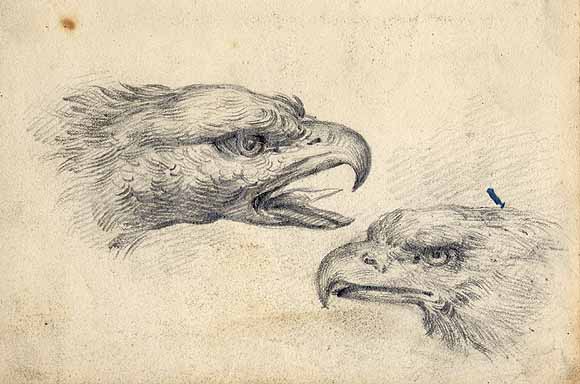
When the Irish Folklore Commission (An Coimisiún Béaloideasa Éireann) was founded in 1935, eagles has been gone from Ireland for at least two decades; Golden Eagles had been extirpated by 1912, and White Tailed Eagles by the end of the 19th century.1 Memories of eagles however still persisted in oral tradition, and it is the popular perception of these birds in the moment following their extirpation which my research seeks to investigate.
This summer I carried out research in Ireland’s National Folklore Collection, sourcing and studying various accounts of eagle folklore. One of the recurring ideas I encountered in the archive related to the great age of the eagle. Some accounts attested that eagles could live for up to 200 or even 300 years.2 A popular proverb tells us that eagles were one of the three longest lived creatures, along with the yew tree and the Cailleach Bhéarra (the Hag of Bearra Peninsula, a sovereignty goddess figure in Irish folk tradition):
Na Trí Saoghail Is Fuide (The Three Longest Lives)
Saoghal an iubhair (The life of the Yew)
Saoghal an Iolraigh (The life of the eagle)
Agus saoghal na Caillighe Béara.3 (The life of the Cailleach Bhéarra)
This folk perception of the long lives of eagles intrigued me, particularly considering that ornithologists today would say that the average lifespan of Golden and White Tailed Eagles is between 20-25 years.4 So why were eagles perceived to be such long-lived creatures in Irish folk tradition?
The answer came in part when I stumbled across a narrative collected from Pádhraic Mac an Iomaire in Carna, Co. Galway, in 1935-6.5 This story recounted how there was once a man who wanted to learn how cold it was on Luan Lae Bhealtaine, or May Day Monday, which Gearóid Ó Crualaoich states is ‘... to be understood here as a kind of unique, first human day of all time that is humanly reckonable’.6 The man seeks out the Cailleach Bhéarra but she can give him no account of the cold of Luan Lae Bhealtaine because she wasn’t around then, and she sends him on to the Eagle, who we are told is 300 years older than her. Upon reaching the Eagle in an old blacksmith’s forge, the Eagle too fails to give an account of the cold of Luan Lae Bhealtaine, and directs the man onwards to the Otter. The man approaches the Otter, who has been on the same stone for 500 years, but he has no account to give of the cold of Luan Lae Bhealtaine either, and sends the man on to the Half Blind Salmon of Eas Ruadh (Assaroe in County Kerry). The salmon can tell the man of the cold there was on Luan Lae Bhealtaine because he alone of the four creatures was there. He tells us that it was so cold on that day that when he leapt out of the water to catch a fly, the river froze over before he could fall back in and he was trapped on the surface of the ice. A seagull came and plucked out his eye, and the blood which issued forth from his body melted the ice around him and he fell back down into the water.
Interpreting this story, Ó Crualaoich writes of the salmon:
He proceeds to tell how he survived the last Ice Age which caught the whole world in its grip. This survival was not without its cost; it required the loss of one eye and the expenditure of his heart’s blood so as to bring his entrapment on the frozen surface of the pre-human, even prefaunal world to an end and to enable him to live on and bear witness in this tale of ‘the cold that was there on Luan Lae Bhealtaine.’7
It would appear thus that this story is a meditation on the origin of the world and the earliest species which inhabited it. If we consider the evolutionary age of the different creatures in this narrative (and the sequence in which they are encountered) the human species is considerably younger than eagles and otters, and the salmon is the oldest of the four, having been around for approximately 70 million years and survived the last Ice Age.8 Thus it would seem that this story is in a sense a narrative about evolution, understood from a vernacular perspective. And this may perhaps account for why the eagle was perceived to be so long-lived in Irish folklore; perhaps their great age refers not to individual lifespan, but to the evolutionary age of the species.
References
1 Lorcan O’Toole et al. ‘Reintroduction of the Golden Eagle into the Republic of Ireland,’ Biological Conservation (2002) 103; Brian Burke et al. 'Reintroduction of white-tailed eagles to the Republic of Ireland: A case study of media coverage,' Irish Geography, 47, no.1 (2015): 97.
2 National Folklore Collection (henceforth NFC) 1341:5-7; Pádraig Uí Cheócháin, Farranfadda, Kilmocomoge, Bantry, Co. Cork. Collector: Tadhg Ó Murchada, July 1953; NFC 32:119; M. Ó Súilleabháin, Derrylough, Co. Kerry. Collector: Seán Ó Súilleabháin, 27 July 1932.
3 NFC 62:283; Collector: Seán Mac Giollarháth, Carna, Co. Galway.
4 ‘White Tailed Eagle’, The Wildlife Trusts, accessed 20 October 2026; ‘Golden Eagle’, The Wildlife Trusts, accessed 20 October 2026,
5 NFC 159:473-8; Pádhraic Mac an Iomaire, Carna, Co. Galway. Collector: Liam Mac Coisdealbha, 1935-6.
6 Gearóid Ó Crualaoich, The Book of the Cailleach: Stories of the Wise-Woman Healer (Cork University Press, 2003), 102.
7 Ó Crualaoich, The Book of the Cailleach, 103
8 Marmian Grimes, ‘New ancient fish species earliest known salmon ancestor’, University of Alaska Fairbanks, May 8, 2025