
Global lake synchrony signals rising planetary-scale ecological coupling
Posted on Wednesday 18 November 2026

Understanding how localized ecosystem dynamics scale up to influence Earth-system stability remains a major challenge. Lakes, though covering less than 2% of Earth’s surface, play a disproportionate role in regulating global carbon, nutrient, and biodiversity dynamics, making them a critical nexus for assessing emerging large-scale environmental coupling. Historically, asynchronous lake dynamics buffered broader environmental variability by distributing ecological disturbances across space. By integrating satellite observations with century-scale sedimentary archives from ~2,000 lakes, in our new paper, published this week in Proceedings of the National Academy of Sciences, we reveal a marked acceleration in global lake synchrony since 2000. This synchronization, coinciding with converging climatic and socioeconomic pressures, signals a widespread erosion of the spatial heterogeneity and regional distinctiveness that historically characterized inland waters.
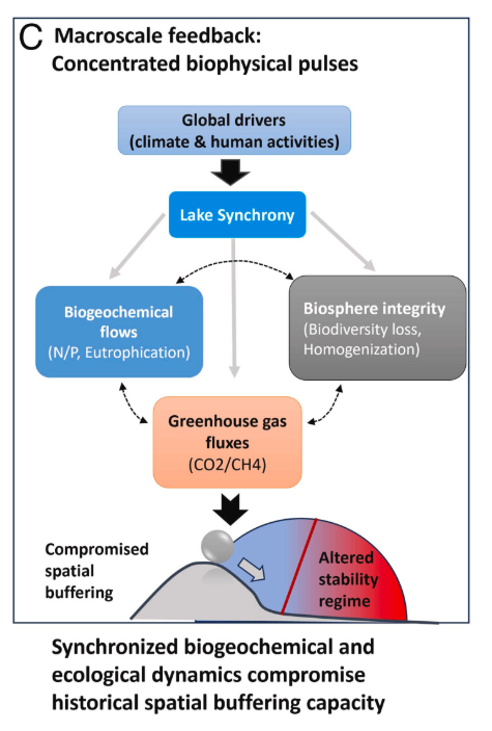
We propose that increasing lake synchrony represents an emergent property of the Anthropocene, transforming lakes from regionally structured, asynchronous waterscapes into dynamically coupled planetary commons. By temporally aligning carbon and nutrient dynamics across broad spatial scales, this synchronization modifies the timing and amplitude of aggregate biophysical fluxes, altering how inland waters interact with larger-scale environmental cycles. Our findings reveal that the spatial heterogeneity essential for environmental stabilization is eroding. Our study demonstrates that this buffering capacity is declining as lakes become increasingly synchronized at macroscales, accompanied by reduced network modularity.
This structural shift transforms inland waters from regionally distinct systems into a dynamically coupled planetary common. We propose the concept of Strategic Planetary Lake Areas (SPLAs) as a basis for polycentric governance, introducing a macroscale dimension that is largely absent from current international assessments. Recognizing and managing this emerging synchrony may prove important for maintaining long-term stability in an increasingly interconnected world.
The emergence of global lake synchrony highlights a widening mismatch in environmental governance: we manage water bodies as local or national resources, yet there is increasing evidence that their dynamics increasingly reflect climatic and socioeconomic telecoupling over broad geographic scales. At the same time, global Frameworks such as Planetary Boundaries are difficult to operationalise on national to regional scales, where management decisions have most effect. Addressing this scale mismatch requires an adjustment in governance to facilitate management across nested spatial scales, from local catchments and regional waterscapes to global monitoring and decision-making networks. Ultimately, our findings motivate a macroscale monitoring framework that jointly tracks synchrony, modularity, and their functional consequences, demanding a shift in governance toward preserving the ecological heterogeneity essential for maintaining long-term environmental stability.
As one possible mechanism for recognizing lakes as interconnected components of a planetary common, we propose the identification of Strategic Planetary Lake Areas (SPLAs): regions where intervention would most effectively preserve lake-mediated ecosystem functions and maintain broader environmental resilience. Effective governance must also ensure that responses to increasing synchrony are equitable. The consequences of synchronized water quality deterioration are unlikely to be distributed evenly, with communities that rely directly on lake resources often facing disproportionate risks from algal blooms, declined water quality, and associated ecosystem degradation. Governance strategies should therefore avoid reinforcing existing inequities while supporting more just and inclusive environmental transitions.
K. Zhang, Y. Han, L. Gillson, X. Zhang, S. McGowan, M.E. Meadows, Y. Jin, L. Subehi, J.A. Dearing, D.P. Hamilton, Y. Zhao, L. Pin Koh, & D. Taylor, Global lake synchrony signals rising planetary-scale ecological coupling, Proc. Natl. Acad. Sci. U.S.A. 123 (47) e2611874123, https://doi.org/10.1073/pnas.2611874123 (2026).