
Exploring urban rewilding in practice
Posted on Thursday 16 July 2026
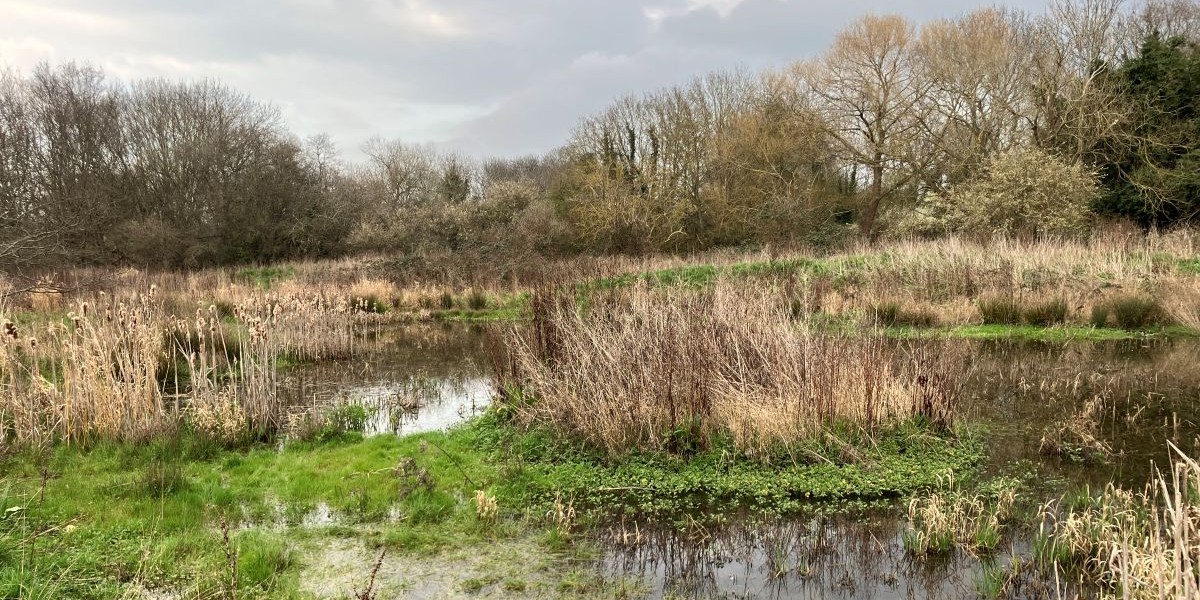
This fieldwork follows a review I conducted on meanings of urban rewilding in academic and grey literature, highlighting the importance of practice-based knowledge to its meanings as an applied concept (Gammon, 2018), and that like other nature-based solutions, socio- ecological-technological systems shape how it is implemented (McPhearson et al., 2022) . To explore these subjects further I decided to build on the momentum and political support for rewilding in London, conducting semi-structured walking interviews with people whose work has been funded by the mayor’s Rewild London Fund.
Walking interviews are interviews that take place along a walk. They are guided by features of the chosen interview site, are multi-sensory, and can be led by the interviewer or participant depending on the research aims (Evans and Jones, 2011). In this case, participants led me around their project sites and I asked them a series of questions relating to key themes: their background and project background; their approach to implementing rewilding in this specific site; and meanings of urban rewilding. With the participant, I experienced weather, birdsong, dogs and interactions with visitors, all things to consider when analysing the interview data.
Working in various environmental and community-related roles for local authorities or charities, participants are managing woodlands, rivers, meadows and other ecosystems within nature reserves and public parks. Guided by the funding criteria, their work has specific priorities and objectives that commonly relate to habitat creation and connectivity, species protection and climate mitigation. These all align with principles of rewilding that are being adapted to urban contexts (Carver et al., 2021).
In relation to meanings, several participants associate rewilding with large sites and grazing animals commonly found in rural rewilding projects such as the Knepp Estate in East Sussex, although also feature in one of the larger and more suburban project sites, Wild Tolworth in Kingston. Restoration to repair ecosystems is a key step involved in many projects and some participants may be going through phases of restoration, such as Perivale Wood in Ealing. Greening (i.e. planting) may be involved, such as in the Old Lea River Restoration Project in Hackney, but is often associated with planning initiatives that do not always prioritise biodiversity.
It came up often that people set urban rewilding apart from rural rewilding. This may drive projects; the Wild Tolworth project led by Citizen Zoo, for example, was conceived to improve accessibility of biodiverse nature for locals. It was repeatedly mentioned that clear communication of conservation actions are essential to improving public perceptions; anti- social or ecologically damaging behaviour is common across sites; and stakeholders’ values and knowledge shapes decision-making around how these ecosystems are managed.
I’m grateful to all participants for their time and really enjoyed our conversations. I’m looking forward to analysing this data further before the next stage, which will involve detailed case study analysis into how local people relate to these sites.
References:
- Carver, S. et al. (2021) ‘Guiding principles for rewilding’, Conservation Biology, 35(6), pp. 1882–1893. Available at: https://doi.org/10.1111/cobi.13730.
- Evans, J. and Jones, P. (2011) ‘The walking interview: Methodology, mobility and place’, Applied Geography, 31(2), pp. 849–858. Available at: https://doi.org/10.1016/j.apgeog.2010.09.005.
- Gammon, A.R. (2018) ‘The Many Meanings of Rewilding: An Introduction and the Case for a Broad Conceptualisation’, Environmental Values, 27(4), pp. 331–350.
- McPhearson, T. et al. (2022) ‘A social-ecological-technological systems framework for urban ecosystem services’, One Earth, 5(5), pp. 505–518. Available at: https://doi.org/10.1016/j.oneear.2022.04.007.