
Lutkemeerpolder: Becoming immersed in the ecology of a small organic urban farm in the Netherlands
Posted on Wednesday 20 May 2026
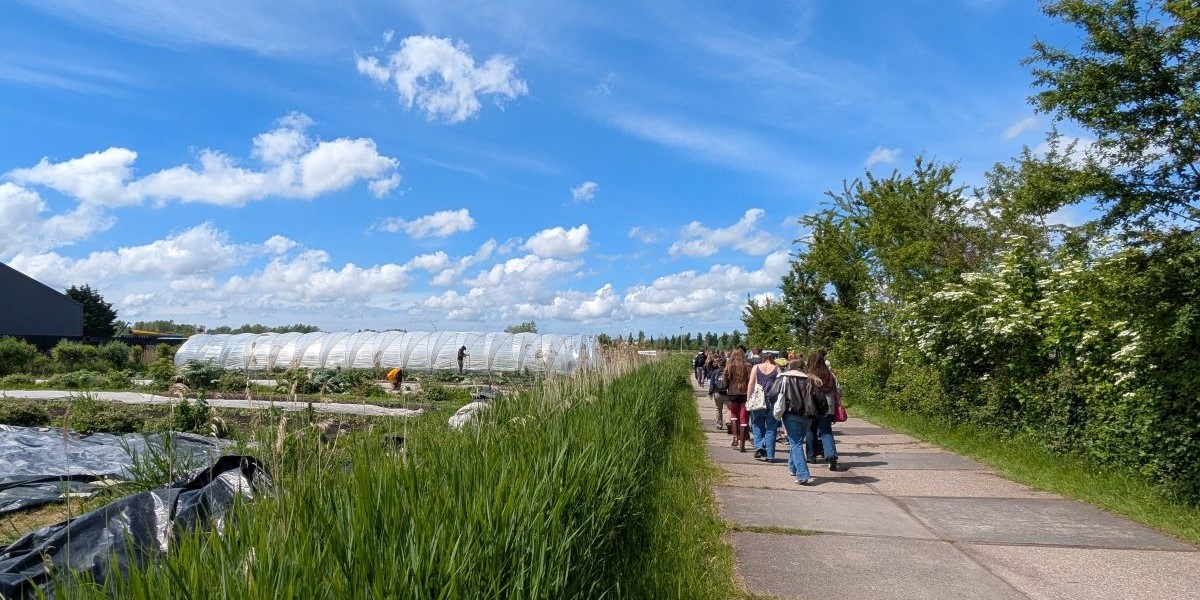
It is mid-afternoon on a late-spring day and pleasantly warm in the orchard at Lutkemeerpolder. The main runway at Amsterdam airport is a little under two miles away, so huge numbers of commercial aircraft are close-by, but they are not flying overhead that day and so are easy to ignore. A group of students are feeding an open fire with sticks and logs of willow.
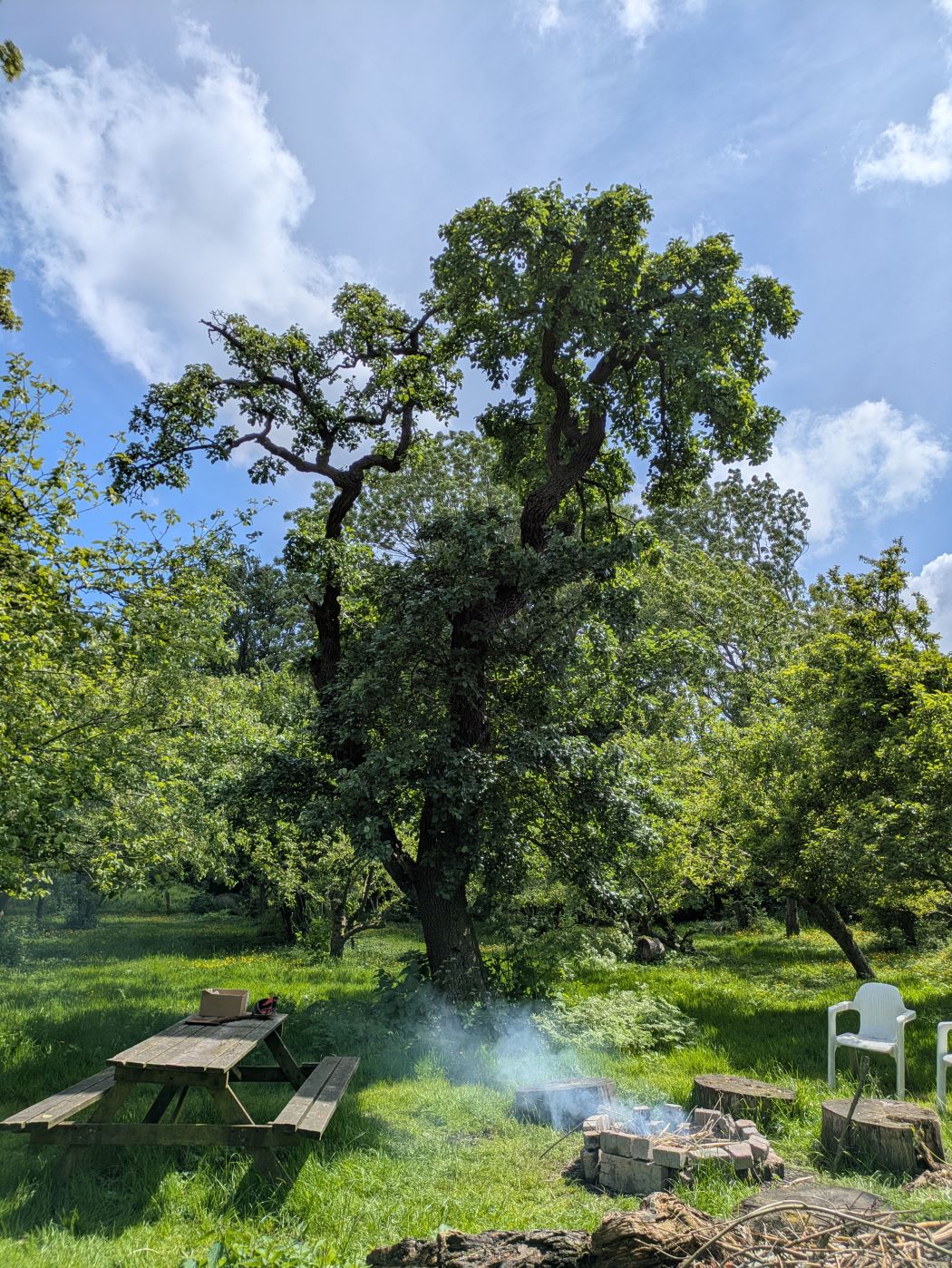
The boughs of the fruit trees and the foliage of the shelterbelt create an enclosed space that is detached from the urban sprawl outside while remaining open to the spring sunshine. It only takes a few minutes for the senses to become flooded by the gentle sound and movement of a thriving multispecies community. Soldier beetles clamber over nettle leaves, busily scavenging for nectar and small prey. Two ancient pear trees, confirmed to be around two hundred years old, tower above the rest of the orchard. Hefty wooden props, evidently constructed relatively recently by their human attendants, help to support their enormous weight. Your host assures you that they still produce excellent fruit. Plenty of wood is added to the fire, which becomes the focal point of collective attention while it reaches its zenith. A swing hangs invitingly from one of the sturdiest branches: it proves irresistible.
This is arguably one of the most important potential aspects of an environmental degree programme: situated, embedded experience. Classroom and desk-based study can be enormously productive, but cannot educate the senses. If the goal is to understand the environment, there are whole layers and forms of highly salient knowledge that can only be accessed through immersion in ecology. In an ecosystem such as that of Lutkemeerpolder, the majority of the subjects of classroom study intersect and, quite literally, come alive.
Its human stewards are inspirational people, who speak passionately of their practical engagement with food justice and agricultural ecology, of their efforts to comprehend and overcome the social and ecological legacy of slavery in a former colonial power in a place like Amsterdam, and of their resistance against the encroaching tide of warehouse units, seemingly driven by investors somewhere in Texas, whose geometric precision and ecological sterility threaten to overwrite a diverse and sumptuously productive ecosystem.[1] Being in these spaces makes all of these distant global phenomena feel real in a way that depends on first-person, sensory experience.
I keep thinking about the paper by Johnson et al. (2023)[2] concerning the ‘invisible labour’ of climate change adaptation, which draws attention to the vast number of people globally whose work will be required to enact any of the potential ‘nature based solutions’ to global climate change that are dreamed up in the conference centres and institutional headquarters of global environmental policy. Ecological workers, who understand the impact that their actions have across scales ranging from microbial to planetary, both now and far into the future, will be needed everywhere. The optimist in me would hope that, at some point in the not-too-distant future, very many environment graduates might find their work in driving the human ecological niche forwards, in a way that promotes multispecies flourishing while producing excellent food.
The animals and plants surrounded and nurtured amongst this community of ideas are evidently thriving, and to assert as much requires no act of ventriloquism on my part;[3,4] their bright colours and inquisitive movements speak for themselves.[5] Lutkemeerpolder is an ecology in which kind ideas and generous intentions scaffold an ecosystem that is qualitatively the opposite of an industrial monoculture. The snack that another student group prepared with ingredients from the farm - a pesto with fresh bread - is thoroughly delicious in a way that is surely a reliable indicator of good ecosystem health.
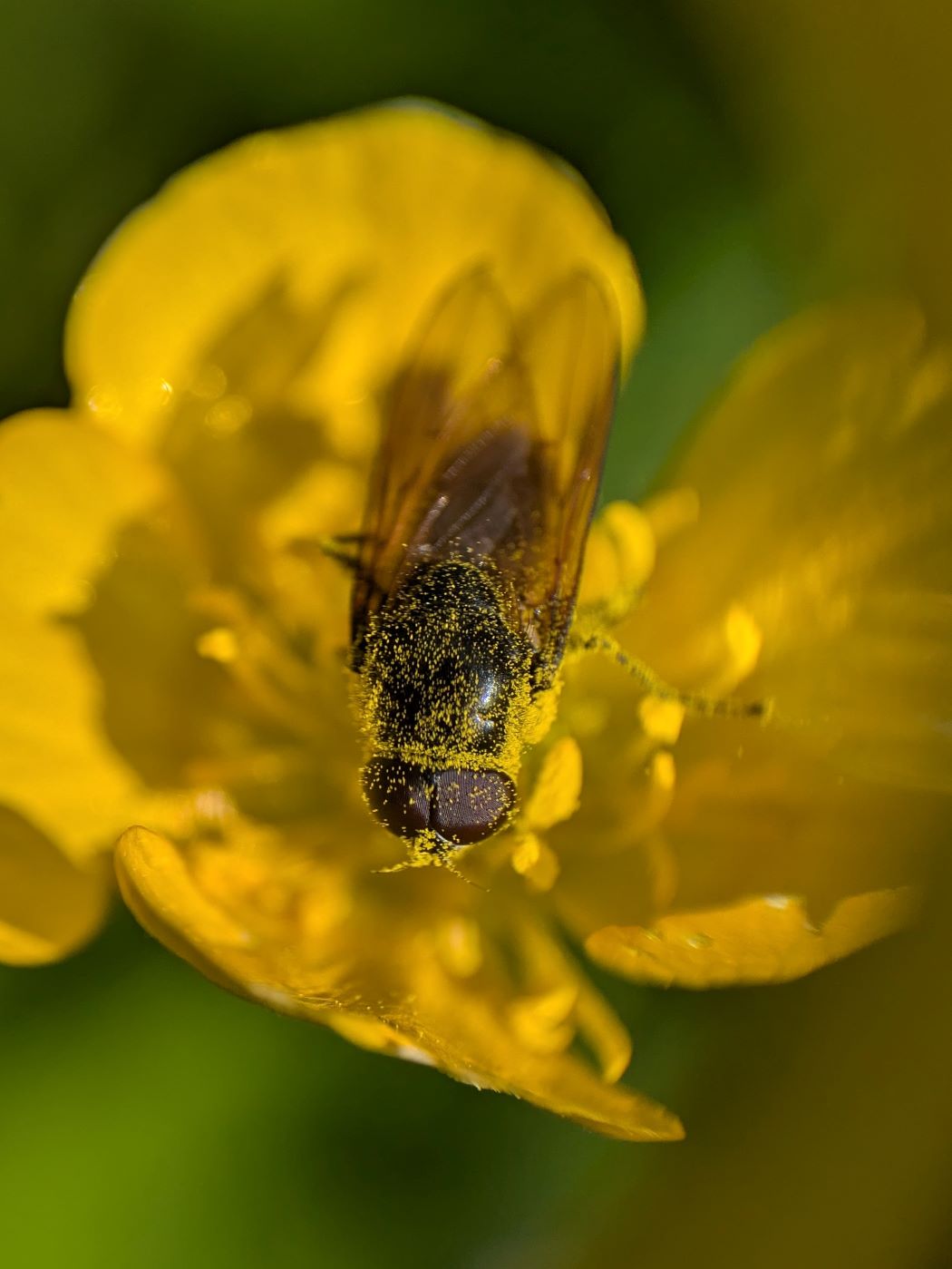
Just before leaving, a hoverfly catches your eye as it feasts atop a buttercup flower. It is a member of the Cheilosia genus, but its identification features are so thick with pollen that it is impossible to tell which species.
References
[1] See e.g. Crime Pays but Botany Doesn’t. (2026). Spiritually depraved & misery-inducing landscapes of North America: Episode 1. [Online]. Available at: https://www.youtube.com/watch?v=C-83-YPYSKA
[2] Johnson, L., Mikulewicz, M., Bigger, P., Chakraborty, R., Cunniff, A., Joshua Griffin, P., Guermond, V., Lambrou, N., Mills-Novoa, M., Neimark, B., et al. (2023). Intervention: The invisible labor of climate change adaptation. Global Environmental Change, 83, p.102769. [Online]. Available at: doi:https://doi.org/10.1016/j.gloenvcha.2023.102769
[3] Appadurai, A. (1988). Introduction: Place and Voice in Anthropological Theory. Cultural Anthropology, 3 (1), pp.16–20. [Online]. Available at: doi:10.1525/can.1988.3.1.02a00020
[4] Kirksey, S. E. and Helmreich, S. (2010). The emergence of multispecies ethnography. Cultural Anthropology, 25 (4), pp.545–576. [Online]. Available at: doi:10.1111/j.1548-1360.2010.01069.x
[5] Della Bosca, H. (2024). Silent Teachers: Exploring the Profound Wisdom of Plants. Medium. [Online]. Available at: https://medium.com/@hrdellabosca/silent-teachers-exploring-the-profound-wisdom-of-stillness-4991d0731a3d