UK’s first quantum network launched
Posted on Wednesday 13 June 2018
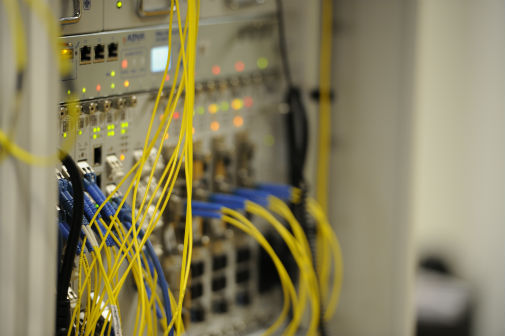
Quantum links rely on particles of light, or photons, to transmit encryption keys through the optical fibre.
The network enables “unhackable” communications, made secure by the laws of physics, between three sites around the city of Cambridge.
The “metro” network provides secure quantum communications between the University of Cambridge’s Electronic Engineering Division in West Cambridge, the Department of Engineering in the city centre and Toshiba Research Europe Ltd (TREL) on the Cambridge Science Park.
Ultra-secure
Quantum links are so secure because they rely on particles of light, or photons, to transmit encryption keys through the optical fibre. If a hacker were to attempt to intercept the communication, the key itself changes through the laws of quantum mechanics, alerting the communicating parties to the presence of an eavesdropper.
Researchers have been testing the ultra-secure network for the last year, providing stable generation of quantum keys at rates between two and three megabits per second. These keys are used to securely encrypt data, both in transit and in storage. Performance has exceeded expectations, with the highest recorded sustained generation of keys in field trials that include encryption of data in multiple 100 gigabit channels.
Applications
Director of the Quantum Communications Hub and Professor of Quantum Information Technologies in the Department of Physics at the University of York, Tim Spiller, said: “Through this network we can further improve quantum communications technologies and interoperability, explore and develop applications and services, and also demonstrate these to potential end users and future customers.”
The quantum network was built by partners in the Quantum Communications Hub, a consortium of eight UK universities, as well as private sector companies and public sector stakeholders.
Collaboration
The UK Quantum Network is funded by the Engineering and Physical Sciences Research Council (EPSRC) through the UK’s National Quantum Technologies Programme. It brings together concentrations of research excellence and innovation, facilitating greater collaboration between the two in development of applications that exploit the unique formal guarantee of security provided by quantum physics.
Dr Liam Blackwell, Head of Quantum Technologies, EPSRC, said: “Development of the network has brought together in the Quantum Communications Hub partnership many world-class researchers and facilities from both UK universities and industry. This is a reflection of EPSRC’s commitment to investing in UK leadership in advanced research and innovation in quantum technologies."