Solving the mysterious handwriting of a medieval scribe
Posted on Tuesday 29 March 2016
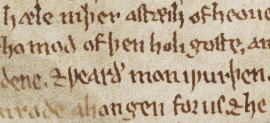
Known as the Tremulous Hand of Worcester, the medieval writer has been the subject of much debate and speculation regarding his condition, but the central question always remained: what type of tremor did he have?
But now University of York historian Dr Deborah Thorpe is able to shed new light on the mysterious scribe after teaming up with consultant neurologist Dr Jane Alty of Leeds Teaching Hospitals NHS Trust.
The study suggests the medieval writer – probably a monk at Worcester Cathedral Priory - suffered from a condition called essential tremor: a type of uncontrollable shake or tremble which today affects around four out of 100 adults over the age of 40.
Essential tremor is usually more noticeable when someone is trying to hold a position or do something with their hands, such as write, which usually gets more severe over time.
Dr Thorpe, who is currently a research associate in the Department of Electronics, said the monk was a linguistic expert of his time and interested in older manuscripts and in particular translating Old English into Middle English.
During the analysis, Dr Thorpe and Dr Alty examined the monk’s tremor through a series of handwriting samples, charting the progression of his condition and then comparing present handwriting from modern-day individuals with different conditions.
Dr Thorpe said: “The Tremulous Hand of Worcester is important as he is the only widely-known medieval writer with a tremor, and for his unusual interest in translating documents written centuries earlier.
“People have always been fascinated with him; but this is the first time his writing has been investigated from a joint neurological and historical perspective.
“To our knowledge, this is the first time medieval handwriting has been analysed by a neurologist with a specialist interest in movement disorders.”
The authors of the study are unable to say how old he was or if he was left or right handed, but suggest he was elderly when he wrote his last manuscript.
They also suggest the absence of any evidence of cognitive decline points away from Parkinson’s or other neurodegenerative disorders.
Dr Thorpe added: “Research on neurological disorders is always looking for the earliest possible bio-marker of any disorder; so anything that can help to detect or analyse those conditions is useful.
“Also, from a social side it is saying how did medieval people cope with getting older? Did they lose their careers if they developed a medical condition or did they just carry on?”
The study, which was funded by the Wellcome Trust and the Centre for Chronic Diseases at the University of York, is published in Brain: A journal of Neurology.
Further information
The paper can be found here: http://brain.oxfordjournals.org/content/early/2015/08/31/brain.awv232.article-info
For more information please visit: