Aiming high – bringing low-cost broadband to rural communities in Nigeria
Posted on Wednesday 7 September 2016
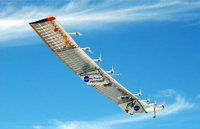
HAPs are airships or solar-powered aircraft which are permanently located in the skies at an altitude of 20km, above aeroplanes but below satellites.
The platforms are capable of delivering wireless services without the need for significant and expensive ground-based infrastructure.
Facebook recently completed its first test flight of a solar-powered drone that is designed to beam down internet access to remote areas of the world.
Now academics at the University of York are aiming to team up with collaborators in Nigeria to boost internet provision across rural communities.
The University has an expertise in providing high-altitude platforms going back 15 years.
Professor David Grace, from the University of York’s Department of Electronics, said: “We have quite a track record in this area and have built up a level of expertise which allows us to pursue some exciting projects with high-altitude platforms.
“It is a revolutionary technology which uses renewable energy and means rural communities no longer have to rely on diesel generators.
“It has the potential to be rapidly deployed and will provide the same level of service as you would get in an urban area, empowering communities and transforming lives.”
Dr Abimbola Fisusi, from the Department of Electronic and Electrical Engineering of the Obafemi Awolowo University in Nigeria, will lead the project in Nigeria, linking up with potential collaborators.
As he is a former University of York PhD graduate, the project is seen as a way to facilitate an emerging link between University of York and Obafemi Awolowo University.
He said: “Affordable broadband will result in an improvement in the livelihood of hard-to-reach rural areas of Nigeria, which this project targets, as it will give them access to a wider market, diverse learning resources, and expert medical advice.”
“It will also enable prompt awareness of government programmes and policies, enhancement of safety and security and effective communication with the outside world in these rural areas.”
Access to broadband services by all citizens is identified by the Nigerian Government as vital to economic growth and societal development.
The country boasts high internet capacity delivered via submarine cable landings on the shores of Lagos, but the capacity is not well distributed, especially to rural areas.
A workshop, which will be held at the University of York, is planned for December to engage with stakeholders and to disseminate the findings.
The project has been funded by the Engineering and Physical Sciences Research Council (EPSRC) Global Challenges Research Fund Institutional Sponsorship Award.