Skip to content Accessibility statement

MA Modern History

Explore the diverse range of themes from the 18th to the 21st century.

Year of entry: 2027 (September)
Show year of entry: 2026/27

Start date
September 2027
View semester dates
Length
1 year full-time,
2 years part-time
School/department

Applications open 21 September 2026

Why study history at York?

Gain a deep understanding on topics from across the modern period. From the history of moving images to the politics of past injustices, analyse important historiographical developments and their impact on modern historical study.

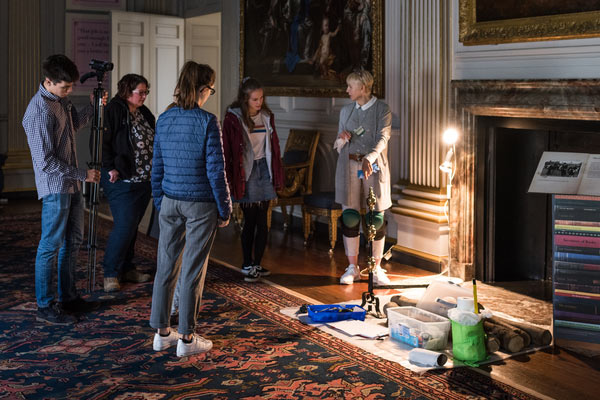
Make use of exceptional facilities and resources. Gain access to the Borthwick Institute for Archives, one of the largest archives in the UK outside London. The city of York also has amazing museums, libraries and archives that cover the modern period.

Collaborate with York’s Centre for Modern Studies. You'll be invited to academic seminars, reading groups and conferences. You'll collaborate with both staff and other postgraduates.

Join a friendly, intellectual community, where teaching is informed by groundbreaking research. Our influential staff feature regularly in the media.

and third nationally for the impact of our research in the Times Higher Education’s ranking of the latest REF results (2021).
Join a faculty full of leading researchers in a range of heritage areas. Make interdisciplinary connections, explore partnerships and become part of a pioneering community.
=12th in the UK
for History, in the QS World University Rankings by Subject, 2026.
When it comes to history, York really is exceptional. If you’re going to undertake an MA, do it somewhere beautiful and do it somewhere that will support you with excellent, engaging teaching. York ticks all of those boxes. It’s a huge privilege to do history surrounded by history, and here that privilege is seen and felt every day.
Grace, postgraduate history student. Read Grace's blog post.

Course content

The course consists of:

  • a core module
  • taught option modules
  • a research training module
  • 14,000 - 16,000-word dissertation

Modules

Core modules:

Option modules:

You will also study three option modules. Examples can be found below. Some option module combinations may not be possible. The options available to you will be confirmed after you begin your course.

Our modules may change to reflect the latest academic thinking and expertise of our staff, and in line with Department/School academic planning.

Dissertation

You will write a dissertation of between 14,000 - 16,000 words on a topic of your choice. Using a variety of source materials and analysis techniques, you will craft the findings into an independently researched dissertation.

You will receive support, advice and guidance from your dissertation supervisor throughout your project. The range of expertise of our staff and of our source materials means we can provide you with guidance on a wide range of topics. 

You will have five one-to-one meetings with your dissertation supervisor across Semester 2 and the summer period (June/July). In these meetings, you will discuss the feasibility of your project and receive feedback on two draft chapters of your dissertation.

Learning outcomes

Every course at York is built on a distinctive set of learning outcomes. These will give you a clear understanding of what you will be able to accomplish at the end of the course and help you explain what you can offer employers. Our academics identify the knowledge, skills, and experiences you'll need upon graduation and then design the course to get you there.

Learning outcomes for this course
  • Deploy an in-depth and comprehensive knowledge of cutting edge scholarship in the field of Modern History, c.1750 to the present day, in order to evaluate dominant themes such as state and nation building, empire, globalization, highlighting continuities as well as key moments of change.
  • Differentiate the perspectives of multiple historical actors, such as social elites and the masses, and assess historical causation by attributing weight to their actions.
  • Demonstrate a high capacity for independent thought and investigation, by taking responsibility for designing and pursuing innovative research questions for essays that deal with important historical topics such as social revolutions and the end of empires.
  • Use conventional historical evidence, such as private and public correspondence, and, where relevant, non-conventional sources such as social memory, visual representation and statistical series to answer novel questions. Also, in the face of chronic uncertainty about the trustworthiness of historical sources, making decisions about how to turn isolated facts into systematic historical evidence to prove conclusively a thesis regarding the making of the modern world.
  • Use advanced manual and digital search techniques and reflect critically on how historians handle the vast residue of information left by past societies in the modern period.
  • Respond responsibly and resourcefully to the ethical and practical issues that arise during advanced historical research, including disciplinary differences between historical methods and those deployed by other scholars and practitioners in academia and beyond.
  • Communicate research findings imaginatively, lucidly and succinctly using a variety of media forms including short reports.

Fees and funding

Annual tuition fees

Study mode UK (home) International and EU
Full-time (1 year) £12,420 £27,840
Part-time (2 years) £6,210 £13,920

Fees are for year one. Fees for future years are subject to confirmation.

Fees information

UK (home) or international fees? The level of fee that you will be asked to pay depends on whether you're classed as a UK (home) or international student. Check your fee status.

Find out more information about tuition fees and how to pay them.

Additional costs

There is no obligation to purchase books or other texts - all core texts and resources will be available in our library or online.

Funding information

Discover your funding options to help with tuition fees and living costs.

We'll confirm more funding opportunities for students joining us in 2027/28 throughout the year.

If you've successfully completed an undergraduate degree at York you could be eligible for a 10% Masters fee discount.

Funding opportunities

Chevening Scholarships

We are pleased to work with Chevening Scholars to offer funding for our Masters programmes. Chevening Scholarships provide one year of fully-funded postgraduate study in the UK for international (including EU) students. The scholarships are open to early and mid-career professionals who have the potential to become future leaders.

Departmental funding opportunities

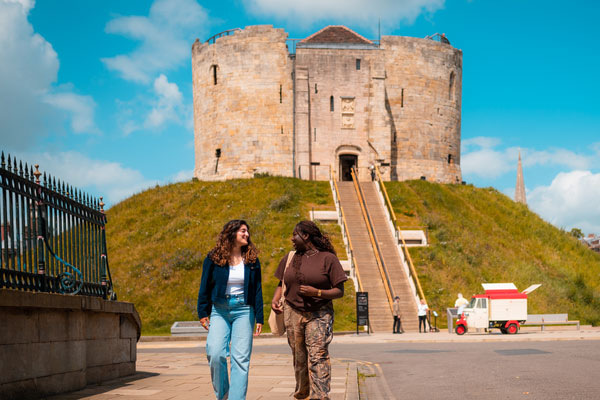
A city rich in history and heritage
York is the ideal place to be inspired to study the past, with a rich and turbulent history stretching back to the Romans. Today the city boasts beautiful historic architecture, as well as a variety of museums, galleries and heritage organisations.
Vibrant city
As well as your department's facilities, you'll have access to the Grade II listed Heslington Hall, a hub with space for events and collaboration.

Teaching and assessment

You’ll work with world‐leading academics who’ll challenge you to think independently and excel in all that you do. Our approach to teaching will provide you with the knowledge, opportunities, and support you need to grow and succeed in a global workplace.

Teaching format

Most of your modules will consist of weekly two-hour seminars. You will normally work in small groups of fewer than 15 students.

Facilities

We are home to the Borthwick Institute for Archives, a major archive repository in Britain. It holds the records of the Archbishopric of York from the early thirteenth century onwards, and specialises in the study of ecclesiastic institutions.

There are several other important archives housed at York, including the JB Morrell Library and the Raymond Burton Library for Humanities Research. These contain collections covering subjects such as the British Civil Wars, French Revolution and Modern Asian history. Find out more about our libraries.

Teaching location

You will be based in the Department of History in Vanbrugh College on Campus West. Most of your teaching will take place in or close to Vanbrugh College.

You will also get the opportunity to visit and be taught at local museums and heritage sites close to the city.

About our campus

Our beautiful green campus offers a student-friendly setting in which to live and study, within easy reach of the action in the city centre. It's easy to get around campus - everything is within walking or pedalling distance, or you can always use the fast and frequent bus service.

Assessment and feedback

You will be primarily assessed by essays and your dissertation. You will have the chance to submit assignments for formative assessment, enabling you to get and use feedback before the final summative assessment. 

Careers and skills

While completing your MA, you will gain essential skills in research, presentation and analysis. These skills are invaluable for progressing to a PhD and for a diverse range of careers.

Career opportunities

  • historian
  • outreach historian
  • teacher
  • heritage trust fundraiser
  • research manager
  • museum education officer
  • museum professional
  • communications officer
  • university lecturer
  • archivist
  • media researcher

Transferable skills

  • analytical thinking
  • formation of original arguments
  • effective time management
  • communication skills
  • efficient organisation, use and management of electronic research resources
  • ability to carry out independent research in primary sources
  • professional presentation skills

Entry requirements

Qualification Typical offer
Undergraduate degree 2:2 or equivalent in History or a relevant subject.
Other qualifications and experience We would consider a 2:2 but our decision would depend on the whole application including the quality of the written work submitted.
Other international qualifications Equivalent qualifications from your country

Additional requirements

You will need to submit examples of written work with your application. Please see our guidance on submitting written work.

English language

If English isn't your first language you may need to provide evidence of your English language ability. We accept the following qualifications:

Qualification Minimum requirement
IELTS (Academic and Indicator) 6.5, minimum 6.0 in each component
Cambridge CEFR B2 First: 176, with 169 in each component
Oxford ELLT 7, minimum of 6 in each component
Oxford Test of English Advanced 136, minimum 126 in each component
Duolingo 120, minimum 105 in all other components
LanguageCert SELT B2 with 33/50 in each component
LanguageCert Academic 70 with a minimum of 65 in each component
Kaplan Test of English Language 478-509, with 444-477 in all other components
Skills for English B2: Merit overall, with Pass with Merit in each component
PTE Academic 60 with 52 in Listening, 53 in Reading, 65 in Speaking, and 59 in Writing
TOEFL 4.5, with 5 in Listening and 4.5 in each other component
Trinity ISE III Merit in all requirements

For more information see our postgraduate English language requirements.

If you haven't met our English language requirements

You may be eligible for one of our pre-sessional English language courses. These courses will provide you with the level of English needed to meet the conditions of your offer.

The length of course you need to take depends on your current English language test scores and how much you need to improve to reach our English language requirements.

After you've accepted your offer to study at York, we'll confirm which pre-sessional course you should apply to via You@York.

Next steps

Discover York

We offer a range of campus accommodation to suit you and your budget, from economy to premium.
Explore campus and city life and hear what our current students have to say about living here.
Lively, full of culture and beautiful, York is regularly voted one of the best places to live and visit in the UK.
Find out more about York. Chat to staff and students and take the tour, on campus or online.