
University Secures Prestigious Breast Cancer Now Grant to Advance Healthcare AI and Robotics
Posted on Wednesday 15 October 2025
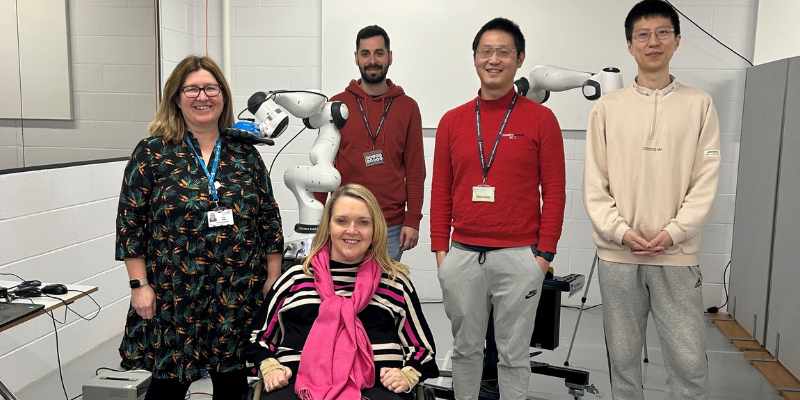
Breast cancer takes a substantial toll on the quality of life, wellbeing and emotional health of many patients, and their families. This significant funding will enable the development of a user-friendly robotic system designed to make breast cancer screening more accessible and inclusive for all women.
Led by Dr. Jihong Zhu, Assistant Professor in robotics at School of Physics, Engineering and Technology, this three-year project is driven by a powerful vision. The idea for this research emerged less than two years ago after a meeting with Dr Bradley who shared the story of one of her patients, Ms Jane Hudson, who was unable to receive a mammogram due to physical disabilities. Jane’s experience highlighted a critical gap in healthcare accessibility in breast cancer diagnosis, particularly for women with physical limitations. This work would not have been possible without her guidance and commitment. The team would like to honour her memory in the light of recent passing.
In a touching gesture that speaks to her spirit, Jane's final wish was to donate the collections from her funeral to the Mammobot project, helping the work she inspired to continue. We are profoundly grateful to Jane and her family for this generous gift, which allows us to honour Jane's legacy by furthering the project she championed. If you want want to know more about ways to support the project, please visit this in-memory crowdfunding page.
Dr. Zhu, as Principal Investigator based at the School of Physics, Engineering and Technology, is spearheading a collaborative effort that brings together a team of experts from the Institute of Safe Autonomy, York Teaching Hospital, and a leading robotics company. Together, they will develop a novel prototype aimed at overcoming the physical barriers that prevent many women from getting a mammogram. This pioneering application of robotics has the potential to transform breast cancer screening, improving both the accuracy and comfort of the procedure for elderly and impaired populations.
Dr Jihong Zhu said:
‘’We are profoundly grateful to Breast Cancer Now for this forward-thinking investment. They understand that to save more lives, we must make early detection more accessible. Our pioneering work in AI and robotics is designed to break down barriers, creating a screening service that is more inclusive. This isn't just technological innovation; it's about building a future where life-saving screening is available to everyone.’’
A core part of the project is a co-design process involving radiologists and patients, ensuring that the final prototype is truly user-friendly and meets the real-world needs of those it is intended to help.
Prof Radu Calinescu from the Institute for Safe Autonomy also shared the multidisciplinary nature of this research:
‘’Our highly interdisciplinary research will leverage our Institute for Safe Autonomy's world-leading expertise and facilities to deliver a transformative embodied-AI solution that will make breast screening more inclusive and accessible, ensuring that advances in AI and robotics truly support and empower people with disabilities. This grant is a validation of the fruitful long-term collaboration between the Institute and medical experts at York and Scarborough Teaching Hospitals.’’
By making early detection more widely available, this research has the potential to lead to better treatment outcomes and save lives.
Dr Roisin Bradley, Consultant Radiologist, York and Scarborough Teaching Hospitals NHS Foundations Trust and Director of Breast Screening for North Yorkshire, added on patient involvement:
‘’From a clinical perspective, the most promising aspect of this technology is its potential to revolutionise accessibility. My team is dedicated to reaching as many people as possible and we know there is a clear gap in provision of breast screening for some physically disabled clients. An effective robotic system could be a game-changer for our service delivery. This generous funding from Breast Cancer Now is an investment in a more equitable future for breast screening, where we can overcome long-standing barriers and make sure everyone can access the care they need.”
Dr Kotryna Temcinaite, senior research and impact communications lead at Breast Cancer Now said:
“We know that breast screening saves lives from breast cancer, so we need to make sure that everyone who needs it can access it. By funding this pioneering research, we hope to make screening more accessible for people with physical disabilities or mobility challenges - whether due to age, injury, or long-term conditions - who currently find it difficult or even impossible to take part.
“We are committed to tackling health inequity through research and exploring how innovation and technologies like AI can help us go further, faster for people affected by breast cancer. We’re excited to fund more research like this in the future that is helping to improve access and reduce inequalities in breast screening.”

For more information about this piece of research, please contact Philanthropy Manager, Audrey Bounaix at audrey.bounaix@york.ac.uk.
Legacy gifts are funding scholarships and supporting life-changing research. For more information or a confidential discussion about leaving a legacy to York, please contact: Maresa Bailey, Legacy Manager by email: maresa.bailey@york.ac.uk or call on +44 (0)1904 328218.