
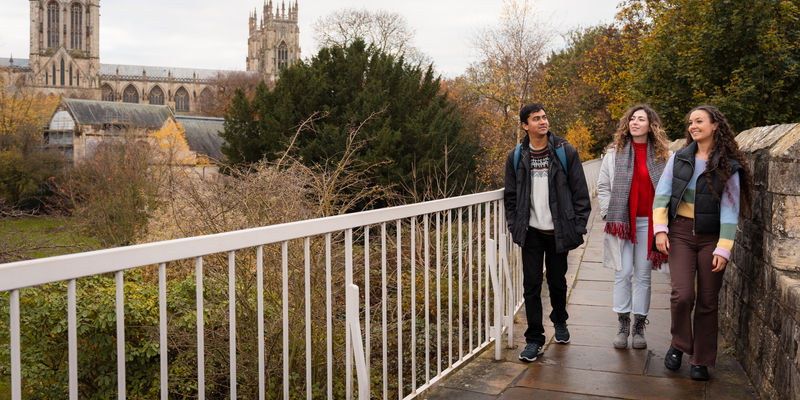
Clinic Based Education at York
Why Clinic Based Education?
The well-established University legal clinic model supports students to develop professional skills, increases confidence and motivation, instils a powerful sense of responsibility and empowerment, and leads to improved interpersonal skills and deeper-learning (e.g. Marson et al., 2016; Unger et al., 2024). This type of action-learning is essential to keep pace with the demand for rapidly changing capacities to tackle 21st century challenges (Fazey, Hughes et al., 2021).
At York we have shown that the legal clinic model can be adapted to other disciplines. Building on the success of our Baroness Hale Legal Clinic, we established a Sustainability Clinic through which students work in multi-disciplinary teams to support community groups, charities, and businesses to achieve their sustainability goals. The community partnership approach built into the Sustainability Clinic was informed by an Office for Students funded project “York Community Projects” in 2020-2022.
The Sustainability Clinic went on to win a 2023 Green Gown award and was 'highly commended' at the 2024 International Green Gown awards, then was part of a 2024 Advance HE CATE award-winning submission. The Green Gown judges commented that the Sustainability Clinic 'serves as an adaptable model for other institutions'.
Areas of Activity
Develop a University of York clinic-based education Good Practice Guide
Drawing on a Spring 2025 institution-wide survey of work-related learning at York, we will: define the types of community engaged learning taking place within curricula at York; conceptualise different approaches to clinic-based education at York and elsewhere; and define how clinic-based education differs to other types of community-engaged learning.
The aim of these activities is to support decision-making about the design of future clinic-based education initiatives at York.
Establish the learning gain associated with clinic-based education
Drawing on the results of pre- and post-module surveys and focus groups, we will seek to: demonstrate that students do perceive learning gain from participation in clinic-based education; identify the nature of the perceived learning gain from participation in clinic-based education; and understand factors perceived to support/hinder learning gain.
Our aim is to understand and learn from students’ perceptions of the learning gained from participation in clinic-based education, to inform the design of current and future clinics.
Establish student perceptions of clinic-based education
Through a survey and focus group with students who have yet to participate in clinic-based learning, we will seek to: understand a priori student perceptions at York of this type of learning; identify potential barriers to participation, to ensure design of clinics is inclusive.
The aim of these activities is to understand and learn from a priori student perceptions of clinic-based education among students, to inform the design of current and future clinics.
Scope potential for one or more new clinic-based education initiatives at York
The aim of this strand is to scope the feasibility of setting up one or more new clinic-based education initiatives in the faculty of Arts and Humanities at York, drawing on the findings of strands A/B/C, and in light of subject-specific industry and societal needs.
Project members
Claire Hughes (Associate Dean for Teaching, Learning and Students, Sciences)
Sam Hellmuth (Associate Dean for Teaching, Learning and Students, Arts and Humanities)
Steve Levett (Sustainability Clinic Director/Baroness Hale Legal Clinic Supervisor, York Law School)
Sarah Rafferty (Community Engaged Learning Manager, Careers and Placements)
Eloísa Monteoliva García (Director of Professional Language Training, Language and Linguistic Science)
Louise Thurston (Associate Director of Careers and Placements)
Research Associates
Salina Cuddy
Jamie Adams