Skip to content Accessibility statement

Paving the way for future railway communications

Working with Hitachi and Network Rail to evaluate Open Radio Access Networks as a viable 5G migration path for UK rail communications.

Project lead: Professor David Grace
Other ISA team members:  Dr Yi Chu, Josh Shackleton, Professor Hamed Ahmadi
Industry partners: Hitachi, Network Rail
Date of the project: March 2025 - October 2026

The issue

UK rail currently relies on the 2G-based Global System for Mobile Communications-Railway (GSM-R) for safety-critical signalling and control. With 2G infrastructure aging and telecommunications rapidly advancing to 5G, the rail industry faces the challenge of migrating to the Future Railway Mobile Communications System (FRMCS), a 5G-based system capable of supporting ultra-reliable, low-latency mission-critical communications. 

The task of migration for the railway is uniquely challenging. Unlike mainstream telecoms, railway equipment has a lifespan of up to 30 years and live operations have to continue uninterrupted. Historically rail communications systems have also been dominated by a small number of vendors.

The research

Funded by Network Rail, Hitachi Rail partnered with researchers at the Institute for Safe Autonomy (ISA) to explore how Open Radio Access Networks (O-RAN) could provide a migration path from GSM-R to FRMCS.  ISA was chosen for its expertise in autonomous connectivity, experience with communications in challenging environments and test-bed facilities. 

Traditionally railway communication systems have relied on bespoke, vertically integrated equipment provided by single vendors. O-RAN, however, disaggregates the system, requiring only limited specialised modules. This opens up the supply chain, offers greater flexibility and cost-savings and enables the integration of specialist hardware better suited to the rail sector.

Having initially worked with Hitachi Rail on a thought leadership article about migration from GSM-R to FRMCS, the ISA team went on to work with Hitachi over 18 months, configuring  an O-RAN testbed to simulate a rail operating scenario. They integrated Hitachi’s multi-bearer gateway and an emergency alarm system, directly into the network. 

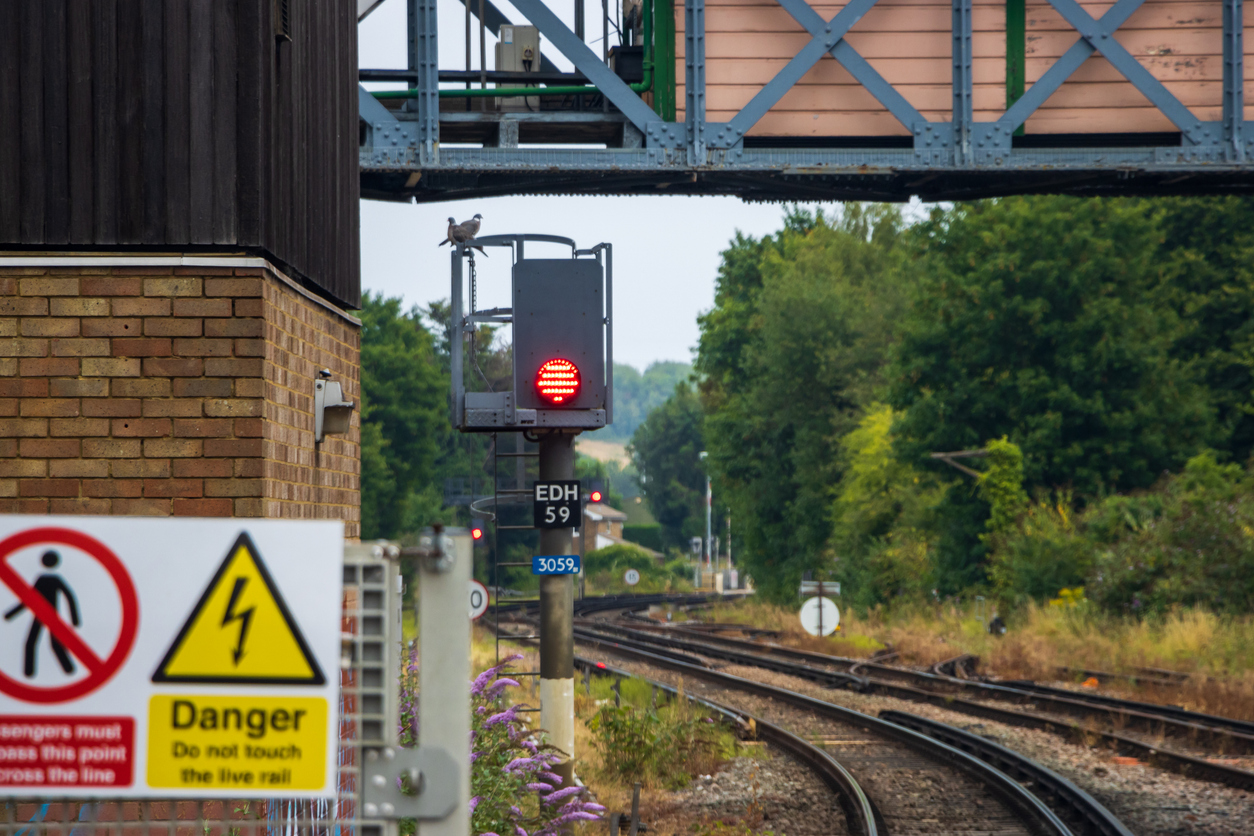
A core requirement for next-generation rail is moving away from traditional trackside signals and other information to digital, in-cab signalling delivered directly to the driver via radio. To ensure uninterrupted connectivity for these critical controls, the system incorporates a multi-bearer gateway capable of drawing on multiple communication channels simultaneously. If one network drops out, another seamlessly takes over without data loss or interruption. This capability also enables a smoother transition, allowing O-RAN to be rolled out gradually alongside active GSM-R infrastructure.

The outcome

In April 2026, ISA researchers carried out the first ever demonstration of O-RAN in a rail context, successfully running Hitachi’s multi-bearer hardware and emergency signalling systems on the testbed. Representatives from Network Rail and The Rail Safety and Standards Board attended the live demonstration.

The successful demo proved the viability of using O-RAN in a rail setting. Following the success of this trial, the team is now exploring plans for a phase two to test the technology in a live train setting. Hitachi and ISA have also gone on to partner together on new projects looking at connectivity on the rail system in Blackpool.

Partnering with the Institute for Safe Autonomy gave us the independent expertise and rigorous testing environment needed to show that O-RAN is a credible technology for future train communications. ISA’s technical insight and collaborative approach were invaluable in proving the core concept and demonstrating that the technology works under test conditions.

Sam Daw, Technical and Assurance Director at Hitachi Rail

Delighted with the positive collaboration with the Institute for Safe Autonomy, looking forward to building upon the joint thought leadership and research activity to help rail infrastructure providers and operators deliver a more resilient, cost efficient railway that meets the expectations of their customers.

David Taylor, Mainline Account Director at Hitachi Rail

Both Hitachi and the Institute for Safe Autonomy are members of Lab of the North, an innovation centre which brings together universities, industry partners and public sector organisations to advance next generation communications across the North of England.

Read Migrating from GSM-R to FRMCS in Great Britain.pdf (PDF , 4,142kb) (originally published in the Institution of Railway Signal Engineering newsletter).