Skip to content Accessibility statement

Cell-free wireless networks for smart port operations

Working with the Port of Tyne to test cell-free wireless technology to provide continuous connectivity for autonomous systems in a port environment.

The issue

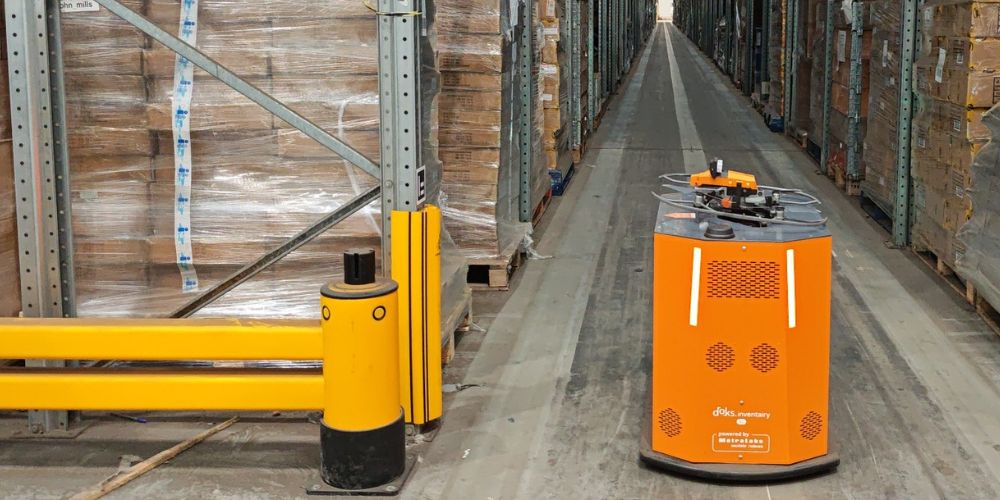
Port of Tyne is introducing increasingly automated and autonomous systems as part of its Smart Port strategy. This creates a need for wireless connectivity that remains reliable as vehicles, robots and other connected equipment move through complex industrial environments. Warehouse 21 presents a particularly challenging wireless environment, with long rack aisles, dense metal structures, pillars and areas where there is no clear line of sight. Conventional wireless networks can experience changes in the serving access point or cell as a device moves through the space, potentially disrupting applications that depend on continuous connectivity. Port of Tyne and ISA collaborated to explore whether emerging wireless architectures could provide a more continuous and resilient connection for these types of autonomous applications.

The relationship between Port of Tyne and ISA began in 2024, when representatives from the Port visited the Institute to discuss potential opportunities for collaboration. Advanced Communication Technologies (ACT) and next-generation communications, including 6G technologies, were identified as an area of mutual interest. 

This led to further discussions and site visits to Port of Tyne to explore potential applications. The Institute for Safe Autonomy (ISA) partnered with Port of Tyne’s automation team, collaborating alongside their primary network providers, BT and Ericsson, to explore next-generation connectivity solutions. 

The research

Researchers designed and installed a cell-free testbed at Warehouse 21 at Port of Tyne. Rather than dividing the warehouse into separate coverage cells, the cell-free architecture coordinates multiple distributed radios as a single network. This means that a device can move through the coverage area without needing to transfer between independent serving cells. This provides built-in network redundancy: if one radio, cable, or power source fails, the connection continues uninterrupted. It also allows autonomous vehicles and drones to move throughout the port space without experiencing traditional cell handovers, preventing the disconnection-related latency and signal drops that cause autonomous machinery to halt.

The outcome

The project delivered a proof-of-concept cell-free wireless network at Port of Tyne, providing an opportunity to test the technology in a challenging industrial environment. The deployment demonstrated how multiple distributed radios could be coordinated as a single network, providing continuous wireless connectivity across the test area without relying on conventional handovers between separate cells.

The work allowed Port of Tyne and the research team to assess the suitability of this approach for future autonomous and connected systems within the port environment, while providing practical experience of deploying and evaluating emerging wireless technologies in an operational setting.

The impact

The work has contributed to the ongoing commercialisation of the technology through Robustient, the University of York spin-out developing cell-free wireless solutions. The collaboration has also generated academic outputs, including a published research paper based on the work, with further papers in development.

The relationship between the University of York, the Institute for Safe Autonomy and Port of Tyne has continued to grow beyond the initial project, with ongoing discussions around potential collaborations and applications of emerging wireless technologies. This continued engagement is helping to identify new opportunities to apply and develop the technology in response to real-world industrial requirements.

“We're hoping that the work we've carried out together will contribute to the smart ports of the future. It’s exciting to collaborate with innovative teams like the researchers at the Institute for Safe Autonomy, pushing the boundaries of what’s possible in maritime and logistics technology. We look forward to exploring the future opportunities this technology could unlock.”

Fergus Watson, Innovations Manager, Port of Tyne

Watch the project in action