
What the Government’s new Class Unit should do with the ‘socio-economic duty’
Posted on Friday 25 September 2026
As part of their call to ‘end class squeamishness’, the Government announced last week they will abolish the longstanding Social Mobility Commission – an independent advisory body that monitors and promotes social mobility – and establish a new dedicated ‘Class Unit’ sitting in the Office for Equality and Opportunity. This brings social class into the same fold as other units on race, women, LGBT+ and disability as part of putting ‘working-class people…at the heart of a renewed government drive to tackle entrenched inequality.’
As is always the case with announcements like these, the details on what this Class Unit will do and how it will do it are yet to be set out and, given primary legislation will be needed to abolish the Social Mobility Commission, it may take some time for these to emerge. But the announcement made a more hard-edged commitment with wide-ranging implications for public bodies across England that may be coming sooner rather than later:
One of the unit’s early priorities will be the introduction of the socio-economic duty – a new power in the Equality Act that will legally require public bodies to consider how to improve the lives of lower-income families as part of decisions around issues like transport, services and budgets.
This ‘new power’ has been lying dormant as Section 1 of the Equality Act 2010 (in England, at least) for 16 years. Originally enacted as a flagship provision in the Act, when Labour lost the 2010 general election the resulting Coalition Government did not commence the duty, with Theresa May MP, the then Minister for Women and Equalities, calling it ‘just another bureaucratic box to be ticked.’ Ever since, there has been a sustained campaign for the duty to be brought into force, culminating in a commitment in the 2024 Labour Manifesto to finally commence it in this Parliament.
The duty holds huge promise for raising the profile of socio-economic inequalities in the decision-making of public bodies such as Local Authorities and Government departments. Our ongoing research – part of a partnership between the University of York and The Equality Trust – identifies three key lessons as we look ahead to commencement.
Firstly, the existing public debate is characterised by wild misunderstandings of what the duty is, what it aims to do and how it works. Our recent discourse analysis of coverage across the media, parliament and by other stakeholders shows the duty being described as everything from ‘a legal duty to reduce inequality’, ‘socialism…made legally enforceable’, and a measure that ‘potentially criminalises inequalities’. A flavour of media headlines is shown in the figure below.
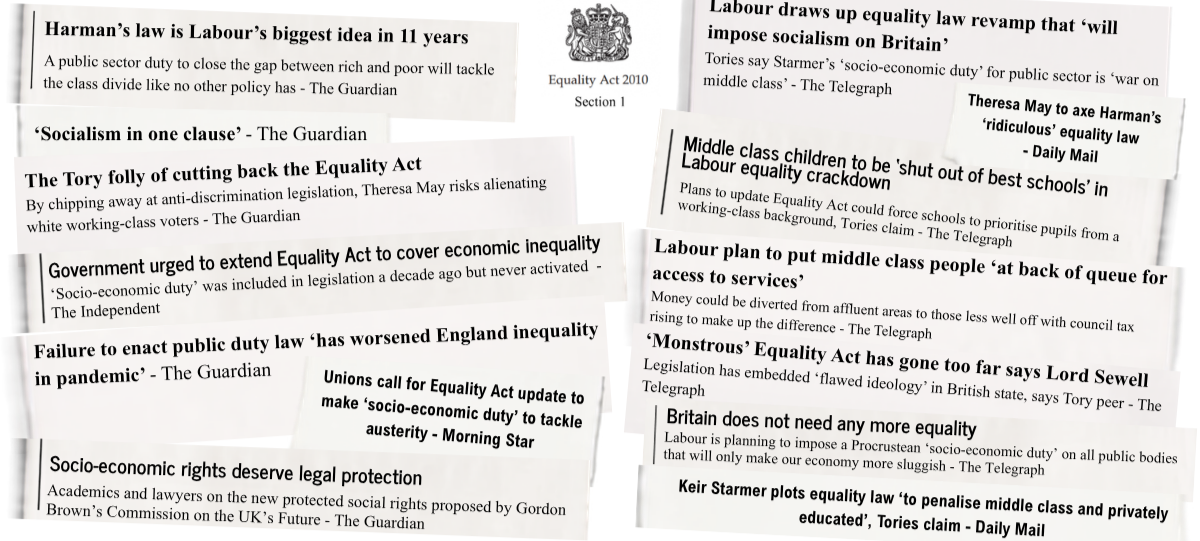 Figure 1: Snapshot of UK newspaper coverage (2009 - 2026) reviewed and categorised using Fairclough's model for critical discourse analysis. Copyright for each segment belongs to the named publications. Reproduced for the purposes of criticism/review and quotation under the Copyright, Designs and Patents Act 1988.
In reality, far from ‘socialism in one clause’ or a ‘war on the middle class’, it is in effect a procedural duty that looks to influence the policy-making process for ‘strategic decisions’ taken by public bodies. It places an obligation on certain public bodies, when taking these kinds of decisions (such as setting budgets or taking key policy decisions) to have due regard to the desirability of reducing the inequalities of outcome which result from socio-economic disadvantage. The public are receiving limited and largely inaccurate information about the duty through the news media and – as we move towards commencement – increasing public understanding of the duty should be a key priority. This is particularly so given the wide-ranging policy debates on these kinds of process-based duties at the moment, including Kemi Badenoch MP’s commitment that any future Conservative Government would abolish the ‘public sector equality duty’.
Second, civil servants think the duty has potential – but that there are challenges to ensuring it achieves change in practice. Based on surveys with nearly 700 public sector workers in England, we found that although awareness of the upcoming duty was very low, a majority were broadly supportive of its introduction. However, two key sentiments were raised time-and-time again across the sample: concerns about a lack of resources available to implement the duty effectively (such as for additional work with affected groups or the data work needed to assess impact), and a call for enforcement to avoid the duty becoming a tick-box exercise and to get buy-in from senior colleagues and other staff across organisations already facing multiple and competing pressures. This enforcement need not take the form of challenging public bodies in court; a recurring theme at the Socio-Economic Rights Conference we ran with Garden Court Chambers on the same week as the Government announcement underscored that the role and capacity of the Equality and Human Rights Commission is likely to be key and they should be supported with resources to promote, support and monitor its implementation.
Finally, there is already impressive work happening across public bodies in England on socio-economic inequalities, often supported by civil society organisations, even without the duty in force. Indeed, dozens of authorities have already voluntarily adopted the socio-economic duty, including by embedding the consideration of socio-economic inequality alongside the impact of policies on protected characteristics, such as ethnicity, sex and age. This integrated approach matters for how commencement is handled as it pulls the socio-economic duty into existing impact assessment processes, helping to both avoid additional bureaucratic hoops for public bodies to jump through and to address some of the longstanding concerns about the intersection between protected characteristics (like disability, sex and race) and socio-economic inequality.
The precise public bodies that fall within the duty’s scope will also be significant in shaping its impact. The original drafting back in 2010 has clearly dated as devolution has moved at pace; mayoral combined authorities do not appear at all given their creation well-after the Act passed. Wales, in specifying its own authorities in 2021, included Local Health Boards, NHS Trusts, fire and rescue authorities and National Park authorities, and Scotland took a similar approach in 2018. For York and North Yorkshire the Combined Authority and the Mayor now take exactly the kinds of strategic decisions on transport and budgets that the Government's announcement describes. For instance, the region is currently piloting rural bus franchising and questions about which services count as socially necessary in communities served by as few as one bus a week are precisely those a socio-economic duty is designed to put in front of decision-makers. This regional tier of Government should be under the duty’s remit on commencement. Further, the equivalent of bodies originally listed in Section 1 but since disbanded or restructured, such as primary care trusts, regional development agencies and police authorities, need to be included. This will enable consistency and maximise the effectiveness of the duty across multi-agency partnerships to tackle complex socio-economic inequalities that various agencies can address, individually and collectively.
As we take our work with the Equality Trust forward, building the evidence base for effective commencement provides an opportunity to bring public bodies (which hold the administrative data), VCSE (Voluntary, Community and Social Enterprise) organisations (who have the relationships with the communities affected) and Universities (who bring research capacity) together to assess and improve the impact of policy choices on people facing socio-economic inequalities. Our next phase of research with the Equality Trust takes up some of these questions, and we would welcome hearing from public bodies and organisations across the region already working on them.