University of York launches Institute for Safe Autonomy
Posted on Tuesday 20 February 2024
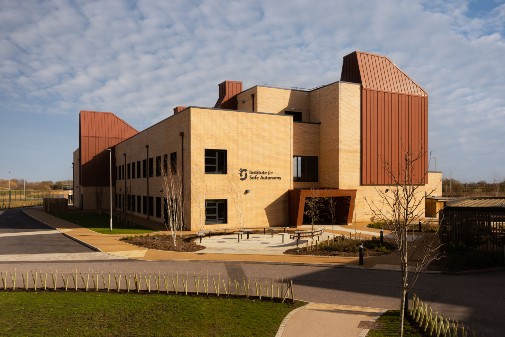
The £45 million facility, the first UK research Institute to focus on the safety of autonomous systems, combines a range of experimental laboratories in robotics, advanced communications and quantum communications.
It aims to provide research that demonstrates how to minimise the risks associated with these technologies, while exploring their potential to deliver impactful solutions for the benefit of society, the economy and the planet.
The building will be officially opened by Dr Ruth Boumphrey, Chief Executive of Lloyd’s Register Foundation, a keystone funding partner aligned to the Assuring Autonomy International Programme, which aims to provide industry, regulators and researchers with guidance in assuring and regulating robotics and autonomous systems.
Safety barriers
Professor Miles Elsden, Director of the Institute for Safe Autonomy, said: “Safety assurance is key to underpinning public trust in these new technologies and is one of the key barriers to the take-up of Autonomous Technology, such as AI, in many sectors.
“To do this right we need to consider a whole range of ethical, legal, regulatory and legislative dimensions as well as risk management and harm minimisation, which are the very areas we are focusing on here at the Institute for Safe Autonomy.
“These technologies are already a big part of our daily lives, whether it's part of your mobile phone, Smart TV, or vacuum cleaner, and yet there is a significant number of people that are wary of their development, and we have to ask why that is and how we can address those concerns by evidencing how safe they are for everyday use.”
Collaborative space
The purpose-built facility provides collaborative work and test spaces for more than 100 researchers across a variety of disciplines, including Computer Science, Engineering, Physics, Law, Management and Philosophy.
Its safety experts work in partnership with academia, industry, government and civil society to research safe, ethical, real-world applications for autonomous systems.
Researchers at the Institute are working on a range of projects, including how robots might be safely integrated into triage procedures in emergency hospital departments; how robots can be used in social care for basic domestic tasks; the safety assurances of beyond-line-of-sight drone use, and the security of long-range underwater quantum communications.
Solar farm
The Institute is also home to a new £1.5m solar farm project, which aims to enable the Institute to become energy self-sufficient by 2025, generating approximately 170 MWh of power annually.
Funded through the UK Research Partnership Investment Fund (UKRPIF) and constructed by Siemens, the solar farm will enhance the Institute’s research capabilities to develop and use autonomous robots and drones to independently inspect and maintain solar arrays .
The Institute will provide work space for small and medium enterprises (SMEs) from both the UK and internationally, operating in the field of autonomous systems.