Researchers to investigate Stone Age settlements preserved under Baltic and North Seas
Posted on Friday 27 October 2023
SUBNORDICA is funded by a European Research Council Synergy Grant and will look to unravel the mysteries of these ancient landscapes, providing invaluable insights into the rich history of human civilization in regions lost to the sea following climate change at the end of the last glaciation.
Radical change
During the past two decades, archaeologists have become increasingly aware that there is a major gap in our understanding of world history. That gap is the 20 million square kilometres of new territory that was exposed for thousands of years around the world when sea levels were around 100 metres lower than at present.
In Europe the extent of the North and Baltic Seas has also changed radically over the past 15,000 years. More than 3 million square kilometres of land was exposed along with coastal plains, lakes, river valleys, shorelines and offshore islands. These provided some of the most attractive land for human settlement anywhere in the continent.
Now lost to the sea following the end of glaciation and global climate change, these landscapes remain almost entirely unexplored. The project begins amid growing concerns for the preservation of these landscapes due to the development of renewable energy infrastructure, such as wind farms, on coastal shelves – a crucial step in meeting net-zero objectives.
Traces
To support ethical development of the seabed and research on the Stone Age landscape and traces of settlements preserved in the North and Baltic Seas, the EU has provided funding of €13.2 million for SUBNORDICA - a research collaboration hosted by Bradford University in collaboration with Moesgaard Museum, Aarhus University and the Lower Saxony Institute for Historical Coastal Research in Wilhelmshaven..
The project team includes researchers from the University of York, the Geological Survey of the Netherlands and the Flanders Marine Institute in Belgium. It will bring together experts in paleoclimate, sea-level change, marine geology, geophysics, computing, and underwater archaeology and will apply the latest technologies to map the seabed and use AI and computer simulation to identify areas where long- lost settlements may still survive and can be explored.
Challenge
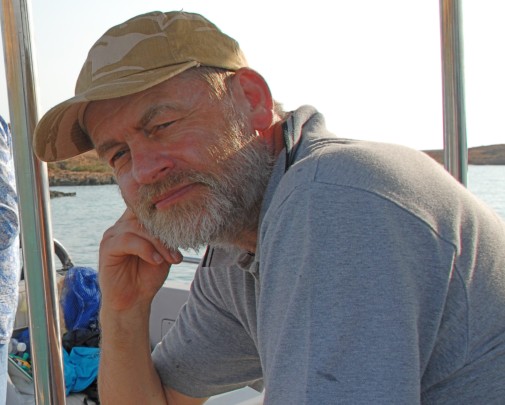
Geoff Bailey, Anniversary Professor of Archaeology (Emeritus) at the University of York, Professor of Archaeology at Flinders University Australia and a member of the SUBNORDICA team, said: “The submerged landscapes of the continental shelf are a major gap in our understanding of human history and their investigation is a world-wide challenge.
“This project will bring together the necessary concentration of resources and expertise to make decisive advances in knowledge, especially in exploring the more deeply submerged landscapes that were drowned by postglacial sea-level rise”.
Professor Bailey has led underwater research on submerged landscapes over the past two decades in the western Mediterranean, the southern Red Sea, Western Australia, Denmark and Britain. He chaired the EU-funded COST Action SPLASHCOS - Submerged Prehistoric Archaeology and Landscapes of the Continental Shelf - a pan-European network which has brought together archaeologists, marine geoscientists, heritage managers and industrial interests from across Europe to promote research collaboration and training in this new field of research, and has helped to lay the groundwork for the SUBNORDICA project.