Neighbourly cooperation can ensure your genes survive, new research finds
Posted on Monday 20 February 2023
The study found that social animals that work closely with their nearest neighbours to repel other groups can maximise the chance of their genes surviving, because those neighbours are likely to carry the same genes too.
The team of UK and US scientists have developed a mathematical model to explain unusual behaviour identified in some ants and primates. Although most species are highly competitive and fight with neighbouring groups, some will work with their neighbours and actively share resources.
Highly agressive
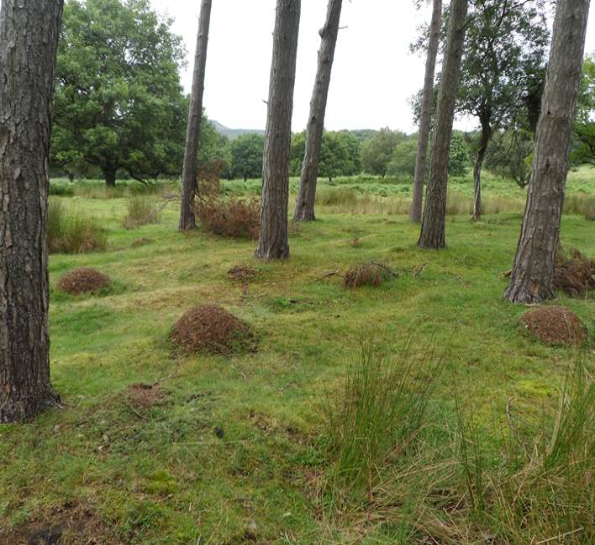
Professor Elva Robinson from the University of York's Department of Biology has seen this phenomenon amongst groups of wood ant nests in Derbyshire, which she has been studying for the last decade.
“Wood ants are known to be highly aggressive, spraying acid if ants from other nests encroach on their territory,” said Professor Robinson. “Yet sometimes multiple nests live peacefully side by side in the same ‘colony’, fighting off outsider ants that come near. The colonies I study have taken this one step further in that they also share food between nests. Some nests gather no food themselves, but rely purely on food supplied by workers from other nests.”
Most primates are aggressively territorial, and only bonobos and humans have been known to share resources in this way. Bonobos will meet neighbouring groups at the boundaries of their territory to exchange high value food such as meat.
Reducing conflict
Professor Robinson worked with colleagues Dr António Rodrigues from Yale University and Dr Jessica Barker from Aarhus University and the University of Alaska Anchorage to try and explain how this level of cooperation could come about and what benefits it might offer to those involved.
They developed the following hypothesis. Firstly, plentiful food means that the group gets bigger but also reduces conflict between its members. When offspring move away to establish satellite groups they don’t move far, in order to remain close to food sources. Kinship and plentiful resources results in little conflict between these different, but related, groups, and makes it in their interest to prevent new groups getting settled nearby. Finally sharing of resources ensures that all the cooperating groups thrive.
To test this hypothesis, Dr Rodrigues created a model that can mathematically quantify the evolutionary consequences of different levels of cooperation. The model allows the researchers to change a number of variables – such as how far offspring move from the parent group – to see how this affects the outcome.
Staying close
Dr Rodrigues said: “It’s not possible to manipulate these variables in the field, so the only way to see if the theory makes sense is to create this kind of model. Using the model, we can also see how groups could benefit from this kind of cooperation, particularly in terms of ensuring the survival of their genes.”
The team found that when offspring stayed close to the main group, it was advantageous to all involved to cooperate and prevent others entering the area. Even if fighting off an aggressor in collaboration with your neighbours resulted in all your own group dying, your genes would still have a higher chance of continuing through your more distant relatives.
Evolutionary advantage
Dr Barker studies human behaviour, but warns against reading too much from the study into levels of cooperation and aggression between human groups. “Our model looks at the evolutionary benefits of behaviour over a long timescale, rather than the decisions we make over shorter timescales to unconsciously maximise such evolutionary advantages,” she said.
“Where the model might have relevance is in trading between early humans, where groups might more readily trade with nearby groups that were related, rather than those where there was no familial connection. That probably would have provided an evolutionary advantage to those families, and still seems likely to us today.”
The research is published in Philosophical Transactions of the Royal Society B.