UK habitats to be impacted by exposure to climate change - but some more than others
Posted on Tuesday 18 July 2023
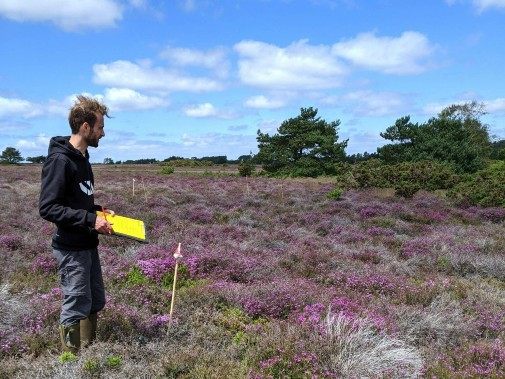
The study in The Journal of Applied Ecology, brings together data on the UK's past and future climate, current land cover, and ecological monitoring sites.
The results show how far human-driven climate change has shifted conditions from their state at the beginning of the 20th Century - and how much more change could be in store over the coming decades.
The research also underlines the value of habitat monitoring initiatives for tracking the impacts of these changes on nature in the UK.
Climate change exposure
The authors say that in each successive multi-year period studied “the UK’s climate change exposure has increased drastically: changes from the last decade to 2021–2040 are predicted to be far larger than those within the 20th Century.”
Human-driven climate change is likely to fall hardest on arable and horticultural land, chalk grasslands, and urban and suburban areas.
According to the findings, chalk grasslands are the most exposed semi-natural habitat (as well as the most exposed of all between 2021–2040 and 2061–2080).
Vulnerability of grasslands
Plantlife is highlighting the value and vulnerability of all grasslands; other research has shown that a staggering 97% of wildflower meadows and 80% of chalk grasslands have been eradicated since the 1940s, and now cover less than 1% of UK land. Of the remaining 3%, 75% exist in small fragments making them especially vulnerable.
The paper shows that climate changes are affecting the UK unevenly: “regionally, it falls more in southern, central and eastern England; locally, it is greater at higher-elevation locations than nearby areas at lower elevations.” In a worst-case scenario for greenhouse gas emissions, much of England could experience Mediterranean-type climatic conditions – with hotter, drier summers – by 2061-2080.
Threat to wild plants
Warming temperatures have seen some wild plant species such as Lizard orchid (Himantoglossum hircinum), Bee orchid (Ophrys apifera) and Pyramidal orchid (Anacamptis pyramidalis) expand northwards in their range.
Some rare arctic-alpine plants including Norwegian Mugwort (Artemisia norvegica), Diapensia (Diapensia lapponica), and Mountain Sandwort (Sabulina rubella) are at risk of going extinct in Britain as uplands become more temperate.
Dr Oliver Wilson, report author, from the University of York's Department of Environment and Geography and Plantlife, said: “In the face of climate change, many plant populations will need to move to survive, but that is made difficult by human activity such as building pressures. Intact habitats and wildlife corridors - from hedgerows to road verges - offer lifelines to climate migrant species so they must be effectively managed.”
Habitat surveillance
Habitat surveillance programmes are crucial for understanding how our habitats and species are responding to their changing conditions. The study examined four of the UK’s world-leading ecological monitoring schemes – the rolling Countryside Survey, the National Plant Monitoring Scheme, the Long-Term Monitoring Network, and the Environmental Change Network – and found that each made important contributions to our understanding.
Dr Oliver Pescott, report author, from the UK Centre for Ecology & Hydrology, said: “Climate change will be one of the biggest drivers of ecological change over the coming decades. Sites that are regularly monitored through schemes like the NPMS give us crucial data on the UK’s changing habitats, and this study’s findings are invaluable for helping us understand how they relate to changes in the wider environment nationwide.”