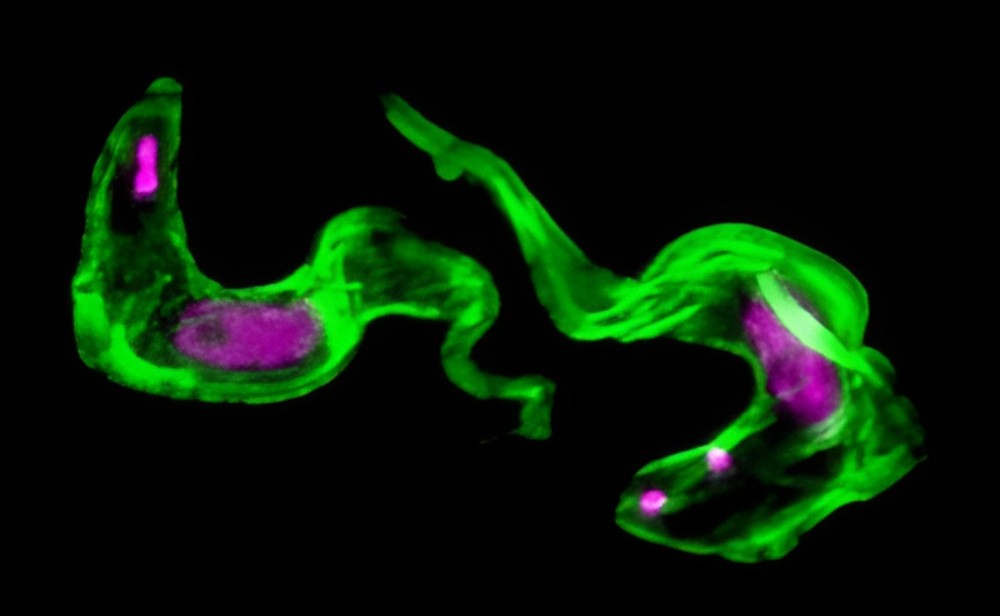
New research could open up a new era of antiviral therapies
Posted on Wednesday 22 December 2021

The new approach utilises our microscopic understanding of how viruses assemble around their genomes.
TIPs
Instead of producing an infectious virion, viruses are misdirected into assembling innocuous versions of the virus that are ‘empty’ of the pathogenic nucleic acid inside. These are known as therapeutic interfering particles, or TIPs.
These ‘empty’ particles still stimulate the immune system like a real virus, and actively undermine the ability of the virus to replicate, but are otherwise harmless. Virally-infected cells are also killed by the immune system.
The study, which is published in Nature’s Scientific Reports, was a collaboration between the Universities of York, York St John and Leeds.
Immune response
Dr Pierre-Philippe Dechant, Senior Lecturer in Mathematical Sciences at York St John University, said: “We can think of this like breaking into a Dalek assembly line and misdirecting the product assembly.
“So we end up with Dalek shells that are empty and don’t house the evil creatures themselves! In fact, the more of these ‘good’ Daleks there are, the more they interfere with the real Daleks.
“As well as disrupting virus production, these fake ‘Daleks’ have the extra power of boosting your immune system. So there is a greater immune response combined with much lower viral load.”
Insights
Professor Reidun Twarock, from the University of York’s Department of Mathematics, added: "We are turning the tables on viruses by using insights into how they assemble to design artificial particles that, akin to a wolf in sheep’s clothing, look like viruses from the outside but are not infectious.
“These particles, called therapeutic interfering particles, compete with viruses for resources, and thus combat viral infections."
This TIP proposal is based on the large body of work by the University of York’s Professor Reidun Twarock and Professor Peter Stockley (University of Leeds) on a detailed mechanistic understanding of how a wide class of viruses assemble.
This includes a range of clinically important viral pathogens. The modelling work here was done as part of research for methods to control Hepatitis C virus infections. The idea is that the TIP design principle can be tailored using the detailed molecular specifics from Professor Twarock and Professor Stockley’s work for different viruses to create bespoke antiviral agents.