
Unravelling the mystery that makes viruses infectious
Posted on Friday 8 January 2021
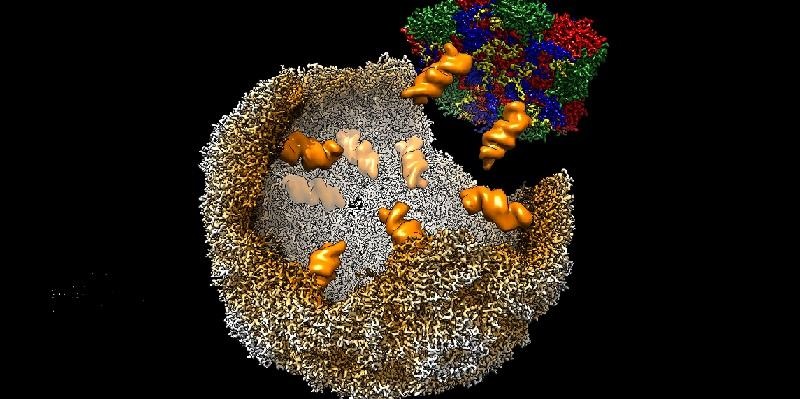
The findings, published in the journal PLOS Pathogens by a team from the Universities of York and Leeds, open up the possibility that drugs or anti-viral agents can be developed that would stop such infections.
Once a cell is infected, a virus needs to spread its genetic material to other cells. This is a complex process involving the creation of what are known as virions - newly -formed infectious copies of the virus. Each virion is a protein shell containing a complete copy of the virus’s genetic code. The virions can then infect other cells and cause disease.
What has been a mystery until now is a detailed understanding of the way the virus assembles these daughter virions.
Drug development
Professor Reidun Twarock, from the University of York’s Department of Mathematics, said: “Understanding in detail how this process works, and the fact that it appears conserved in an entire family of viral pathogens, will enable the pharmaceutical industry to develop anti-viral agents that can block these key interactions and prevent disease.”
The study focuses on a harmless bovine virus that is non-infectious in people, Enterovirus-E, which is the universally adopted surrogate for the poliovirus. The poliovirus is a dangerous virus that infects people, causing polio and is the target of a virus eradication initiative by the World Health Organization.
The enterovirus group also includes the human rhinovirus, which causes the common cold.
Halt infection
Professor Peter Stockley, former Director of the Astbury Centre for Structural Molecular Biology at Leeds, said: “This study is extremely important because of the way it shifts our thinking about how we can control some viral diseases. If we can disrupt the mechanism of virion formation, then there is the potential to stop an infection in its tracks.
“Our analysis suggests that the molecular features that control the process of virion formation are genetically conserved, meaning they do not mutate easily – reducing the risk that the virus could change and make any new drugs ineffective.”
Packaging signals
The study details the role of what are called RNA packaging signals, short regions of the RNA molecule which together with proteins from the virus's casing ensure accurate and efficient formation of an infectious virion.
Using a combination of molecular and mathematical biology, the researchers were able to identify possible sites on the RNA molecule that could act as packaging signals. Using advanced electron microscopes, scientists were able to directly visualise this process - the first time that has been possible with any virus of this type.



.jpg)