New climate projections show an Earth that is alien to humans by 2500
Posted on Friday 1 October 2021
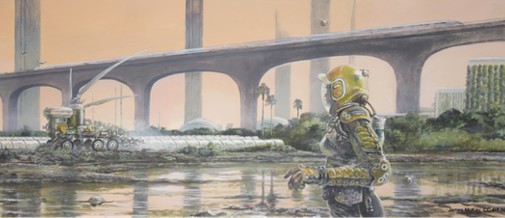
The study, led by researchers at the White Rose universities of York, Leeds and Sheffield, ran different atmospheric concentrations of CO2 through a widely-used climate model to assesses the impact on our planet's climate, ecosystems and food production up to the year 2500.
The research, published in Global Change Biology, also modelled vegetation distribution, heat stress and growing conditions for our current major crop plants, to get a sense of the kind of environmental challenges today’s children and their descendants might have to adapt to from the 22nd century onward.
Beyond 2100
The researchers found that if efforts to combat climate change remain at low or medium levels, global average temperatures will continue to increase beyond 2100. Under those scenarios, vegetation and the best crop-growing areas move towards the poles, and the area suitable for some crops is reduced. Places with long histories of cultural and ecosystem richness, like the Amazon Basin, may become barren.
Further, the study found heat stress may reach fatal levels for humans in tropical regions which are currently highly populated. Such areas might become uninhabitable. Even under high-mitigation scenarios, the researchers found that sea levels will carry on rising due to expanding and mixing water in warming oceans.
Severe consequences
Co-author of the study, Professor Rob Marchant from the Department of Environment and Geography, said: “Although there is plenty of focus on the UN Climate Change Conference (COP26) and decisions that will be taken in Glasgow focusing on de-carbonising economies and supporting adaptation towards 2030 and 2050, it is useful to remember that climate change is not going to stop in the coming decades. We are calling for social political economic systems to be aligned to addressing the challenges, both short and long term.”
The recently published United Nations assessment of Nationally Determined Contributions (NDCs) warns that current promises from governments set us up for a very dangerous 2.7 degrees Celsius warming by 2100: this means unprecedented fires, storms, droughts, floods and heat, and profound land and aquatic ecosystem change that will have severe consequences for people around the world. While most climate models only run up to 2100, the effects of climate change won’t stop then, so we need to project further into the future to better prepare ourselves.
Time to act
Co-author of the study Professor Lindsay Stringer, from the Department of Environment and Geography added: “Our study shows that while some of the impacts of climate change are now inevitable, there is still time for society to act to mitigate against the worst effects.
“If we fail to urgently reduce emissions, planet Earth will become radically different over the next 500 years and beyond. Research needs to look beyond 2100 and better consider these longer-term impacts”