Researchers reconstruct medieval shrine of Saint Thomas Becket
Posted on Tuesday 7 July 2020
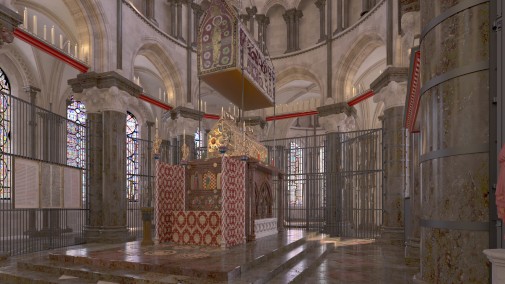
The CGI reconstruction is being released to the public on the 800th anniversary of the construction of the original shrine in Canterbury Cathedral.
The memorial of “unparalleled splendour” was created within Trinity Chapel shortly after Becket’s murder in the cathedral by the knights of his former friend, King Henry II. Thousands of medieval pilgrims seeking miraculous healing flocked to the shrine each year until its destruction in 1538.
Surviving fragments
After many years of debate among historians over how the shrine would have looked, the new, freely-viewable reconstruction uses all the available evidence to establish the most accurate recreation to-date. It is also the first reconstruction to be based upon surviving fragments of the shrine discovered in and around Canterbury Cathedral since the nineteenth century.
Dr John Jenkins, historical researcher on the reconstruction team from the Department of History and the Centre for the Study of Christianity and Culture at the University of York, said: “Our CGI reconstruction uses all currently available evidence to reconstruct how the shrine could have looked. This includes contemporary eye-witness accounts, surviving fragments and information on the materials used and the accessibility and location of the shrine within the church. While there are no exact contemporary comparators, we also looked at the work and style of the shrine’s creators and similar examples of shrines elsewhere.
“Historians have debated whether the fragments found in and around the cathedral came from St Thomas’ shrine, however the trefoil and stiff-leaf decoration on some of the fragments stylistically indicates a common origin, and they are very close in type and quality to the carved capitals of the Trinity Chapel.
“Within the cathedral this marble is only found in the Trinity Chapel, which surely indicates that these fragments come from St Thomas’ shrine rather than any others.”
Thirty years to build
The team’s model is based upon how the shrine would have looked in 1408, a time when it was visited by up to 100,000 pilgrims a year. The researchers believe that the shrine was created between 1180 and 1220, and would have likely taken more than thirty years to build and ornament.
Dr Jenkins added: “We propose the shrine was a collaborative effort, with the marble base initiated and largely finished by William the Englishman and the vast, expensive golden feretory brought to completion only under Elias of Dereham and Walter of Colchester almost four decades later”.
The team’s model includes features not included in previous reconstructions, such as iron grilles. These enclosed the memorial, and would have served to enhance a sense of mystery for visitors to the candle-lit shrine, the researchers say. Offerings in thanks for miraculous cures were attached to the grilles so that the shrine would be seen “through a curtain of proof of Thomas’ power to respond to prayer”.
Valient death
St Thomas Becket was Archbishop of Canterbury and one of the most important figures in medieval Europe at the time of his death. He was believed to have died valiantly as a martyr while defending the rights of the Church. After his death he was quickly honoured as a saint, and was adopted as the patron saint of London, the city of his birth.
Dr Jenkins said: “The murder of Thomas Becket stunned the whole of Christendom. All across Europe he was acclaimed as a martyr. Within ten years of his death over 700 healing miracles had been recorded at his tomb and it rapidly became one of the most important three or four European pilgrimage centres, so it is therefore appropriate that on the 800th anniversary of his shrine we publish our latest findings to explain how new discoveries have helped us create this reconstruction.”
Recreating the past
The reconstruction models were created by the Centre for the Study of Christianity and Culture at the University of York and are published by Taylor & Francis Group. They are free to view via a video.
The reconstruction forms part of a wider three-year AHRC-funded ‘Pilgrimage and England’s Cathedrals: Past and Present’ project. It will be used as a heritage interpretation tool to help visitors to Canterbury and its cathedral go back in time to share the experience of medieval pilgrims, as well as a research tool for academics.
Dr Dee Dyas, Director of the Centre for the Study of Christianity and Culture at the University of York, said: "This is a wonderful example of our team's historical, archaeological, art historical, and digital modelling expertise which enables us to recreate the past in ways which are valuable not only to other researchers but to those who manage historic sites and the millions of visitors who want to explore and experience them. It is a brilliant way for the Arts and Humanities to enhance access to heritage and culture for people of all ages and backgrounds."
Further information
The Centre for the Study of Christianity and Culture works with major heritage institutions across the country to bring their history to life through research-based digital reconstructions of buildings and creative approaches to re-telling the stories of the past. Visit www.york.ac.uk/projects/