Scientists discover rapid sea level rise along the Atlantic coast of North America 300 years ago
Posted on Friday 28 February 2020
The study, led by the University of York, found evidence for a period of enhanced pre-industrial sea-level rise of about two to three millimetres per year in three locations: Nova Scotia, Maine and Connecticut.
The researchers say that the large rises at these three locations were natural, and partly related to the North Atlantic Oscillation – a large-scale atmospheric pressure see-saw over the North Atlantic region – and to periods of enhanced ice melt in the Arctic.
Natural variability
The authors of the study say cities like New York and Boston will have to take into account this natural variability in planning for future sea level rise.
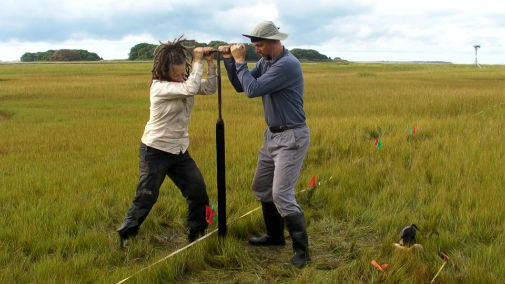
The findings are based on sea level reconstructions derived from salt-marsh sediments from the Atlantic coast and from microscopic salt-marsh fossils.
Previous studies have shown that, since the 1950s, rates of sea level rise along the Atlantic coast of North America were faster than the global average – leading to this region coming to be known as a sea level rise “hotspot.”
However, lead author Prof Roland Gehrels, from the University of York’s Department of Environment and Geography, said this earlier rapid episode of sea level rise in the 18th Century wasn’t known before.
He said: “To find out what global warming is doing to sea levels today we need that base level from historical times.
“In the 20th Century we see rates of up to three or four millimetres per year, faster than in any century in at least the last 3000 years.
“In the 18th Century they were slightly slower, but still much quicker than you would expect for the Little Ice Age, partly because the Arctic was relatively warm during the 18th Century.
“It is pre-industrial so there are no anthropogenic forces - or human influences - at play, but in the 20th Century there may well have been.
“This means that those rapid episodes of sea level rise on the north east coast of North America in the 18th Century have a natural cause.”
Sediment
Scientists say salt-marshes are good “archives” of sea levels as they contain several metres of sediment which contains data going back hundreds of years.
Prof Gehrels added: “The high rates in this “hotspot” could present significant coastal risks for large population centres if they are a persistent and recurring feature.
“The likely future sea level rise in places like New York City is expected to be considerably greater than the global average by the end of the 21st century.”
“Our findings suggest that enhanced rates of sea level rise along eastern North America are not only symptomatic of human activity, but might additionally arise from natural processes in the climate system.”