Tropical forests can handle the heat, up to a point
Posted on Thursday 21 May 2020
The world’s tropical forests store a quarter-century worth of fossil fuel emissions in their trees alone. There are fears that global heating can reduce this store if tree growth reduces or tree death increases, accelerating climate change.
An international research team – including academics from the University of York - measured more than half a million trees in 813 forests across the tropics to assess how much carbon is stored by forests growing under different climatic conditions.
High temperatures
The study reveals that tropical forests continue to store high levels of carbon under high temperatures, showing that in the long run these forests can handle heat up to an estimated threshold of 32 degrees Celsius in daytime temperature.
Yet this positive finding is only possible if forests have time to adapt, they remain intact, and if global heating is strictly limited to avoid pushing global temperatures into conditions beyond the critical threshold.
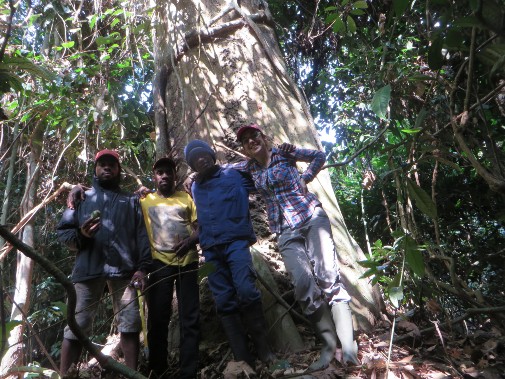
Dr. Aida Cuni-Sanchez, at the Department of Environment and Geography at the University of York sampled trees in the rainforests across five countries in Africa for eight years.
She said: “Monitoring how tropical forests respond to climatic changes is a huge task. In each monitoring plot we identify the species and measure the diameter of each tree and its height, to calculate how much carbon is being stored. Plots are revisited every few years to see how much carbon has been taken in, and how long it has been stored before trees died.”
Carbon
Forests release carbon dioxide into the atmosphere when the amount of carbon gained by tree growth is less than that lost through tree mortality and decay.
Lead author Dr Martin Sullivan, from the University of Leeds and Manchester Metropolitan University, said: “Our analysis reveals that up to a certain point of heating tropical forests are surprisingly resistant to small temperature differences. If we limit climate change they can continue to store a large amount of carbon in a warmer world.
“The 32 degree threshold highlights the critical importance of urgently cutting our emissions to avoid pushing too many forests beyond the safety zone.”
The study is the first to analyse long-term climate sensitivity based on direct observation of whole forests across the topics. The research suggests that over the long-term temperature has the greatest effect on forest carbon stocks by reducing growth, with drought killing trees the second key factor.
Climatic conditions
The researchers conclude that tropical forests have long-term capacity to adapt to some climate change, in part because of their high biodiversity, as tree species better able to tolerate new climatic conditions grow well and replace less well-adapted species, over the long-term.
But maximizing this potential climate resilience depends on keeping forests intact.
The insights into how the world’s tropical forests respond to climate were only possible with decades of careful fieldwork, often in remote locations. The global team of 225 researchers combined forests observations across South America (RAINFOR), Africa (AfriTRON) and Asia (T-FORCES).