Connected forest networks on oil palm plantations key to protecting endangered species
Posted on Tuesday 20 August 2019
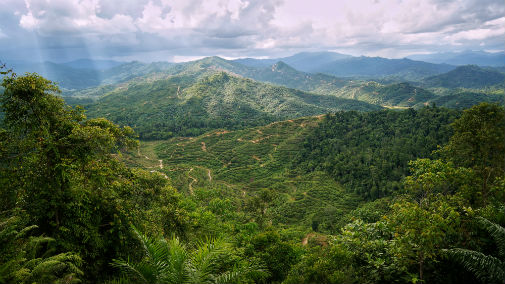
There is growing pressure to reduce the consumption of palm oil due to concerns over deforestation. However, the research team, led by the University of York, says promoting more sustainable palm oil is a better alternative.
For palm oil to be certified as sustainable, the Roundtable on Sustainable Palm Oil (RSPO) requires oil palm growers to identify and conserve areas within a plantation that support high conservation values.
If these patches contain high-quality forest, they may help protect species like orangutans, as well as various species of insects, birds and bats – many of which are threatened with extinction in areas of Indonesia and Malaysia, where 85% of the world’s palm oil is produced.
Climate change
Connections between forest fragments in oil palm plantations to other areas of forest and remaining natural habitat are essential for species to be able to move freely – something that is increasingly important as species face growing pressure to seek out alternative habitat due to continued land-use and climate change.
The researchers suggest that current criteria for the sustainable production of palm oil should incorporate clearer guidance for plantation companies to ensure connectivity between set-aside areas of forest.
Lead author of the research, Dr Sarah Scriven, who is working in Professor Jane Hill’s lab within the Department of Biology at the University of York, said: “Palm is the world’s most-productive major vegetable oil crop and yields six to 10 times as much oil per hectare as crops like soy or rapeseed. Switching to alternative sources of vegetable oil wouldn’t enable producers to provide enough oil for the world’s growing population and has the potential to do even more environmental damage.
Critical importance
“With demand for crop land set to increase, coming up with new ways to conserve biodiversity within agricultural landscapes is of critical importance.”
However, the researchers found that even large areas of set-aside forest provide few benefits to forest species movement if they are isolated from other forested areas in the wider landscape.
In addition, set-aside areas frequently contain degraded forest. If plantation companies were to reforest these patches, the researchers calculate that set-asides within plantations in the lowlands of Borneo would be 16% better connected for forest species.
Dr Scriven added: “There is a pressing need to restore previously forested habitats. Rapid expansion of commodity agriculture has resulted in widespread loss and fragmentation of forest and in many areas of Indonesia and Malaysia, formerly extensive forests now persist as isolated remnants scattered across vast agricultural landscapes.
Reconnecting
“Current RSPO guidelines are not prescriptive about strategies for maximising the connectivity of forest set-asides in oil palm landscapes. We therefore recommend that large, isolated areas of forest should be identified and reconnected with forested areas in the wider landscape.
“Future revisions to the RSPO guidelines should also ensure that plantation companies improve the quality of previously forested set-asides so that they can support high levels of biodiversity and contribute to landscape connectivity.”