
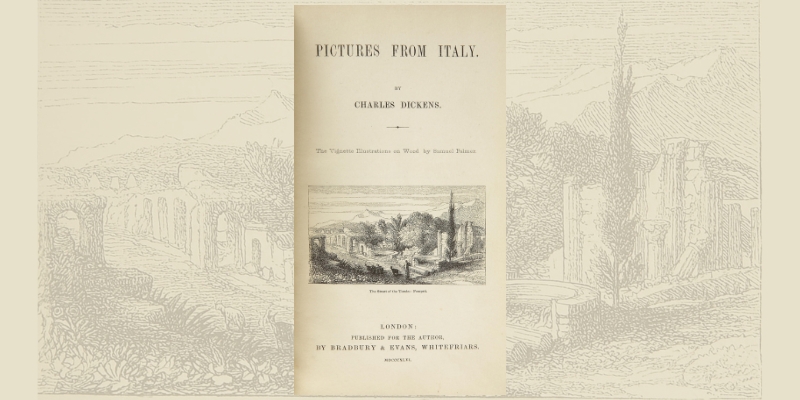
“This strange dream upon the water”: Charles Dickens drowning in Venice
Room P/L/002, School of Physics, Engineering and Technology Building, Campus West, University of York (Map)
Event details
Victorian Expansions: Cross-Cultural Migrations Conference 2026 - Keynote
In Dickens’s “An Italian Dream” (1846), one of the chapters in his travelogue titled Pictures from Italy, the restive traveller uses the noun and verb forms of ‘dream’ in a variety of ways, some of which contradict each other. The sensory overload of an “unbroken succession of novelties” is comparable, he says, to the recall of half-formed dreams. In a pattern we see repeated in several works of nineteenth-century fiction and poetry, dreaming is not only related to movement and travel but depicted as dynamic itself: the black boat, which the author boards after the coach ride, marks a “dreamy kind of track” towards the mysteriou lights shining like tapers on the dark waves. This talk uses “the Dream” to examine fugue states, or states between sleep and wakefulness, active aesthetic reception and passive sufferance, as explored in Dickens’s works. The “Italian Dream” is an act of moving closer to “the heart of this strange place”: it is also the strange place itself, Venice, a bulwark of the majesty and magnificence of the European civilisation, which is also, from some angles, “gorgeous in the wild luxuriant fancies of the East.” Venice is described as “this strange Dream upon the water,” a dream of death by drowning. Dickens presciently warns readers against the Anthropocene, when water will eventually subsume the solid realities of the old city.

About the speaker
Ankhi Mukherjee is Professor of English and World Literatures at the University of Oxford and a Fellow of Wadham College. Her most recent book, Unseen City: The Psychic Lives of
the Urban Poor (Cambridge University Press, 2021), has won Columbia University's Robert S. Liebert Award for "outstanding scholarship in the field of applied psychoanalysis".
Mukherjee's second monograph, What Is a Classic? Postcolonial Rewriting and Invention of the Canon (Stanford UP, 2014), was awarded the British Academy Prize in English Literature. Her other publications include Aesthetic Hysteria: The Great Neurosis in Victorian Melodrama and Contemporary Fiction (Routledge, 2007), and the collections of essays she has edited, namely A Concise Companion to Psychoanalysis, Literature, and Culture (with Laura Marcus, Wiley-Blackwell, 2015), After Lacan (Cambridge University Press, 2018), and Decolonizing the English Literary Curriculum (with Ato Quayson, Cambridge UP, 2023).
Mukherjee has published in competitive peer-reviewed journals and sits on the editorial boards of several international journals. She has been a postdoctoral research fellow of the British Academy (2003-2006), a visiting fellow at the Humanities Research Centre at the Australian National University (2015), and the John Hinkley (Visiting) Professor at Johns Hopkins University (2019). She was invited faculty at Harvard University's Institute for World Literature (IWL) in summer 2023 and 2024, and will be returning to teach for IWL at this year's host institution, Humboldt University of Berlin. At present, Mukherjee has two books under contract. She is working on A Very Short Introduction to Postcolonial Literature in the widely circulated VSI series (Oxford UP) and her fourth monograph, Mavericks and Charlatans: Empire, Modernity, and the Authorization of Dreams (Princeton UP).
Venue details
Wheelchair accessible
Hearing loop