
The Creaturely Camera: Animals in Early British Photography
This event has now finished.
Room V/N/123, Vanbrugh College, Campus West, University of York (Map)
Event details
History of Art Research Seminar
The Victorian and Edwardian periods marked a significant juncture in the representation of nonhuman life. Not only did urbanisation, colonialism, and evolutionary theory radically alter the way that other animals were understood, but photography offered new means of representing and categorising animals. However, while isolated accounts of early animal photographers have been published, the field lacks a comprehensive review of this popular arm of Victorian and Edwardian visual culture. This talk explores how photographers’ experiments with nonhuman subjects and substances was fundamental to the medium’s burgeoning popularity. Rosalind argues that our contemporary anthropocentric relationship with other species found popular expression for the first time in the nineteenth and early twentieth centuries, a recognition which poses urgent questions about how and why these animals came to represent humans’ modern relationship with nature. Through a focus on process as well as subject, this talk suggests that technological innovation within photographic history was precipitated—and occasionally complicated—by the incorporation of animals as both sitters and substance.
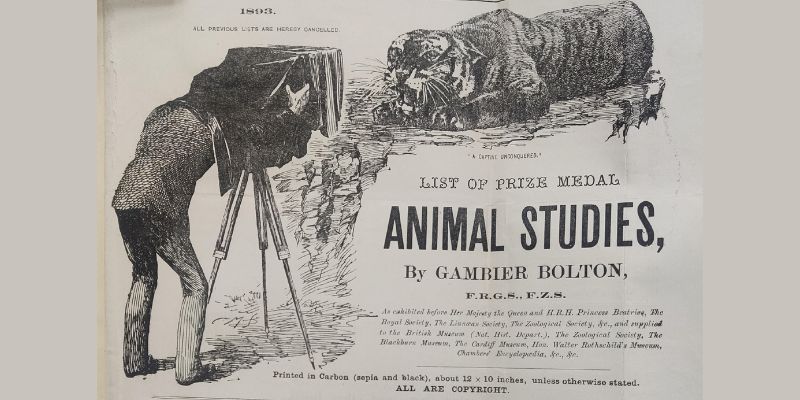
Image: Detail of a promotional flyer for Gambier Bolton's List of Prize Medal Animal Studies, 1893.
About the speaker
Dr Rosalind Hayes is Career Development Fellow in Visual Studies at the University of Durham, UK, specialising in nineteenth-century British art history. Her research interests span animal studies, meat-eating, British imperial history, and art’s animal materialities. She is currently working on a monograph provisionally titled The Creaturely Camera. A book chapter titled ‘Photography Needs Animals: Materials, Processes and Colonial Supply Chains of Gelatine Dry Plates’ was published in Animal Modernities (ed. Katie Hornstein and Daniel Harkett) in 2025. She was a Postdoctoral Fellow at the Paul Mellon Centre for Studies in British Art (2023-24).
Venue details
Wheelchair accessible
Hearing loop