
Place-name study helps protect ancient woodlands
Posted on Friday 9 October 2026
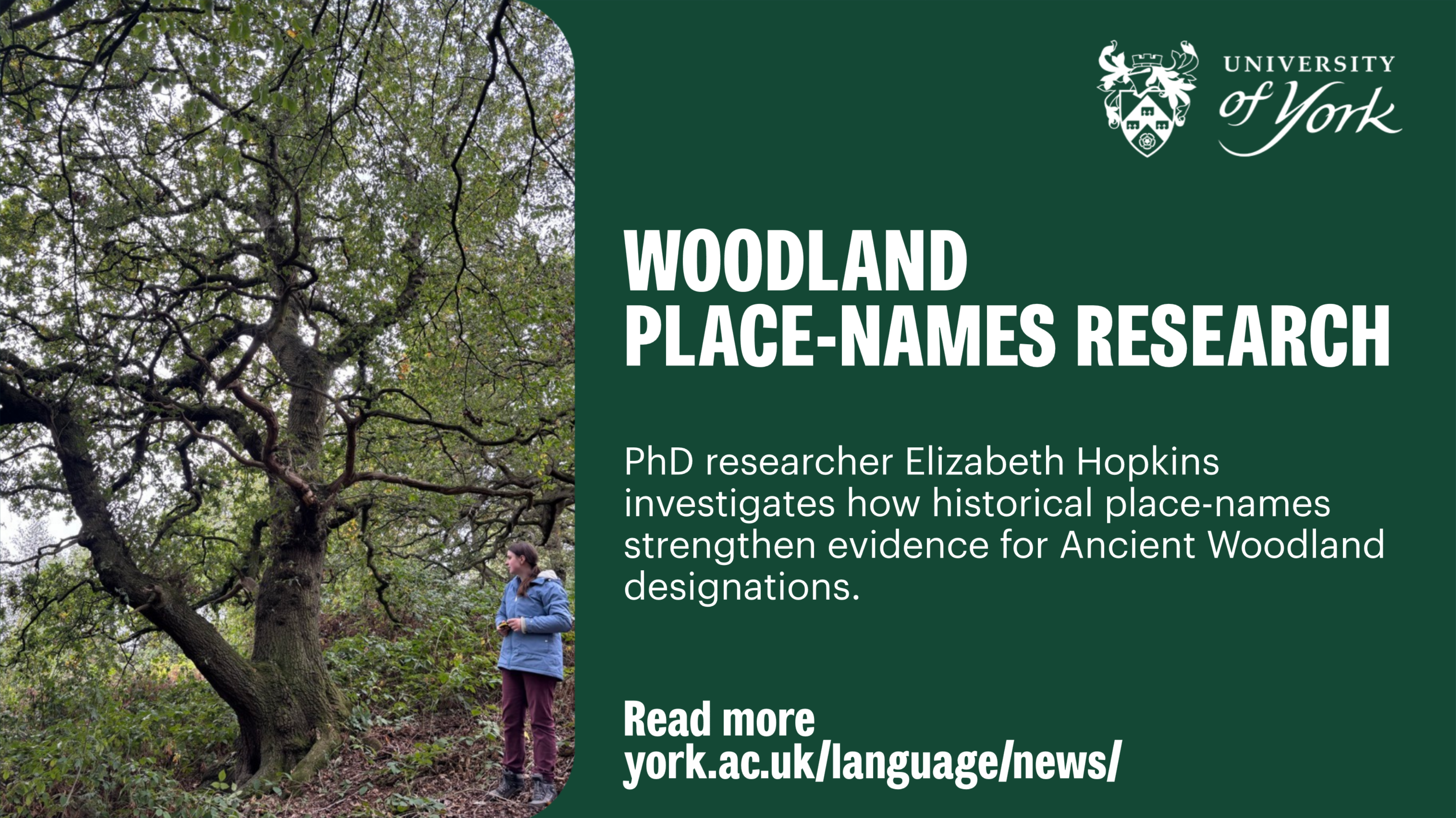
PhD researcher Elizabeth Hopkins from the Department of Language and Linguistic Science has completed a placement exploring how place-name research can strengthen environmental protection. Working with the North and East Yorkshire Ecological Data Centre (NEYEDC), the project investigated how historical linguistic evidence helps identify and protect Ancient Woodland sites.
The placement was funded by the Arts and Humanities Research Council through the White Rose College of the Arts and Humanities (WRoCAH). During the project, Hopkins, who is supervised by Dr Ellie Rye and Dr Claire Childs, examined local field-names and historical charters to support environmental decision making across North and East Yorkshire.
To conclude the placement, Hopkins joined the NEYEDC team for fieldwork at Brayton Barff woodland near Selby. The woodland appears in a 1316 Selby Abbey charter as le Bergh, derived from the Old English word beorg, meaning hill, which evolved into the local dialect word Barff.
Hopkins has shared her methodology and findings in two public blog posts published on the NEYEDC website.
"In a charter from Selby Abbey from 1316, it's recorded as in quodam bosco de Brayton qui vocatur le Bergh," said Hopkins. "Berg, which becomes dialectal Barff, is from Old English beorg, meaning hill."
Read the first blog post on woodland place-names on the NEYEDC website: https://www.neyedc.org.uk/updates-insights/2026/9/15/woodland-place-names-how-do-they-work
Read the second blog post on place-names and the Ancient Woodland Inventory on the NEYEDC website: https://www.neyedc.org.uk/updates-insights/2026/9/25/woodland-place-names-and-the-ancient-woodland-inventory