
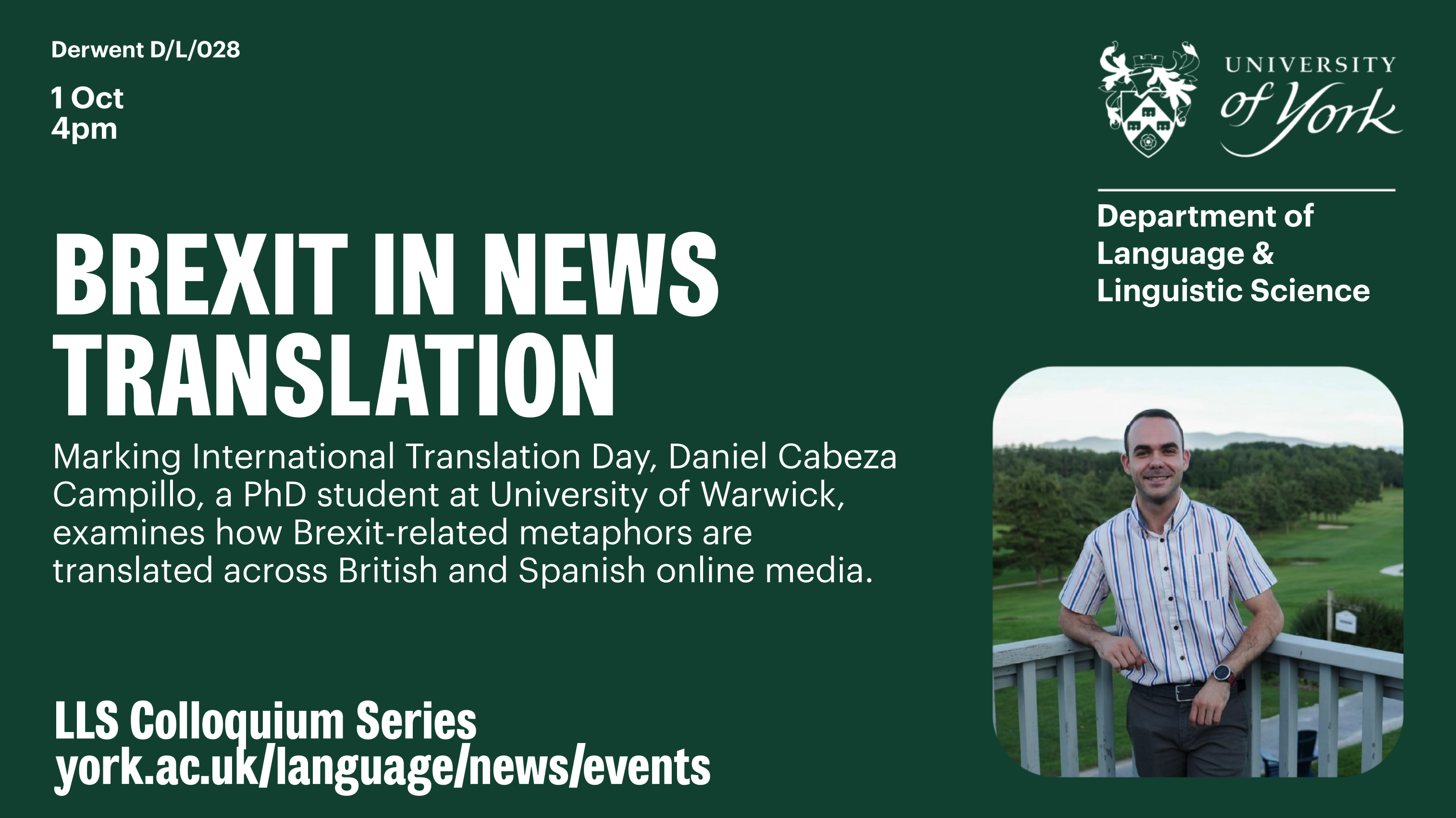
Colloquium talk: Daniel Cabeza Campillo – Brexit in News Translation: Critical Metaphor Analysis in British and Spanish Online Media
Event details
Abstract:
This paper examines the translation of Brexit-related conceptual metaphors in media discourse, drawing on a bilingual corpus of 240 news article pairs (i.e., 480 news articles in total) published in six media outlets in English and Spanish between 2016 and 2022: BBC News and BBC News Mundo; The Guardian and elDiario.es; and El País and El País English Edition. Conceptual metaphors are part of our everyday language because thought itself is fundamentally metaphorical in nature, and we use them effortlessly and unconsciously to understand and describe the world around us (Lakoff and Johnson 1980/2003). In discourse, metaphorical linguistic expressions can hold significant persuasive power, generating empathy and framing socially shared perspectives (Charteris-Black 2018; 2019). Within the realm of media discourse on Brexit, various metaphorical expressions pertaining to divorce, war and poison have been used to depict both the Leave and Remain campaigns. These expressions have contributed to the construction of narratives rooted in a sense of humiliation and cultural trauma (Toomey and Shepherd 2023) amongst pro-Brexit members, and existential anxiety and ontological (in)security (Browning 2018) amongst pro-Remain members. For example, the views of pro-Brexit supporters have been summarised as follows: “The [Leave] campaign believes its only chance of victory lies in voters, their pencils hovering over their ballot papers in the privacy of their polling booth, having fear of foreigners at the forefront of their minds” (Jones 2016). From a pro-Remain perspective, it has been claimed that “Britain would be ‘killed’ in trade talks if it left the EU” (Watt 2016) and that “British exit would be ‘poison’” (Syal 2016). Through data triangulation, this paper identifies the most frequent translation procedures used for each type of Brexit-related conceptual metaphor and offers a critical analysis of their cognitive and persuasive functions. By combining approaches from disciplines such as News Translation Studies, Conceptual Metaphor Theory and Critical Metaphor Analysis, this paper seeks to elucidate the pivotal role of translation as a conduit for thought representation, which can either circulate or resist ideological narratives surrounding Brexit.

Daniel Cabeza Campillo (University of Warwick)
https://warwick.ac.uk/fac/arts/modernlanguages/academic/postgraduate/cabezacampillo/