
A Sheep, a Sheaf and a Fistful of Sticks: The Perks of Serfdom; Gender-related Issues in Uroscopy in Medieval and Early Modern England, c. 1320-1575
Event details
Join us for research seminars hosted by the Department of History with a selection of visiting academics, alongside University of York researchers. All students and staff are very welcome.
A zoom link will be made available for distance learning PhD students on request. Please contact Dr Jasper Heinzen or Dr Stephanie Mawson if you have any questions. View the full schedule for the semester.
Speakers: Jenni Lane; Veronika Lahodinski
Abstract: A Sheep, a Sheaf and a Fistful of Sticks: The Perks of Serfdom
Jenni Lane
Perquisites were rewards and allowances awarded to manorial tenants in return for the completion of customary agricultural services. They were, as the name suggests, the ‘perks of the job’ and ranged from meals, foodstuffs, animals, raw resources, fodder and money. Most were a straightforward exchange of goods between lord and tenant, while others took the form of a performative game or competition. Given their prevalence in manorial custumals, the almost total absence of perquisites from scholarly discourse of late medieval serfdom requires redress. Employing new evidence gleaned from a corpus of over 150 custumals between 1200 and 1350, this paper identifies the various categories of perquisites and the customary services most commonly associated with them. As codified statements of the lord’s financial liabilities to tenants, perquisites reveal a two-way flow of obligation in what has traditionally been understood as a largely one-way exchange from tenant to lord. The reciprocity and exchange represented by perquisites have, therefore, great potential to nuance our understanding of the fundamental aspects of lord-tenant relationships and the nature of serfdom. As such, they symbolise far more than just a perk of the job.
Abstract: Gender-related Issues in Uroscopy in Medieval and Early Modern England, c. 1320-1575
Veronika Lahodinski
Here begynneth the seynge of urynes […], first published anonymously in 1525, was a frequently reprinted English-language book which focused almost entirely on uroscopy. It could be described as a repackaged version of medieval manuscripts such as The Dome of Uryne or the British Library Sloane MS 382 manuscript. This includes the reiteration of those sections and passages which dealt with specific gender-related issues such as the diagnosis of pregnancy or the biological sex of the embryo via uroscopy, as well as the question as to whether a particular urine sample stemmed from a male or a female person, and aspects relating to female sexuality. The iudycyall of vryns […], a newly composed text published anonymously in 1527, drew on components of earlier manuscripts and adapted the relevant parts of the book.
Annotations show that the above stated uroscopy-related topics attracted the readers’ attention the most. This suggests that the likely audience of these works were medical professionals and that the new medium of print played a significant part in the transfer of gender-specific uroscopic knowledge. Furthermore, it indicates that the authors of 16th-century printed uroscopy books were successful in their attempts to establish the authority of their texts.
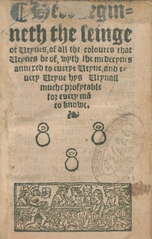
Image: Seinge of urynes -National library of medicine digital collections