
Is surveillance in Sub-Saharan Africa the key to the future of COVID preparedness?
The emergence of Omicron in Sub-Saharan Africa was no surprise to our expert epidemiologist living and working in Uganda, Professor Rob Newton. It made perfect sense. The population is largely unvaccinated and has the highest proportion of HIV-infected, immuno-suppressed people in the world. This scenario provides the perfect incubator for new variants of SARS-CoV-2, because the virus can thrive, mutating unchecked and with little resistance. Furthermore, despite the valiant efforts of scientists working in South Africa, who revealed Omicron to the world, there is precious little surveillance on the continent. This means a new variant can be widespread before anyone notices.
The emergence of Omicron
Currently, one of the most credible scenarios is that Omicron came from an immune-suppressed individual. This would account for its rapid evolution from the original form of SARS-CoV-2 into the current form, which contains many mutations, some of which make it highly transmissible. The lack of monitoring of COVID means that we can’t yet pinpoint the precise origins of the Omicron variant. It was first detected in South Africa but it may have been circulating in other countries before that. This is a problem that Rob Newton wants to solve, “monitoring of COVID and indeed, of other diseases, is a vital step in preventing their spread”.
Efficient surveillance model
Rob works with an established team at the Uganda Virus Research Institute. With funding from the UK Medical Research Council and others, including the University of York, they have created a beacon of good practice for COVID monitoring in East Africa, providing vital information on the spread of SARS-CoV-2, direct to the Ugandan Ministry of Health, thereby allowing real data to inform rapid policy change. It is an efficient model that could be used across the continent to improve surveillance, in our efforts to get the upper hand with emerging variants. “We all need to become more informed so that we can react quickly and appropriately to emerging threats.” says Rob.
In future, if annual vaccine boosters are required (each being tailored to target new circulating variants), better infrastructure in high-risk populations, such as those in sub-Saharan Africa, is needed. Of course, improved vaccine delivery to the continent would substantially decrease the risk of such situations arising.
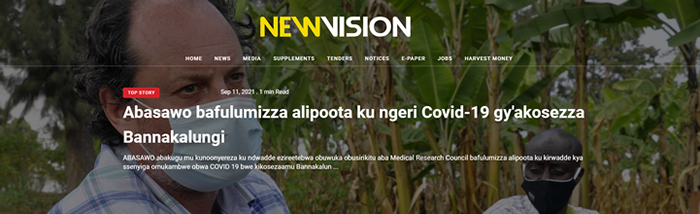
The team's engagement work with local communities on the covid-19 situation was featured on the front page of "New Vision" one of Uganda's national newspapers.
Rob’s team works in a centre of excellence for research in East Africa with a well-established multi-disciplinary group of researchers. They have all the skills necessary to identify and study pandemics, including epidemiology, statistics, social science, immunology, virology and bioinformatics. The team has strong collaborative links with the Ugandan Ministry of Health and local academic institutions, which have been built over 30 years. The Centre is led by an eminent Ugandan virologist and is funded, in large part, by the UK Medical Research Council in conjunction with the London School of Hygiene and Tropical Medicine.
Funding need
Much more funding is needed in Sub-Saharan Africa as a whole, to foster local capacity for disease surveillance and prevention. Indeed, such capacity building is at the heart of Rob’s work in Uganda. Unfortunately, the pandemic happened just at the time when UK funding for such initiatives, for example by the now defunct Department for International Development (DfID) and the Overseas Development Aid (ODA) budget, disappeared.
“The world needs to pay attention to Sub-Saharan Africa and do more to look out for the next wave of COVID. It is a matter of urgency that this funding is forthcoming” says Rob.