
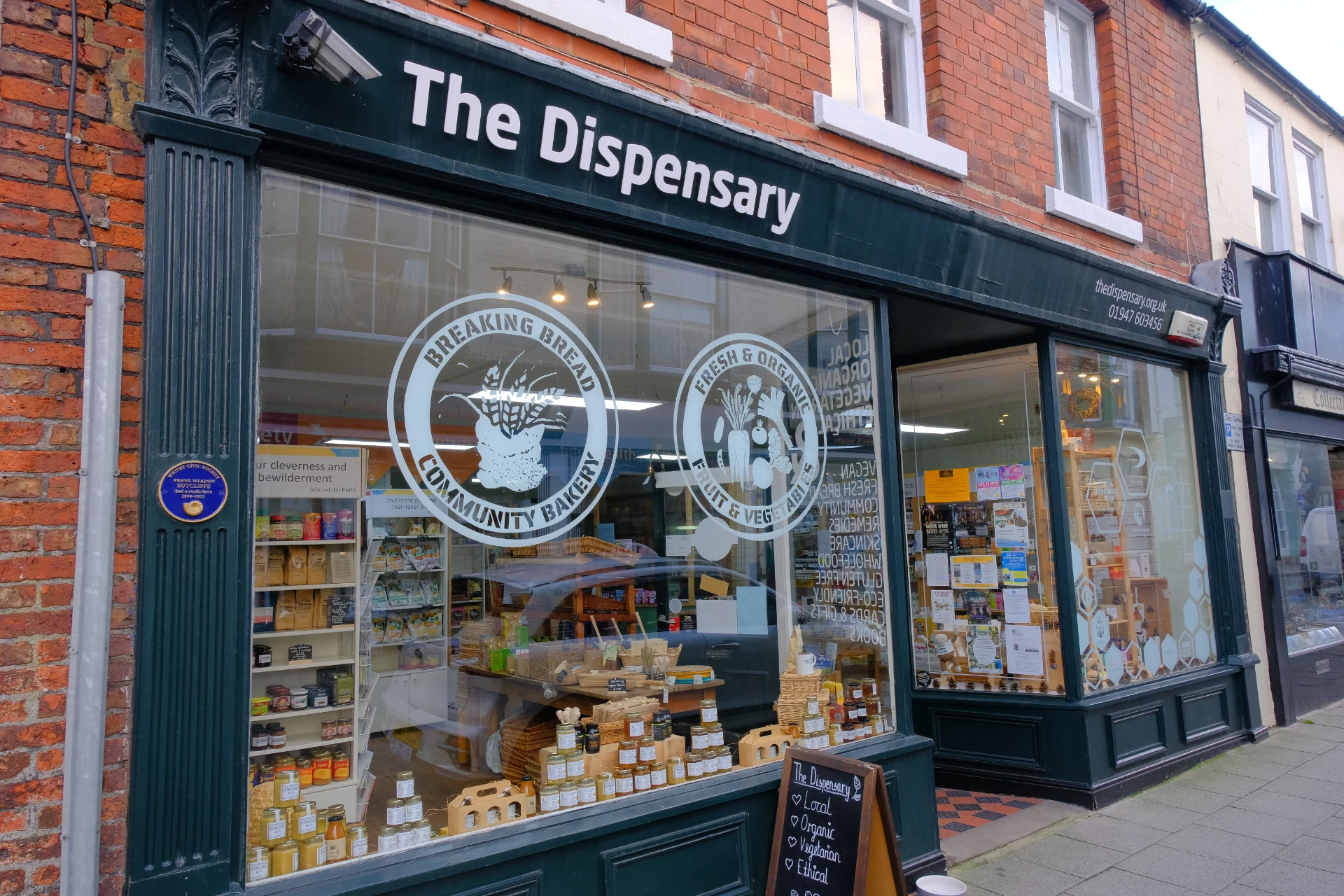
The Dispensary might first appear to be a humble health food shop in Whitby - but behind its doors lies a community health initiative and a living experiment in what it means to do business with purpose. We spoke to Founder James Fearnley, who has spent over 50 years looking at what ‘meaningful’ means and has created more than 20 social, cultural or economic initiatives.
How One Social Enterprise Is Building an Ecosystem for Wellbeing
One of the first things James Fearnley mentions is that it is difficult to talk about The Dispensary as a standalone initiative. It’s one thread in a broader vision for how business, community and meaning can work together.
Part of Common Cause, a not-for-profit Community Interest Company, it is funded largely through his corporate enterprise, Whitby-based Nature’s Laboratory, which researches and manufactures herbal and bee-based medicines. The Dispensary also exists alongside a third initiative, the Bee Arc, a not-for-profit education, research and community centre currently in development.
"The bee is not a metaphor. It’s a model," he explains. "A hive may have 70,000 bees, but it functions as a single organism.”
Where it all began
A former revolutionary student in 1968, he has spent the past six decades living and building according to values that often sat outside the mainstream. From self-sufficiency in the countryside to co-creating ethical business networks, he has always asked a different question of enterprise - what if the real currency of business is relationship, not revenue?
As CEO of Nature’s Laboratory, he promotes what he feels is the need for more sustainable three-dimensional businesses, which balance their economic life with their social and community life and their cultural and spiritual life.
"I set it up as an aspiration," he says. That aspiration has since grown into an 8,000-square-foot facility producing both plant and bee-based medicines and employing 20 people.
The Roots of Meaningful Practice
"If you get the message that things have to be different, then you have to make them different," he says.
This means creating relationships across every layer of the business. Suppliers aren't just suppliers and customers aren't just revenue streams. Herbal practitioners are partners in a shared field. The company funds PhDs (and those students later become employees). It organises international research conferences and founded the International Propolis Research Group.
"Our strategies aren’t linear. They evolve out of people’s sense of purpose," he says. For instance, when developing the latest business strategy, each director presented their biography and vision for their role. "We’re trying to build something coherent out of the reality and talents of those who come together."
Real Living Wage
Of course, it hasn't been easy. Balancing the aspirations of meaningfulness with the realities of payroll, pricing and operations is an ongoing challenge.
"We pay the Real Living Wage. It's a start, but it's not enough," he says. "Ideally, we’d pay people according to need, but we’re not there yet."
Enterprise as a Community Immune System
Out of this approach grew The Dispensary. It began as a kind of outreach from the corporate business but has since taken on a life of its own.
"Just like a human being has a nervous, respiratory and metabolic system, organisations and communities also need balance between their economic, social and cultural health, he explains. “And during COVID, it was one of the only places open in town. It became a place not just for food, but for contact."
The Dispensary shop offers a wide range of locally sourced organic and vegan products. Medicines from the beehive, fruit and vegetables, sourdough bread, natural skincare products, locally roasted coffee, cards, books and crafts by local artisans and authors.
“These and other suppliers are carefully chosen for the quality of their products and their ethical credentials.”
They also have an in-house library, organise health and wellbeing events and workshops and are committed to animal welfare work.
“This includes our local Compassion In World Farming Group, campaigning for an end to factory farming and the long-distance transport of live animals. It also includes our work with Crustacean Compassion to bring about humane treatment for crustaceans including crabs and lobsters, many of which currently suffer greatly during cruel handling and slaughtering procedures.
"People used to say this approach would never work. But we’re 12 years in, and we’re approaching self-sufficiency."
Backing Purpose with Profit
Unlike many social enterprises, The Dispensary hasn’t relied on external grants, being almost entirely funded by the corporate business, but it’s not without tension.
"Of course it causes strain. When you're struggling to pay wages, it can feel like a luxury to fund a cause. But it's not. It's part of who we are."
He likens it to parenting - the goal is for the social enterprise to stand alone, but it needed nurturing first. Now, with a core team and growing community, it’s beginning to walk on its own.
Measuring What Matters
Traditional metrics of social impact don’t fit easily here.
"We’re not setting up projects for specific outcomes. We’re building resilience. That’s hard to measure."
Still, some tangible indicators exist. The Dispensary gives members 5% of their purchases back via a dividend scheme. There are over 2,000 members. But more than that, there's a shift in expectation.
"We don’t mark prices up then offer discounts. We charge the RRP and give 5% back. Slowly, people are starting to realise we’re not here to take from you. We’re here to build with you."
Meaning is a Living Thing
His ideas, formed over a lifetime, are still evolving. Almost 80, he’s currently pursuing a PhD to explore models of enterprise that can meet the crises of our age.
“Meaning cannot be tacked onto business like an accessory - it must be the organising principle. Unlike buzzwords like sustainability or ethics, meaning cuts deeper. It’s not a label, but a living quality.”
His advice to others?
"Do what you truly feel called to do. If it comes from the right place, the rest will follow. Not easily, but meaningfully."
And for policymakers, funders and institutions looking to support businesses like his?
"Listen and recognise that meaning can't be measured the way we're used to. It’s not a tick box exercise. It’s a living thing.
"Without a sense of purpose, we are just a clock running down," he says. "Just as the honeybee works for the good of the whole hive, businesses should create value that serves everyone - not just for profit, but for people and purpose too."