
Efficient and Selective Chemical Recycling of Polymer Mixtures
Posted on Monday 23 June 2025
Polymers are vital materials that underpin everyday life, however, their recycling can be logistically difficult and energy intensive. Polymers that can be easily broken down into their monomer building blocks, reprocessed and reused, therefore have particular value.
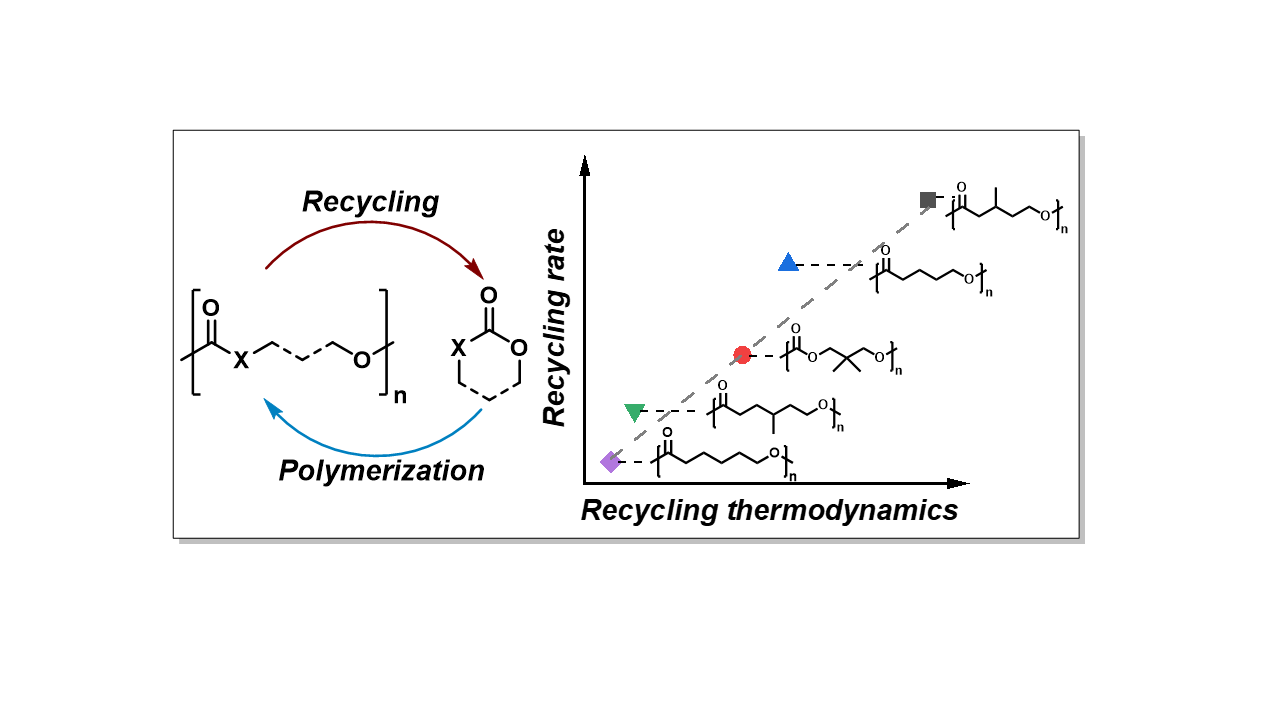
A new study from the University of Oxford (led by Prof. Charlotte K. Williams FRS OBE) and the Department of Chemistry at the University of York led by Prof. Antoine Buchard; (Green Chemistry Centre of Excellence) has revealed a general link between the structure of polymers and the rate at which they can be depolymerised back to their pure monomers.
The discovery of this linear free energy relationship between kinetics and thermodynamics of depolymerisation has been published in the Journal of the American Chemical Society.
This new fundamental insight allows researchers to identify the lowest-energy conditions resulting in the rapid recycling of polymers into monomers, with minimised catalyst loading. It also reveals the appropriate temperatures to selectively separate structurally similar polymer mixtures by recycling them back into their pure monomers.
The study, sponsored by the Royal Society, the EPSRC UK Catalysis Hub and the Sustainable Chemicals and Materials Manufacturing Hub (SCHEMA Hub), focused on polyesters and polycarbonates made from cyclic esters and carbonates. These materials are particularly interesting as several monomers are biobased and already commercially used, with their properties matching those of conventional hydrocarbon polymers. This opens a future in which biobased polymers may be more easily recycled, enhancing sustainability across the whole life cycle of the material.
This work will therefore be important to inform the future design of efficient and selective chemical recycling processes, and to enhance the circularity of plastic materials.
Notes to editors:
This work has been published in the Journal of the American Chemical Society