
Revealing the Radical Truth About Light-activated Metal-Metal Bonds
Posted on Thursday 26 November 2026
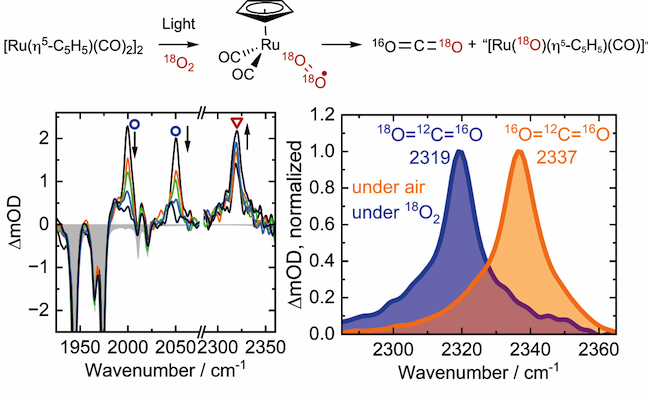
Radicals are highly reactive chemical species with an unpaired electron that, if harnessed correctly, can perform remarkable synthetic transformations. Despite these incredibly useful applications, studying the chemistry of radicals is difficult, because their high reactivity means that they are short-lived. A team at the University of York has shown how the lifecycle of radicals can be tracked on the fastest chemically important timescales. Laser light was used to break a range of metal-metal bonds and then observe the evolution of the radicals that were generated.
This method provided unique insight into why radicals based on the element manganese show a privileged reactivity, but related species based on iron, ruthenium and molybdenum are less active. The interdisciplinary research team, led by Professor Jason Lynam and Professor Ian Fairlamb, showed that reaction with oxygen was key to this difference: manganese-based radicals bind reversibly to oxygen, whereas radicals formed by the other metals were decomposed by oxygen to generate carbon dioxide.
Professor Lynam said: “As well as providing insight the unique reactivity of manganese-based systems, we hope that this detailed understanding will enable future efforts to inhibit the oxygen-induced decomposition of other metal radicals, unlocking greater use of metals such as Fe, Mo and Ru in synthetic applications”
Notes to editors:
This paper has been published in Angewandte Chemie (https://onlinelibrary.wiley.com/doi/10.1002/anie.7350605) as a Hot Paper.