
Revealing the inner workings of organometallic single-crystal reactivity using platinum solid-state NMR
Posted on Thursday 3 September 2026
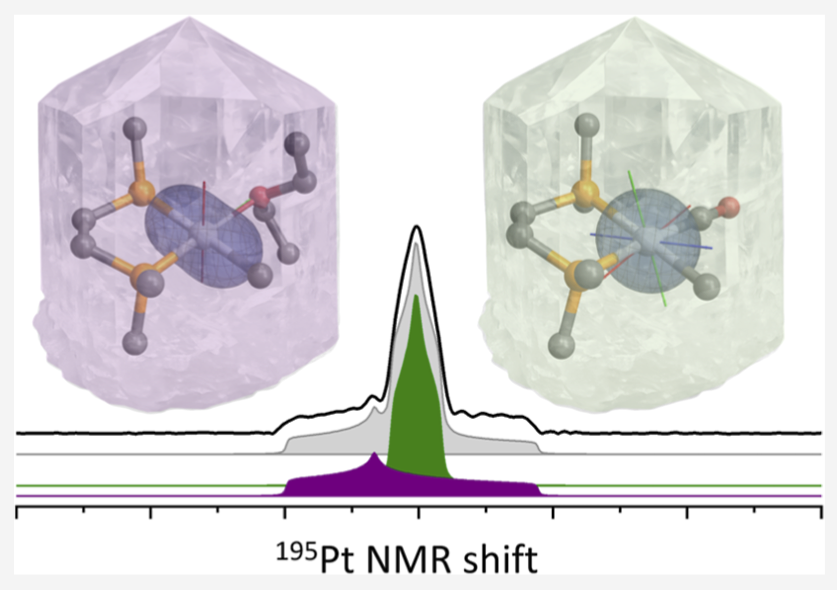
Catalysis is an enabling technology, with the overarching goal of delivering sustainable, lower energy, input processes that are highly selective. While many industrially relevant catalysts are heterogenous (i.e. they are used as solids and often reacted with gases), understanding the precise nature of the active site is challenging due to complexity associated with the interactions between the active site and the support. Such molecular-level detail is necessary to improve catalysis, stop decomposition pathways, and allow for better recycling of resource-limited precious metals.
A new collaboration between researchers at the University of York (Weller group) and ETH Zürich (Copéret group) now reports a breakthrough in the ability to precisely link the molecular level structures found in the solid state with advanced analytical methods. Combining synthetic methods to study single-crystal to single-crystal reactivity developed in York (solid-state molecular organometallic chemistry, SMOM) with detailed analysis of the resulting 195Pt solid-state NMR spectra, developed at ETH Zurich, led to a unique fingerprint signal being observed for each complex. Using three simple parameters that report on the shape and position of the signal, the groups were able to show that these fingerprints report precisely on the structures and reactivities of the platinum metal centres in the single-crystals.
Platinum is used widely in heterogeneous catalysis for many important processes (e.g. fuel cells, industrial hydrogenation reactions, catalytic convertors). This new study provides important baseline data for the precise characterisation of heterogeneous platinum catalysts using solid-state NMR. The work has been published in the Journal of the American Chemical Society, and was led by PDRA Dr Kris Altus, with structural characterisation of some of the Pt-complexes using 3D electron diffraction by Dr Huw Jenkins.
Notes to editors:
This work has been published in the Journal of the American Chemical Society,