
Robot-assisted chemistry delivers 1,440 new iridium complexes for metalloantibiotic drug discovery
Posted on Tuesday 22 September 2026
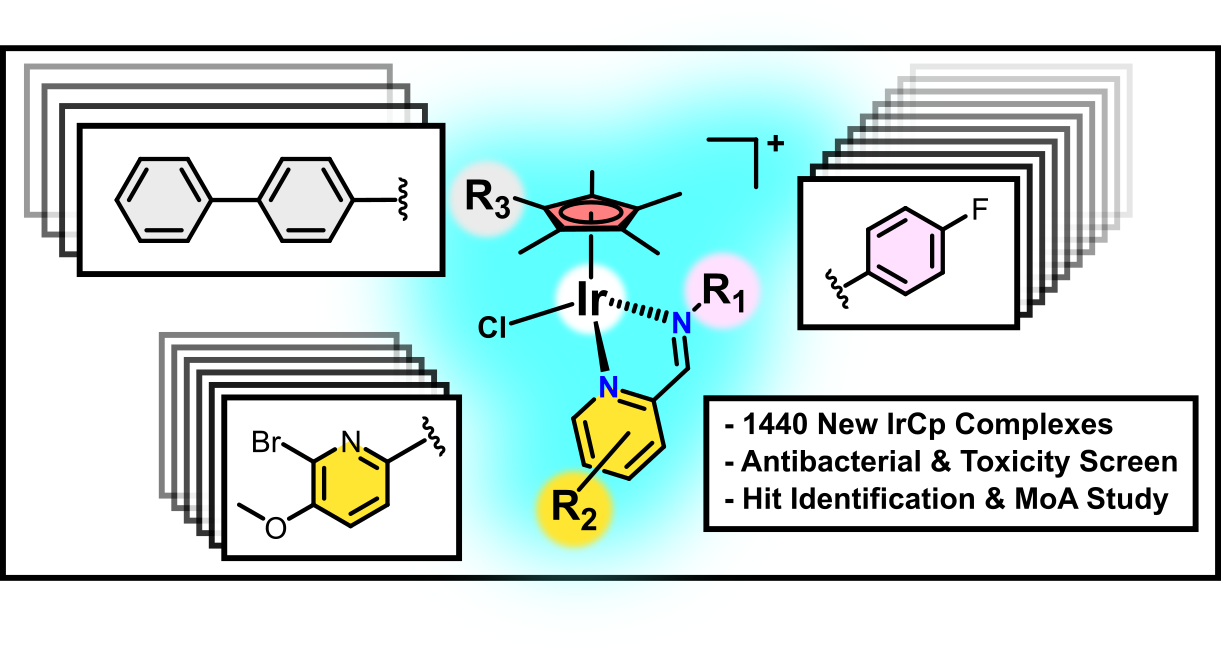
Led by Dr Çağrı Özsan, the study builds on the Frei Group’s direct-to-biology approach, in which compounds are synthesised in parallel and screened directly from crude reaction mixtures. Using an automated liquid-handling robot, the team carried out a one-pot, three-component combinatorial synthesis of 1,440 piano-stool iridium(III) cyclopentadienyl Schiff-base complexes.
Screening of the resulting library identified several compounds active against the Gram-positive bacterium Staphylococcus aureus. One of the leading compounds showed low-micromolar activity across a panel of Gram-positive pathogens, together with low haemolytic activity and moderate cytotoxicity. Further mechanistic studies suggest that the compound acts through a membrane-associated mechanism, producing mild membrane depolarisation and changes in bacterial nucleoid morphology.
The work demonstrates how automation and direct-to-biology screening can greatly accelerate the exploration of metal-complex chemical space, enabling very large libraries of compounds to be efficiently synthesised and biologically evaluated.
Published in JACS Au, the study was led by Dr Angelo Frei and Dr Çağrı Özsan, with contributions from Athi Welsh, Stefano Zineddu, who visited the group from Florence, David Husbands, and MBiochem student Kiera Robinson.
The research was supported by the Swiss National Science Foundation (SNSF).
Notes to editors:
This paper was published in JACS Au.