
Breakthrough Intermediates Drive Greener Iridium Recycling
Posted on Thursday 30 July 2026
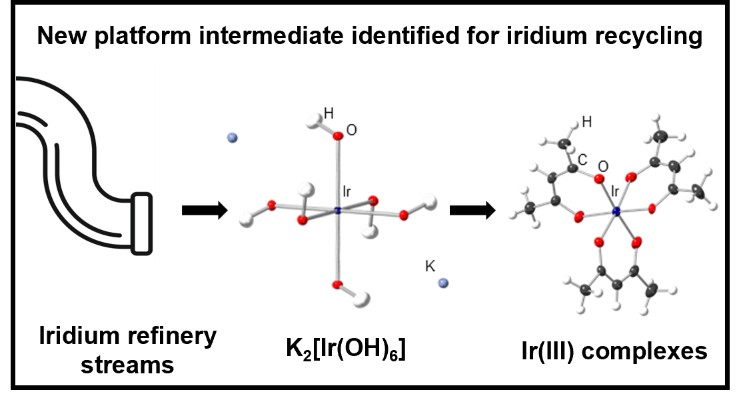
Chemists at the University of York, in collaboration with Johnson Matthey and international academic partners, have developed an efficient, low-energy route to recycle iridium, one of the Earth's rarest and most critical elements. Iridium is central to sustainable hydrogen fuel production, OLED displays and technologically vital catalysis, hence its recycling is crucial in the drive towards a sustainable future.
Published in Chemical Science, PhD student Rebecca Willans and the team (led by Charlotte Willans, Jackie Mosley and Andrew Weller) have demonstrated how a previously difficult to isolate compound, K2[Ir(OH)6], can act as an ideal, halide-free intermediate in iridium waste-stream recycling. By making use of complementary real time monitoring techniques such as cyclic voltammetry and UV-vis spectroscopy, in combination with detailed structural studies - including single crystal neutron diffraction - the researchers developed a method to successfully transform complex refinery waste streams into high-purity iridium(III) complexes under mild conditions, using K2[Ir(OH)6] as a platform intermediate. This approach avoids traditional energy-intensive recycling processes which use high temperatures and harsh conditions, offering a circular economy approach to the future supply of this crucial metal.
Notes to editors:
This work has been published in the RSC journal Chemical Science.