
York study warns AI synthesis tools could lock-in toxic solvent use in chemistry
Posted on Tuesday 27 October 2026
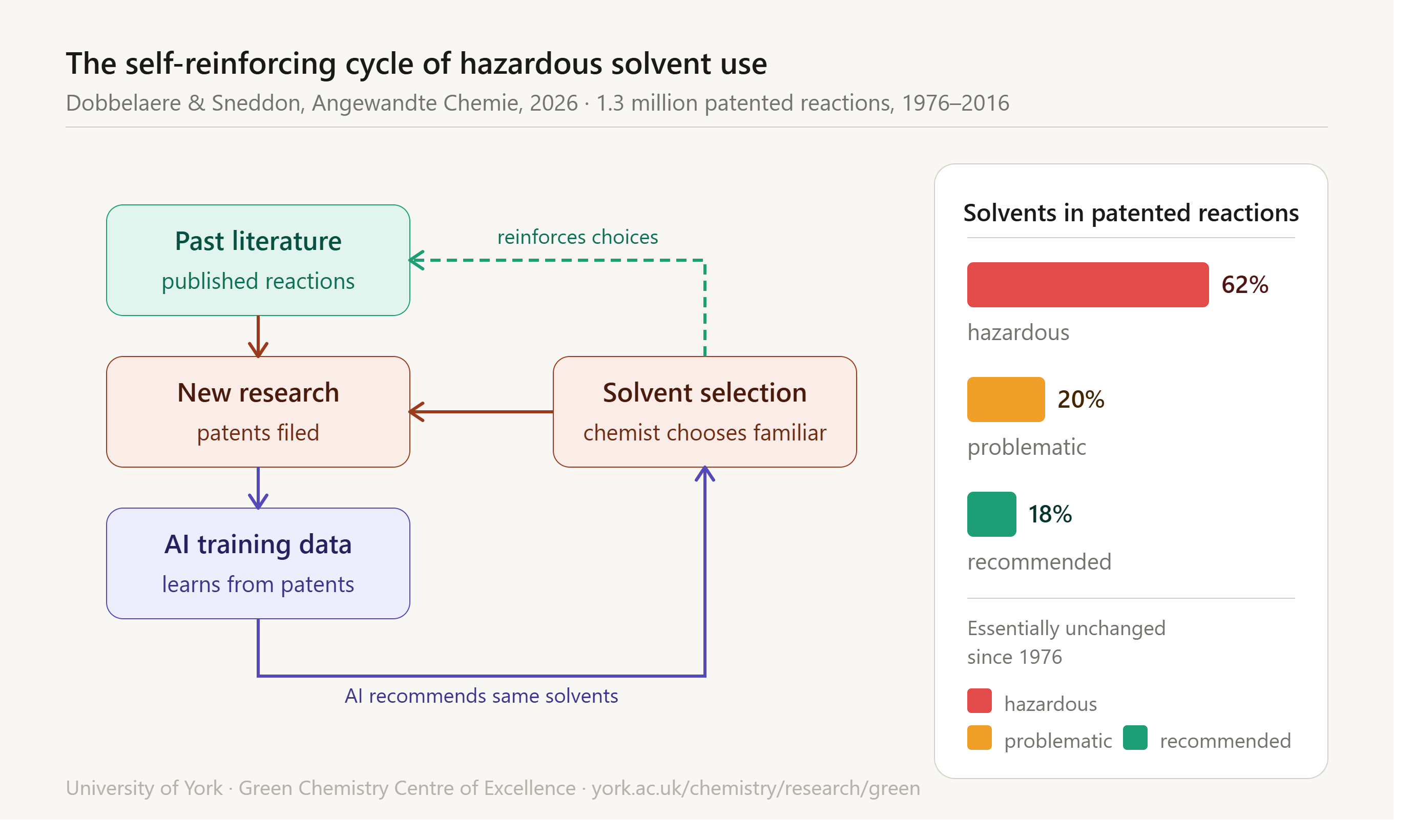
Artificial intelligence is transforming how chemists plan reactions, but a new study from the University of York, recently published in Angewandte Chemie International Edition, warns it could make a long-standing sustainability problem significantly worse.
Professor Helen Sneddon (Green Chemistry Centre of Excellence, University of York) and Dr Maarten Dobbelaere (Ghent University) analysed over 1.3 million patented reactions spanning four decades, finding that the use of hazardous solvents has barely changed since 1976. More than 60% of solvents used in recently patented reactions were classified as hazardous; the fraction of "recommended" solvents remained stubbornly small throughout.
A key finding, highlighted in coverage of the article in Nature and the Royal Society of Chemistry’s Chemistry World, is that AI-assisted synthesis planning tools — increasingly used to accelerate drug and materials discovery — learn from this same body of literature. Without deliberate intervention, they will systematically favour the hazardous solvents that dominate training data, embedding those choices into the next generation of chemistry.
The authors call for solvent selection to be treated as a design challenge from first principles, and for AI tools to be trained on curated, sustainability-weighted datasets.
Notes to editors:
This work has been published in the journal Angewandte Chemie International Edition