
10 Years of Kigali: The Story Behind a Climate Breakthrough
Posted on Tuesday 10 November 2026
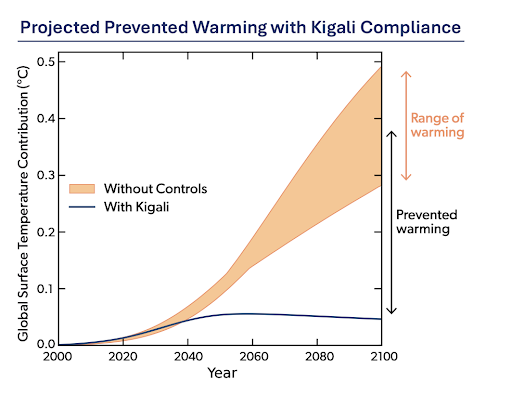
This year marks the 10th anniversary of the adoption of the Kigali Amendment to the Montreal Protocol. For the first time, the Montreal Protocol was used to control gases – the hydrofluorocarbons (HFCs) - purely because of their effect on the climate, in addition to the existing controls on ozone-depleting substances such as CFCs and HCFCs. The Kigali Amendment agreed to phase down HFC production in favour of gases with lower global warming potentials. Full implementation is projected to avoid up to 0.4°C of global warming by the end of the century, with benefits doubling when paired with improved energy efficiency in cooling equipment.
The Environmental Investigation Agency (EIA) have released a new short documentary, 10 Years of Kigali: The Story Behind a Climate Breakthrough which explores the science, diplomacy and international cooperation behind the Montreal Protocol and its Kigali Amendment. The film features Professor Lucy Carpenter and the University of York's Wolfson Atmospheric Chemistry Laboratories, highlighting the vital role of atmospheric research in understanding ozone depletion, monitoring changes in our atmosphere and informing international environmental policy.
Professor Carpenter is one of the co-chairs of the Scientific Assessment Panel (SAP) of the Montreal Protocol, whose role is to assess the status of the depletion of the ozone layer and relevant atmospheric science issues, and bring emerging scientific findings and policy-relevant data directly to the attention of the Parties to guide decision-making. Lucy has just returned from the 38th Meeting of the Parties (MOP) in Kigali where, along with the other co-chairs, she updated the Parties to the Montreal Protocol on the recently published executive summary of the Scientific Assessment of Ozone Depletion: 2026.